

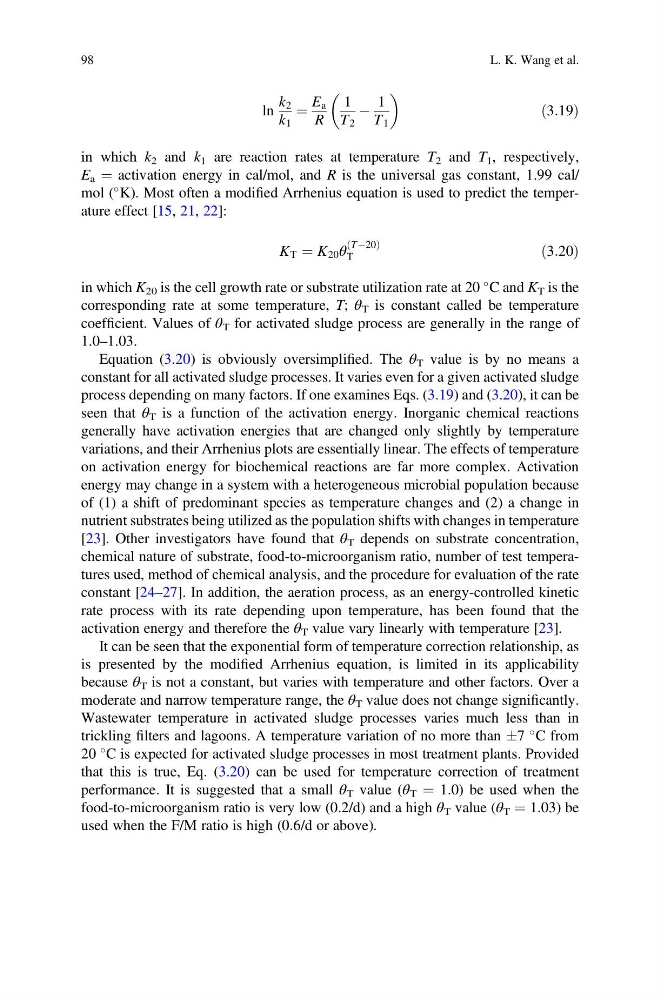
ln
k 2
k 1
¼
E a
R
1
T 2
À
1
T 1
ð3:19Þ
in which k 2 and k 1 are reaction rates at temperature T 2 and T 1 , respectively,
E a ¼ activation energy in cal/mol, and R is the universal gas constant, 1.99 cal/
mol (
K). Most often a modified Arrhenius equation is used to predict the temperature effect [15, 21, 22]:
K T ¼ K 20 θ
TÀ20
ð
Þ
T
ð3:20Þ
in which K 20 is the cell growth rate or substrate utilization rate at 20
C and K T is the
corresponding rate at some temperature, T; θ T is constant called be temperature
coefficient. Values of θ T for activated sludge process are generally in the range of
1.0–1.03.
Equation (3.20) is obviously oversimplified. The θ T value is by no means a
constant for all activated sludge processes. It varies even for a given activated sludge
process depending on many factors. If one examines Eqs. (3.19) and (3.20), it can be
seen that θ T is a function of the activation energy. Inorganic chemical reactions
generally have activation energies that are changed only slightly by temperature
variations, and their Arrhenius plots are essentially linear. The effects of temperature
on activation energy for biochemical reactions are far more complex. Activation
energy may change in a system with a heterogeneous microbial population because
of (1) a shift of predominant species as temperature changes and (2) a change in
nutrient substrates being utilized as the population shifts with changes in temperature
[23]. Other investigators have found that θ T depends on substrate concentration,
chemical nature of substrate, food-to-microorganism ratio, number of test temperatures used, method of chemical analysis, and the procedure for evaluation of the rate
constant [24–27]. In addition, the aeration process, as an energy-controlled kinetic
rate process with its rate depending upon temperature, has been found that the
activation energy and therefore the θ T value vary linearly with temperature [23].
It can be seen that the exponential form of temperature correction relationship, as
is presented by the modified Arrhenius equation, is limited in its applicability
because θ T is not a constant, but varies with temperature and other factors. Over a
moderate and narrow temperature range, the θ T value does not change significantly.
Wastewater temperature in activated sludge processes varies much less than in
trickling filters and lagoons. A temperature variation of no more than Æ7
C from
20
C is expected for activated sludge processes in most treatment plants. Provided
that this is true, Eq. (3.20) can be used for temperature correction of treatment
performance. It is suggested that a small θ T value (θ T ¼ 1.0) be used when the
food-to-microorganism ratio is very low (0.2/d) and a high θ T value (θ T ¼ 1.03) be
used when the F/M ratio is high (0.6/d or above).
98
L. K. Wang et al.
k 2
k 1
¼
E a
R
1
T 2
À
1
T 1
ð3:19Þ
in which k 2 and k 1 are reaction rates at temperature T 2 and T 1 , respectively,
E a ¼ activation energy in cal/mol, and R is the universal gas constant, 1.99 cal/
mol (
K). Most often a modified Arrhenius equation is used to predict the temperature effect [15, 21, 22]:
K T ¼ K 20 θ
TÀ20
ð
Þ
T
ð3:20Þ
in which K 20 is the cell growth rate or substrate utilization rate at 20
C and K T is the
corresponding rate at some temperature, T; θ T is constant called be temperature
coefficient. Values of θ T for activated sludge process are generally in the range of
1.0–1.03.
Equation (3.20) is obviously oversimplified. The θ T value is by no means a
constant for all activated sludge processes. It varies even for a given activated sludge
process depending on many factors. If one examines Eqs. (3.19) and (3.20), it can be
seen that θ T is a function of the activation energy. Inorganic chemical reactions
generally have activation energies that are changed only slightly by temperature
variations, and their Arrhenius plots are essentially linear. The effects of temperature
on activation energy for biochemical reactions are far more complex. Activation
energy may change in a system with a heterogeneous microbial population because
of (1) a shift of predominant species as temperature changes and (2) a change in
nutrient substrates being utilized as the population shifts with changes in temperature
[23]. Other investigators have found that θ T depends on substrate concentration,
chemical nature of substrate, food-to-microorganism ratio, number of test temperatures used, method of chemical analysis, and the procedure for evaluation of the rate
constant [24–27]. In addition, the aeration process, as an energy-controlled kinetic
rate process with its rate depending upon temperature, has been found that the
activation energy and therefore the θ T value vary linearly with temperature [23].
It can be seen that the exponential form of temperature correction relationship, as
is presented by the modified Arrhenius equation, is limited in its applicability
because θ T is not a constant, but varies with temperature and other factors. Over a
moderate and narrow temperature range, the θ T value does not change significantly.
Wastewater temperature in activated sludge processes varies much less than in
trickling filters and lagoons. A temperature variation of no more than Æ7
C from
20
C is expected for activated sludge processes in most treatment plants. Provided
that this is true, Eq. (3.20) can be used for temperature correction of treatment
performance. It is suggested that a small θ T value (θ T ¼ 1.0) be used when the
food-to-microorganism ratio is very low (0.2/d) and a high θ T value (θ T ¼ 1.03) be
used when the F/M ratio is high (0.6/d or above).
98
L. K. Wang et al.