

2 System Variables and Control
The activated sludge process involves a highly complex biological system. In order
to design and operate the treatment system properly, one needs to understand the
system variables as well as the control alternatives that are available. Engineers have
in the past identified the major system variables that significantly affect the performance of an activated sludge process. Among these variables are hydraulic retention
time, organic loading, mean cell residence time (sludge retention time), aeration,
mixing, and enzyme regulation. It is possible to control these variables, partially if
not completely, through process design and operation. Discussions on these system
variables, their relationships, and their significance in process control and performance are presented in this section.
2.1 Kinetics of Sludge Growth and Substrate Removal
The success of an activated sludge process in producing a high-quality effluent
depends on the continuous growth of biological flocs having a good settling characteristic. The growth of these biological flocs is accompanied by organic substrate
removal, where the rate of microbial growth and the rate of substrate utilization are
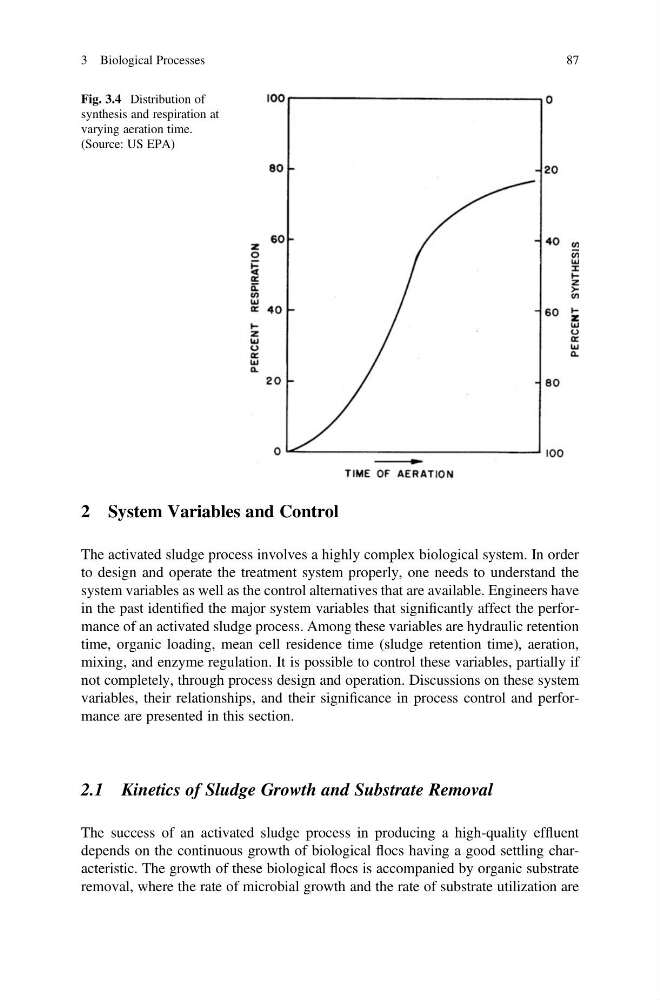
Fig. 3.4 Distribution of
synthesis and respiration at
varying aeration time.
(Source: US EPA)
3 Biological Processes
87
The activated sludge process involves a highly complex biological system. In order
to design and operate the treatment system properly, one needs to understand the
system variables as well as the control alternatives that are available. Engineers have
in the past identified the major system variables that significantly affect the performance of an activated sludge process. Among these variables are hydraulic retention
time, organic loading, mean cell residence time (sludge retention time), aeration,
mixing, and enzyme regulation. It is possible to control these variables, partially if
not completely, through process design and operation. Discussions on these system
variables, their relationships, and their significance in process control and performance are presented in this section.
2.1 Kinetics of Sludge Growth and Substrate Removal
The success of an activated sludge process in producing a high-quality effluent
depends on the continuous growth of biological flocs having a good settling characteristic. The growth of these biological flocs is accompanied by organic substrate
removal, where the rate of microbial growth and the rate of substrate utilization are
Fig. 3.4 Distribution of
synthesis and respiration at
varying aeration time.
(Source: US EPA)
3 Biological Processes
87