

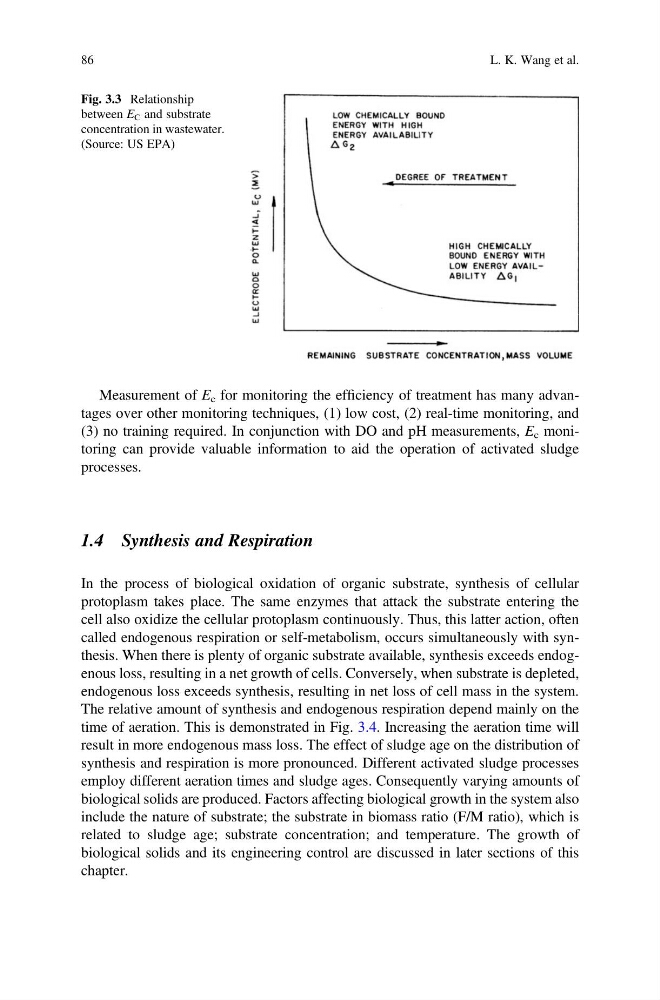
Measurement of E c for monitoring the efficiency of treatment has many advantages over other monitoring techniques, (1) low cost, (2) real-time monitoring, and
(3) no training required. In conjunction with DO and pH measurements, E c monitoring can provide valuable information to aid the operation of activated sludge
processes.
1.4 Synthesis and Respiration
In the process of biological oxidation of organic substrate, synthesis of cellular
protoplasm takes place. The same enzymes that attack the substrate entering the
cell also oxidize the cellular protoplasm continuously. Thus, this latter action, often
called endogenous respiration or self-metabolism, occurs simultaneously with synthesis. When there is plenty of organic substrate available, synthesis exceeds endogenous loss, resulting in a net growth of cells. Conversely, when substrate is depleted,
endogenous loss exceeds synthesis, resulting in net loss of cell mass in the system.
The relative amount of synthesis and endogenous respiration depend mainly on the
time of aeration. This is demonstrated in Fig. 3.4. Increasing the aeration time will
result in more endogenous mass loss. The effect of sludge age on the distribution of
synthesis and respiration is more pronounced. Different activated sludge processes
employ different aeration times and sludge ages. Consequently varying amounts of
biological solids are produced. Factors affecting biological growth in the system also
include the nature of substrate; the substrate in biomass ratio (F/M ratio), which is
related to sludge age; substrate concentration; and temperature. The growth of
biological solids and its engineering control are discussed in later sections of this
chapter.
Fig. 3.3 Relationship
between E C and substrate
concentration in wastewater.
(Source: US EPA)
86
L. K. Wang et al.
(3) no training required. In conjunction with DO and pH measurements, E c monitoring can provide valuable information to aid the operation of activated sludge
processes.
1.4 Synthesis and Respiration
In the process of biological oxidation of organic substrate, synthesis of cellular
protoplasm takes place. The same enzymes that attack the substrate entering the
cell also oxidize the cellular protoplasm continuously. Thus, this latter action, often
called endogenous respiration or self-metabolism, occurs simultaneously with synthesis. When there is plenty of organic substrate available, synthesis exceeds endogenous loss, resulting in a net growth of cells. Conversely, when substrate is depleted,
endogenous loss exceeds synthesis, resulting in net loss of cell mass in the system.
The relative amount of synthesis and endogenous respiration depend mainly on the
time of aeration. This is demonstrated in Fig. 3.4. Increasing the aeration time will
result in more endogenous mass loss. The effect of sludge age on the distribution of
synthesis and respiration is more pronounced. Different activated sludge processes
employ different aeration times and sludge ages. Consequently varying amounts of
biological solids are produced. Factors affecting biological growth in the system also
include the nature of substrate; the substrate in biomass ratio (F/M ratio), which is
related to sludge age; substrate concentration; and temperature. The growth of
biological solids and its engineering control are discussed in later sections of this
chapter.
Fig. 3.3 Relationship
between E C and substrate
concentration in wastewater.
(Source: US EPA)
86
L. K. Wang et al.