

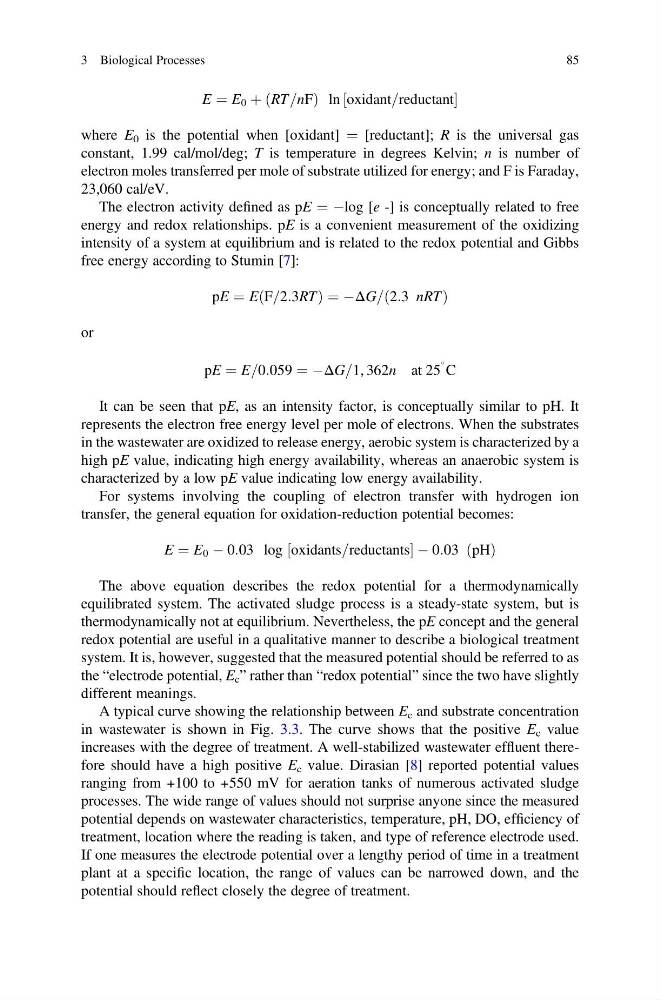
E ¼ E 0 þ RT=nF
ð
Þ ln oxidant=reductant
½
where E 0 is the potential when [oxidant] ¼ [reductant]; R is the universal gas
constant, 1.99 cal/mol/deg; T is temperature in degrees Kelvin; n is number of
electron moles transferred per mole of substrate utilized for energy; and F is Faraday,
23,060 cal/eV.
The electron activity defined as pE ¼ Àlog [e -] is conceptually related to free
energy and redox relationships. pE is a convenient measurement of the oxidizing
intensity of a system at equilibrium and is related to the redox potential and Gibbs
free energy according to Stumin [7]:
pE ¼ E F=2:3RT
ð
Þ¼À ΔG= 2:3 nRT
ð
Þ
or
pE ¼ E=0:059 ¼ ÀΔG=1, 362n at 25
C
It can be seen that pE, as an intensity factor, is conceptually similar to pH. It
represents the electron free energy level per mole of electrons. When the substrates
in the wastewater are oxidized to release energy, aerobic system is characterized by a
high pE value, indicating high energy availability, whereas an anaerobic system is
characterized by a low pE value indicating low energy availability.
For systems involving the coupling of electron transfer with hydrogen ion
transfer, the general equation for oxidation-reduction potential becomes:
E ¼ E 0 À 0:03 log oxidants=reductants
½
À 0:03 pH
ð Þ
The above equation describes the redox potential for a thermodynamically
equilibrated system. The activated sludge process is a steady-state system, but is
thermodynamically not at equilibrium. Nevertheless, the pE concept and the general
redox potential are useful in a qualitative manner to describe a biological treatment
system. It is, however, suggested that the measured potential should be referred to as
the “electrode potential, E c ” rather than “redox potential” since the two have slightly
different meanings.
A typical curve showing the relationship between E c and substrate concentration
in wastewater is shown in Fig. 3.3. The curve shows that the positive E c value
increases with the degree of treatment. A well-stabilized wastewater effluent therefore should have a high positive E c value. Dirasian [8] reported potential values
ranging from +100 to +550 mV for aeration tanks of numerous activated sludge
processes. The wide range of values should not surprise anyone since the measured
potential depends on wastewater characteristics, temperature, pH, DO, efficiency of
treatment, location where the reading is taken, and type of reference electrode used.
If one measures the electrode potential over a lengthy period of time in a treatment
plant at a specific location, the range of values can be narrowed down, and the
potential should reflect closely the degree of treatment.
3 Biological Processes
85
ð
Þ ln oxidant=reductant
½
where E 0 is the potential when [oxidant] ¼ [reductant]; R is the universal gas
constant, 1.99 cal/mol/deg; T is temperature in degrees Kelvin; n is number of
electron moles transferred per mole of substrate utilized for energy; and F is Faraday,
23,060 cal/eV.
The electron activity defined as pE ¼ Àlog [e -] is conceptually related to free
energy and redox relationships. pE is a convenient measurement of the oxidizing
intensity of a system at equilibrium and is related to the redox potential and Gibbs
free energy according to Stumin [7]:
pE ¼ E F=2:3RT
ð
Þ¼À ΔG= 2:3 nRT
ð
Þ
or
pE ¼ E=0:059 ¼ ÀΔG=1, 362n at 25
C
It can be seen that pE, as an intensity factor, is conceptually similar to pH. It
represents the electron free energy level per mole of electrons. When the substrates
in the wastewater are oxidized to release energy, aerobic system is characterized by a
high pE value, indicating high energy availability, whereas an anaerobic system is
characterized by a low pE value indicating low energy availability.
For systems involving the coupling of electron transfer with hydrogen ion
transfer, the general equation for oxidation-reduction potential becomes:
E ¼ E 0 À 0:03 log oxidants=reductants
½
À 0:03 pH
ð Þ
The above equation describes the redox potential for a thermodynamically
equilibrated system. The activated sludge process is a steady-state system, but is
thermodynamically not at equilibrium. Nevertheless, the pE concept and the general
redox potential are useful in a qualitative manner to describe a biological treatment
system. It is, however, suggested that the measured potential should be referred to as
the “electrode potential, E c ” rather than “redox potential” since the two have slightly
different meanings.
A typical curve showing the relationship between E c and substrate concentration
in wastewater is shown in Fig. 3.3. The curve shows that the positive E c value
increases with the degree of treatment. A well-stabilized wastewater effluent therefore should have a high positive E c value. Dirasian [8] reported potential values
ranging from +100 to +550 mV for aeration tanks of numerous activated sludge
processes. The wide range of values should not surprise anyone since the measured
potential depends on wastewater characteristics, temperature, pH, DO, efficiency of
treatment, location where the reading is taken, and type of reference electrode used.
If one measures the electrode potential over a lengthy period of time in a treatment
plant at a specific location, the range of values can be narrowed down, and the
potential should reflect closely the degree of treatment.
3 Biological Processes
85