

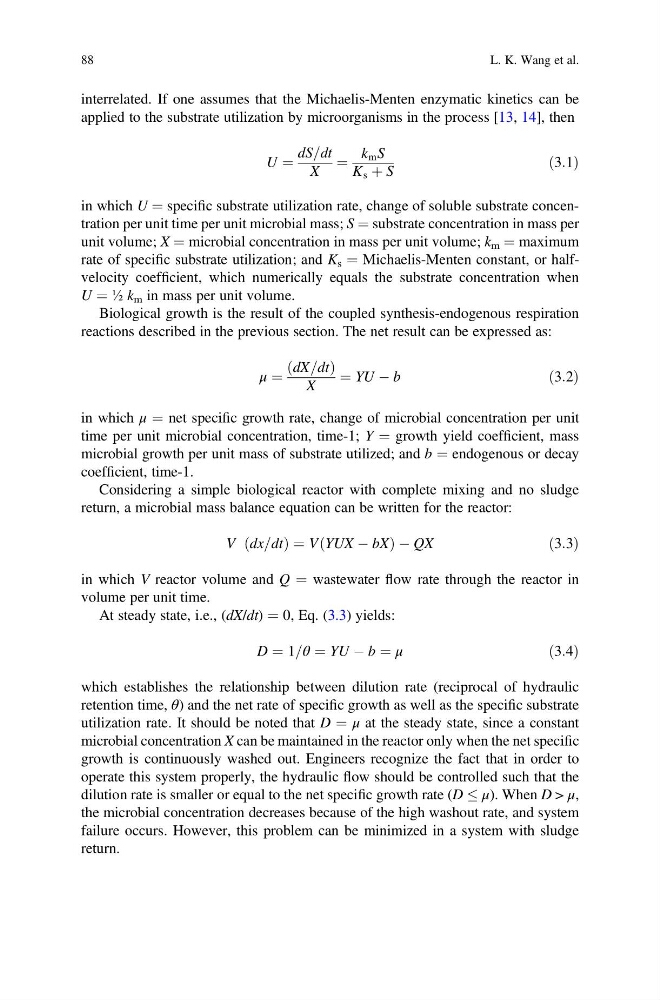
interrelated. If one assumes that the Michaelis-Menten enzymatic kinetics can be
applied to the substrate utilization by microorganisms in the process [13, 14], then
U ¼
dS=dt
X
¼
k m S
K s þ S
ð3:1Þ
in which U ¼ specific substrate utilization rate, change of soluble substrate concentration per unit time per unit microbial mass; S ¼ substrate concentration in mass per
unit volume; X ¼ microbial concentration in mass per unit volume; k m ¼ maximum
rate of specific substrate utilization; and K s ¼ Michaelis-Menten constant, or halfvelocity coefficient, which numerically equals the substrate concentration when
U ¼ ½ k m in mass per unit volume.
Biological growth is the result of the coupled synthesis-endogenous respiration
reactions described in the previous section. The net result can be expressed as:
μ ¼
dX=dt
ð
Þ
X
¼ YU À b
ð3:2Þ
in which μ ¼ net specific growth rate, change of microbial concentration per unit
time per unit microbial concentration, time-1; Y ¼ growth yield coefficient, mass
microbial growth per unit mass of substrate utilized; and b ¼ endogenous or decay
coefficient, time-1.
Considering a simple biological reactor with complete mixing and no sludge
return, a microbial mass balance equation can be written for the reactor:
V dx=dt
ð
Þ¼V YUX À bX
ð
ÞÀQX
ð3:3Þ
in which V reactor volume and Q ¼ wastewater flow rate through the reactor in
volume per unit time.
At steady state, i.e., (dX/dt) ¼ 0, Eq. (3.3) yields:
D ¼ 1=θ ¼ YU À b ¼ μ
ð3:4Þ
which establishes the relationship between dilution rate (reciprocal of hydraulic
retention time, θ) and the net rate of specific growth as well as the specific substrate
utilization rate. It should be noted that D ¼ μ at the steady state, since a constant
microbial concentration X can be maintained in the reactor only when the net specific
growth is continuously washed out. Engineers recognize the fact that in order to
operate this system properly, the hydraulic flow should be controlled such that the
dilution rate is smaller or equal to the net specific growth rate (D μ). When D > μ,
the microbial concentration decreases because of the high washout rate, and system
failure occurs. However, this problem can be minimized in a system with sludge
return.
88
L. K. Wang et al.
applied to the substrate utilization by microorganisms in the process [13, 14], then
U ¼
dS=dt
X
¼
k m S
K s þ S
ð3:1Þ
in which U ¼ specific substrate utilization rate, change of soluble substrate concentration per unit time per unit microbial mass; S ¼ substrate concentration in mass per
unit volume; X ¼ microbial concentration in mass per unit volume; k m ¼ maximum
rate of specific substrate utilization; and K s ¼ Michaelis-Menten constant, or halfvelocity coefficient, which numerically equals the substrate concentration when
U ¼ ½ k m in mass per unit volume.
Biological growth is the result of the coupled synthesis-endogenous respiration
reactions described in the previous section. The net result can be expressed as:
μ ¼
dX=dt
ð
Þ
X
¼ YU À b
ð3:2Þ
in which μ ¼ net specific growth rate, change of microbial concentration per unit
time per unit microbial concentration, time-1; Y ¼ growth yield coefficient, mass
microbial growth per unit mass of substrate utilized; and b ¼ endogenous or decay
coefficient, time-1.
Considering a simple biological reactor with complete mixing and no sludge
return, a microbial mass balance equation can be written for the reactor:
V dx=dt
ð
Þ¼V YUX À bX
ð
ÞÀQX
ð3:3Þ
in which V reactor volume and Q ¼ wastewater flow rate through the reactor in
volume per unit time.
At steady state, i.e., (dX/dt) ¼ 0, Eq. (3.3) yields:
D ¼ 1=θ ¼ YU À b ¼ μ
ð3:4Þ
which establishes the relationship between dilution rate (reciprocal of hydraulic
retention time, θ) and the net rate of specific growth as well as the specific substrate
utilization rate. It should be noted that D ¼ μ at the steady state, since a constant
microbial concentration X can be maintained in the reactor only when the net specific
growth is continuously washed out. Engineers recognize the fact that in order to
operate this system properly, the hydraulic flow should be controlled such that the
dilution rate is smaller or equal to the net specific growth rate (D μ). When D > μ,
the microbial concentration decreases because of the high washout rate, and system
failure occurs. However, this problem can be minimized in a system with sludge
return.
88
L. K. Wang et al.