

3 Collective Magnetic Behaviour
81
0
100
200
300
T(K)
-2
-1
0
1
2
3
4
10
-5
0
1 0 0
2 0 0
3 0 0
T(K)
0
0.2
0.4
0.6
0.8
1
1.2
10
-4
0
100
200
300
T(K)
5
6
7
8
9
10
M(emu)
10
-6
0
100
200
300
T(K)
0
2
4 10 -4
20%
Fe@Cr
VFF
5%
10%
Fe@Ag, VFF 10%
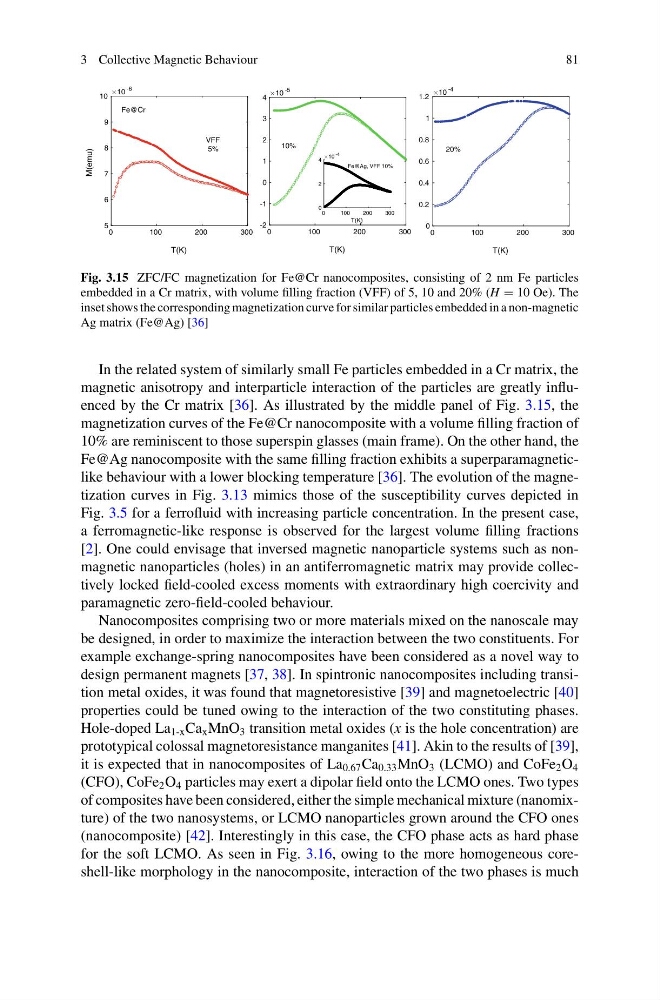
Fig. 3.15 ZFC/FC magnetization for Fe@Cr nanocomposites, consisting of 2 nm Fe particles
embedded in a Cr matrix, with volume filling fraction (VFF) of 5, 10 and 20% (H = 10 Oe). The
inset shows the corresponding magnetization curve for similar particles embedded in a non-magnetic
Ag matrix (Fe@Ag) [36]
In the related system of similarly small Fe particles embedded in a Cr matrix, the
magnetic anisotropy and interparticle interaction of the particles are greatly influenced by the Cr matrix [36]. As illustrated by the middle panel of Fig. 3.15, the
magnetization curves of the Fe@Cr nanocomposite with a volume filling fraction of
10% are reminiscent to those superspin glasses (main frame). On the other hand, the
Fe@Ag nanocomposite with the same filling fraction exhibits a superparamagneticlike behaviour with a lower blocking temperature [36]. The evolution of the magnetization curves in Fig. 3.13 mimics those of the susceptibility curves depicted in
Fig. 3.5 for a ferrofluid with increasing particle concentration. In the present case,
a ferromagnetic-like response is observed for the largest volume filling fractions
[2]. One could envisage that inversed magnetic nanoparticle systems such as nonmagnetic nanoparticles (holes) in an antiferromagnetic matrix may provide collectively locked field-cooled excess moments with extraordinary high coercivity and
paramagnetic zero-field-cooled behaviour.
Nanocomposites comprising two or more materials mixed on the nanoscale may
be designed, in order to maximize the interaction between the two constituents. For
example exchange-spring nanocomposites have been considered as a novel way to
design permanent magnets [37, 38]. In spintronic nanocomposites including transition metal oxides, it was found that magnetoresistive [39] and magnetoelectric [40]
properties could be tuned owing to the interaction of the two constituting phases.
Hole-doped La 1-x Ca x MnO 3 transition metal oxides (x is the hole concentration) are
prototypical colossal magnetoresistance manganites [41]. Akin to the results of [39],
it is expected that in nanocomposites of La 0.67 Ca 0.33 MnO 3 (LCMO) and CoFe 2 O 4
(CFO), CoFe 2 O 4 particles may exert a dipolar field onto the LCMO ones. Two types
of composites have been considered, either the simple mechanical mixture (nanomixture) of the two nanosystems, or LCMO nanoparticles grown around the CFO ones
(nanocomposite) [42]. Interestingly in this case, the CFO phase acts as hard phase
for the soft LCMO. As seen in Fig. 3.16, owing to the more homogeneous coreshell-like morphology in the nanocomposite, interaction of the two phases is much
81
0
100
200
300
T(K)
-2
-1
0
1
2
3
4
10
-5
0
1 0 0
2 0 0
3 0 0
T(K)
0
0.2
0.4
0.6
0.8
1
1.2
10
-4
0
100
200
300
T(K)
5
6
7
8
9
10
M(emu)
10
-6
0
100
200
300
T(K)
0
2
4 10 -4
20%
Fe@Cr
VFF
5%
10%
Fe@Ag, VFF 10%
Fig. 3.15 ZFC/FC magnetization for Fe@Cr nanocomposites, consisting of 2 nm Fe particles
embedded in a Cr matrix, with volume filling fraction (VFF) of 5, 10 and 20% (H = 10 Oe). The
inset shows the corresponding magnetization curve for similar particles embedded in a non-magnetic
Ag matrix (Fe@Ag) [36]
In the related system of similarly small Fe particles embedded in a Cr matrix, the
magnetic anisotropy and interparticle interaction of the particles are greatly influenced by the Cr matrix [36]. As illustrated by the middle panel of Fig. 3.15, the
magnetization curves of the Fe@Cr nanocomposite with a volume filling fraction of
10% are reminiscent to those superspin glasses (main frame). On the other hand, the
Fe@Ag nanocomposite with the same filling fraction exhibits a superparamagneticlike behaviour with a lower blocking temperature [36]. The evolution of the magnetization curves in Fig. 3.13 mimics those of the susceptibility curves depicted in
Fig. 3.5 for a ferrofluid with increasing particle concentration. In the present case,
a ferromagnetic-like response is observed for the largest volume filling fractions
[2]. One could envisage that inversed magnetic nanoparticle systems such as nonmagnetic nanoparticles (holes) in an antiferromagnetic matrix may provide collectively locked field-cooled excess moments with extraordinary high coercivity and
paramagnetic zero-field-cooled behaviour.
Nanocomposites comprising two or more materials mixed on the nanoscale may
be designed, in order to maximize the interaction between the two constituents. For
example exchange-spring nanocomposites have been considered as a novel way to
design permanent magnets [37, 38]. In spintronic nanocomposites including transition metal oxides, it was found that magnetoresistive [39] and magnetoelectric [40]
properties could be tuned owing to the interaction of the two constituting phases.
Hole-doped La 1-x Ca x MnO 3 transition metal oxides (x is the hole concentration) are
prototypical colossal magnetoresistance manganites [41]. Akin to the results of [39],
it is expected that in nanocomposites of La 0.67 Ca 0.33 MnO 3 (LCMO) and CoFe 2 O 4
(CFO), CoFe 2 O 4 particles may exert a dipolar field onto the LCMO ones. Two types
of composites have been considered, either the simple mechanical mixture (nanomixture) of the two nanosystems, or LCMO nanoparticles grown around the CFO ones
(nanocomposite) [42]. Interestingly in this case, the CFO phase acts as hard phase
for the soft LCMO. As seen in Fig. 3.16, owing to the more homogeneous coreshell-like morphology in the nanocomposite, interaction of the two phases is much