

80
R. Mathieu and P. Nordblad
-10
-7.5
-5
-2.5
0
2.5
5
7.5
10
H (kOe)
-10
-8
-6
-4
-2
0
2
4
6
8
10
M(emu/g)
-50
-25
0
25
50
H (kOe)
-10
0
10
M(emu/g)
FC
ZFC
Fe@(Fe,O)
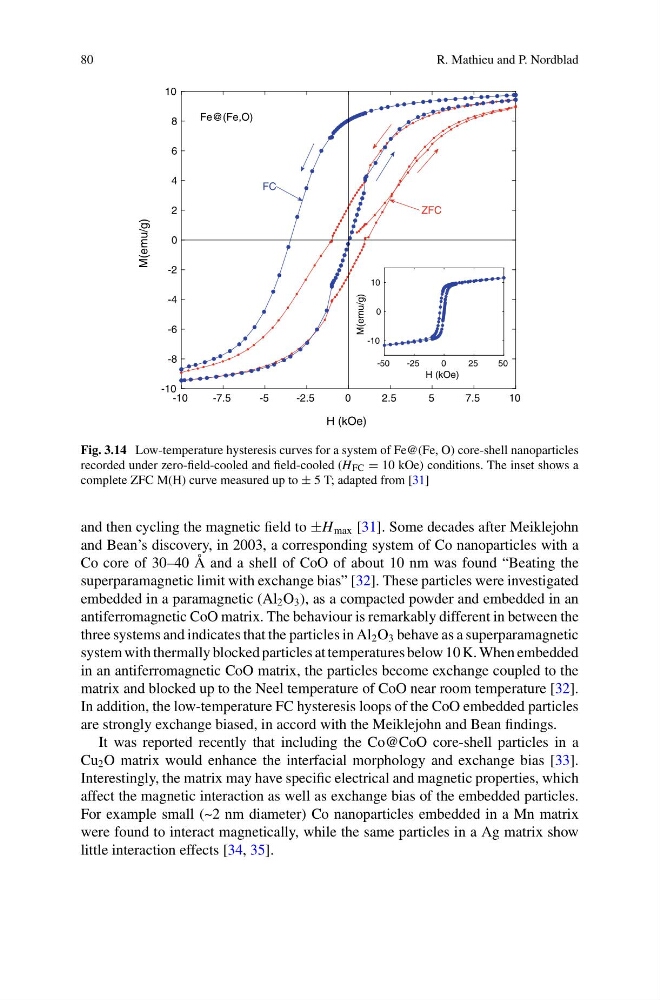
Fig. 3.14 Low-temperature hysteresis curves for a system of Fe@(Fe, O) core-shell nanoparticles
recorded under zero-field-cooled and field-cooled (H FC = 10 kOe) conditions. The inset shows a
complete ZFC M(H) curve measured up to ± 5 T; adapted from [31]
and then cycling the magnetic field to ±H max [31]. Some decades after Meiklejohn
and Bean’s discovery, in 2003, a corresponding system of Co nanoparticles with a
Co core of 30–40 Å and a shell of CoO of about 10 nm was found “Beating the
superparamagnetic limit with exchange bias” [32]. These particles were investigated
embedded in a paramagnetic (Al 2 O 3 ), as a compacted powder and embedded in an
antiferromagnetic CoO matrix. The behaviour is remarkably different in between the
three systems and indicates that the particles in Al 2 O 3 behave as a superparamagnetic
system with thermally blocked particles at temperatures below 10 K. When embedded
in an antiferromagnetic CoO matrix, the particles become exchange coupled to the
matrix and blocked up to the Neel temperature of CoO near room temperature [32].
In addition, the low-temperature FC hysteresis loops of the CoO embedded particles
are strongly exchange biased, in accord with the Meiklejohn and Bean findings.
It was reported recently that including the Co@CoO core-shell particles in a
Cu 2 O matrix would enhance the interfacial morphology and exchange bias [33].
Interestingly, the matrix may have specific electrical and magnetic properties, which
affect the magnetic interaction as well as exchange bias of the embedded particles.
For example small (~2 nm diameter) Co nanoparticles embedded in a Mn matrix
were found to interact magnetically, while the same particles in a Ag matrix show
little interaction effects [34, 35].
R. Mathieu and P. Nordblad
-10
-7.5
-5
-2.5
0
2.5
5
7.5
10
H (kOe)
-10
-8
-6
-4
-2
0
2
4
6
8
10
M(emu/g)
-50
-25
0
25
50
H (kOe)
-10
0
10
M(emu/g)
FC
ZFC
Fe@(Fe,O)
Fig. 3.14 Low-temperature hysteresis curves for a system of Fe@(Fe, O) core-shell nanoparticles
recorded under zero-field-cooled and field-cooled (H FC = 10 kOe) conditions. The inset shows a
complete ZFC M(H) curve measured up to ± 5 T; adapted from [31]
and then cycling the magnetic field to ±H max [31]. Some decades after Meiklejohn
and Bean’s discovery, in 2003, a corresponding system of Co nanoparticles with a
Co core of 30–40 Å and a shell of CoO of about 10 nm was found “Beating the
superparamagnetic limit with exchange bias” [32]. These particles were investigated
embedded in a paramagnetic (Al 2 O 3 ), as a compacted powder and embedded in an
antiferromagnetic CoO matrix. The behaviour is remarkably different in between the
three systems and indicates that the particles in Al 2 O 3 behave as a superparamagnetic
system with thermally blocked particles at temperatures below 10 K. When embedded
in an antiferromagnetic CoO matrix, the particles become exchange coupled to the
matrix and blocked up to the Neel temperature of CoO near room temperature [32].
In addition, the low-temperature FC hysteresis loops of the CoO embedded particles
are strongly exchange biased, in accord with the Meiklejohn and Bean findings.
It was reported recently that including the Co@CoO core-shell particles in a
Cu 2 O matrix would enhance the interfacial morphology and exchange bias [33].
Interestingly, the matrix may have specific electrical and magnetic properties, which
affect the magnetic interaction as well as exchange bias of the embedded particles.
For example small (~2 nm diameter) Co nanoparticles embedded in a Mn matrix
were found to interact magnetically, while the same particles in a Ag matrix show
little interaction effects [34, 35].