

3 Collective Magnetic Behaviour
79
-90 -60 -30 0 30 60 90
H( kOe)
-4
-2
0
2
4
M(emu/g)
-90
-60
-30
0
30
60
90
H( kOe)
-18
-9
0
9
18
M(emu/g)
-800 -400
0
400 800
H(Oe)
-4
-2
0
2
4
M(emu/g)
M
H FC = 0
H FC = 20 kOe
H FC = 0
H FC = 0
Au(Fe)
Cu(Mn)
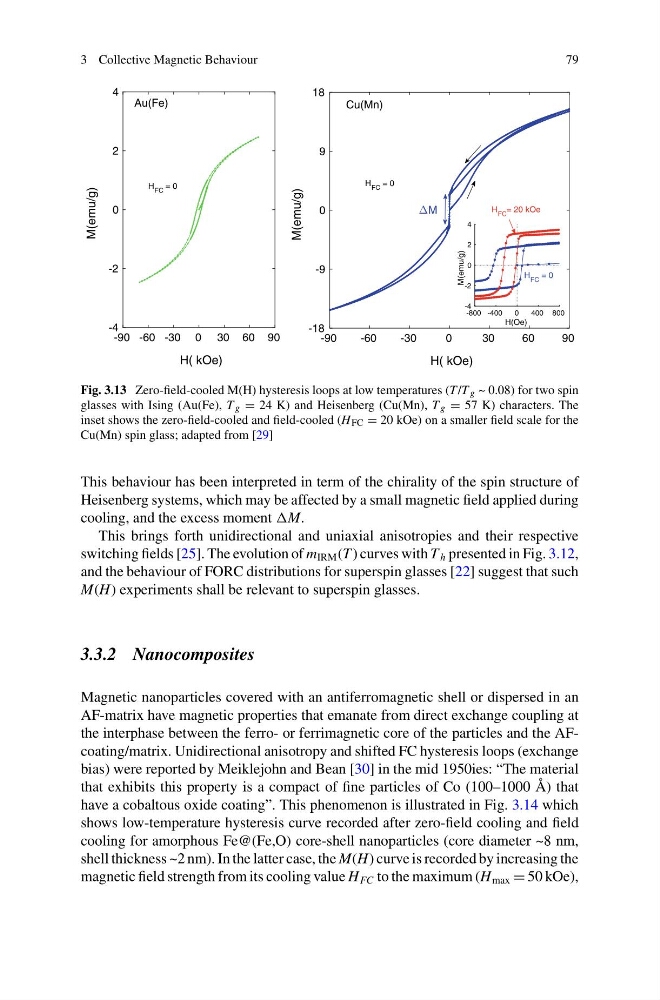
Fig. 3.13 Zero-field-cooled M(H) hysteresis loops at low temperatures (T /T g ~ 0.08) for two spin
glasses with Ising (Au(Fe), T g = 24 K) and Heisenberg (Cu(Mn), T g = 57 K) characters. The
inset shows the zero-field-cooled and field-cooled (H FC = 20 kOe) on a smaller field scale for the
Cu(Mn) spin glass; adapted from [29]
This behaviour has been interpreted in term of the chirality of the spin structure of
Heisenberg systems, which may be affected by a small magnetic field applied during
cooling, and the excess moment
This brings forth unidirectional and uniaxial anisotropies and their respective
switching fields [25]. The evolution of m IRM (T ) curves with T h presented in Fig. 3.12,
and the behaviour of FORC distributions for superspin glasses [22] suggest that such
M(H) experiments shall be relevant to superspin glasses.
3.3.2 Nanocomposites
Magnetic nanoparticles covered with an antiferromagnetic shell or dispersed in an
AF-matrix have magnetic properties that emanate from direct exchange coupling at
the interphase between the ferro- or ferrimagnetic core of the particles and the AFcoating/matrix. Unidirectional anisotropy and shifted FC hysteresis loops (exchange
bias) were reported by Meiklejohn and Bean [30] in the mid 1950ies: “The material
that exhibits this property is a compact of fine particles of Co (100–1000 Å) that
have a cobaltous oxide coating”. This phenomenon is illustrated in Fig. 3.14 which
shows low-temperature hysteresis curve recorded after zero-field cooling and field
cooling for amorphous Fe@(Fe,O) core-shell nanoparticles (core diameter ~8 nm,
shell thickness ~2 nm). In the latter case, the M(H) curve is recorded by increasing the
magnetic field strength from its cooling value H FC to the maximum (H max = 50 kOe),
79
-90 -60 -30 0 30 60 90
H( kOe)
-4
-2
0
2
4
M(emu/g)
-90
-60
-30
0
30
60
90
H( kOe)
-18
-9
0
9
18
M(emu/g)
-800 -400
0
400 800
H(Oe)
-4
-2
0
2
4
M(emu/g)
M
H FC = 0
H FC = 20 kOe
H FC = 0
H FC = 0
Au(Fe)
Cu(Mn)
Fig. 3.13 Zero-field-cooled M(H) hysteresis loops at low temperatures (T /T g ~ 0.08) for two spin
glasses with Ising (Au(Fe), T g = 24 K) and Heisenberg (Cu(Mn), T g = 57 K) characters. The
inset shows the zero-field-cooled and field-cooled (H FC = 20 kOe) on a smaller field scale for the
Cu(Mn) spin glass; adapted from [29]
This behaviour has been interpreted in term of the chirality of the spin structure of
Heisenberg systems, which may be affected by a small magnetic field applied during
cooling, and the excess moment
This brings forth unidirectional and uniaxial anisotropies and their respective
switching fields [25]. The evolution of m IRM (T ) curves with T h presented in Fig. 3.12,
and the behaviour of FORC distributions for superspin glasses [22] suggest that such
M(H) experiments shall be relevant to superspin glasses.
3.3.2 Nanocomposites
Magnetic nanoparticles covered with an antiferromagnetic shell or dispersed in an
AF-matrix have magnetic properties that emanate from direct exchange coupling at
the interphase between the ferro- or ferrimagnetic core of the particles and the AFcoating/matrix. Unidirectional anisotropy and shifted FC hysteresis loops (exchange
bias) were reported by Meiklejohn and Bean [30] in the mid 1950ies: “The material
that exhibits this property is a compact of fine particles of Co (100–1000 Å) that
have a cobaltous oxide coating”. This phenomenon is illustrated in Fig. 3.14 which
shows low-temperature hysteresis curve recorded after zero-field cooling and field
cooling for amorphous Fe@(Fe,O) core-shell nanoparticles (core diameter ~8 nm,
shell thickness ~2 nm). In the latter case, the M(H) curve is recorded by increasing the
magnetic field strength from its cooling value H FC to the maximum (H max = 50 kOe),