

82
R. Mathieu and P. Nordblad
-60
-40
-20
0
20
40
60
H (kOe)
-60
-40
-20
0
20
40
60
M (emu/g)
-60 -40 -20
0
20
40
60
H (kOe)
-50
-25
0
25
50
M (emu/g)
-60 -40 -20 0 20 40 60
H (kOe)
-100
-50
0
50
100
M (emu/g)
LCMO + CFO
LCMO
CFO
nanocomposite
nanomixture
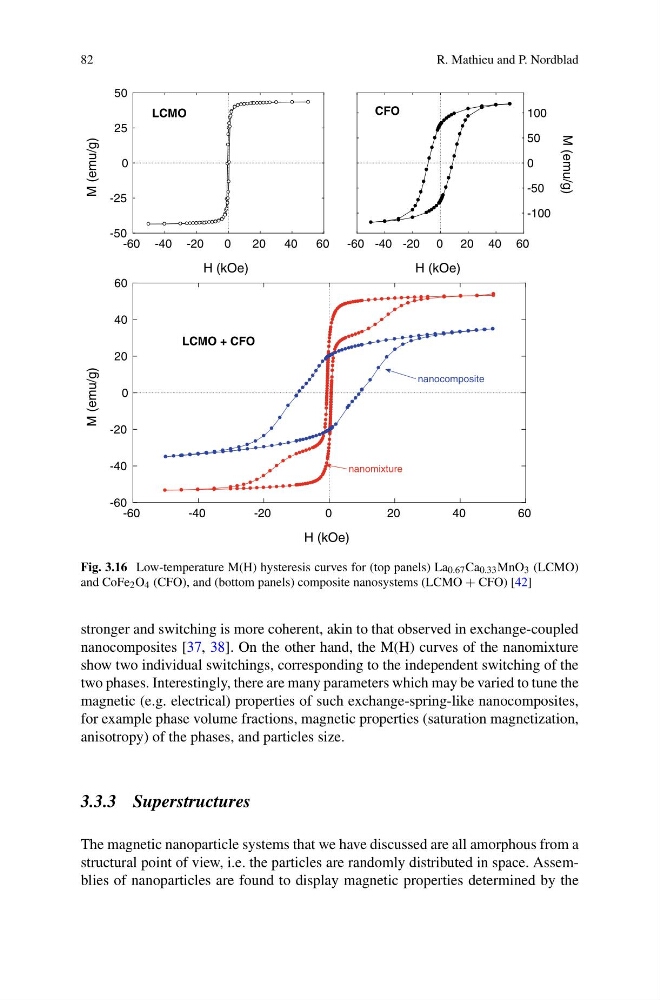
Fig. 3.16 Low-temperature M(H) hysteresis curves for (top panels) La 0.67 Ca 0.33 MnO 3 (LCMO)
and CoFe 2 O 4 (CFO), and (bottom panels) composite nanosystems (LCMO + CFO) [42]
stronger and switching is more coherent, akin to that observed in exchange-coupled
nanocomposites [37, 38]. On the other hand, the M(H) curves of the nanomixture
show two individual switchings, corresponding to the independent switching of the
two phases. Interestingly, there are many parameters which may be varied to tune the
magnetic (e.g. electrical) properties of such exchange-spring-like nanocomposites,
for example phase volume fractions, magnetic properties (saturation magnetization,
anisotropy) of the phases, and particles size.
3.3.3 Superstructures
The magnetic nanoparticle systems that we have discussed are all amorphous from a
structural point of view, i.e. the particles are randomly distributed in space. Assemblies of nanoparticles are found to display magnetic properties determined by the
R. Mathieu and P. Nordblad
-60
-40
-20
0
20
40
60
H (kOe)
-60
-40
-20
0
20
40
60
M (emu/g)
-60 -40 -20
0
20
40
60
H (kOe)
-50
-25
0
25
50
M (emu/g)
-60 -40 -20 0 20 40 60
H (kOe)
-100
-50
0
50
100
M (emu/g)
LCMO + CFO
LCMO
CFO
nanocomposite
nanomixture
Fig. 3.16 Low-temperature M(H) hysteresis curves for (top panels) La 0.67 Ca 0.33 MnO 3 (LCMO)
and CoFe 2 O 4 (CFO), and (bottom panels) composite nanosystems (LCMO + CFO) [42]
stronger and switching is more coherent, akin to that observed in exchange-coupled
nanocomposites [37, 38]. On the other hand, the M(H) curves of the nanomixture
show two individual switchings, corresponding to the independent switching of the
two phases. Interestingly, there are many parameters which may be varied to tune the
magnetic (e.g. electrical) properties of such exchange-spring-like nanocomposites,
for example phase volume fractions, magnetic properties (saturation magnetization,
anisotropy) of the phases, and particles size.
3.3.3 Superstructures
The magnetic nanoparticle systems that we have discussed are all amorphous from a
structural point of view, i.e. the particles are randomly distributed in space. Assemblies of nanoparticles are found to display magnetic properties determined by the