

3 Collective Magnetic Behaviour
67
3.1.2 Interaction Mechanisms
Dipolar interaction is always present and governed by the magnetic moment of
the particles and the distance between particles. When the particles are touching,
there is a possibility of direct or super-exchange interaction between particles. In
a metallic matrix, interparticle interaction mediated via the conduction electrons
becomes possible. If the matrix is antiferromagnetic, direct magnetic interaction at
the interphase between matrix and particle occurs. Ferro- or ferrimagnetic matrices
yield nanostructured magnets, which constitute a separate class of ordered magnetic
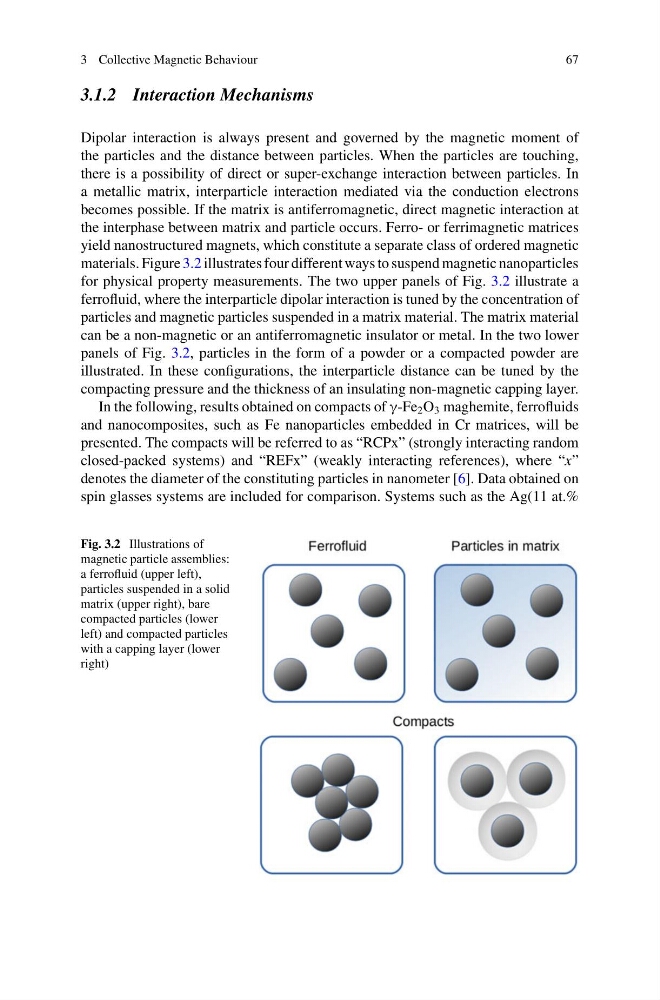
materials. Figure 3.2 illustrates four different ways to suspend magnetic nanoparticles
for physical property measurements. The two upper panels of Fig. 3.2 illustrate a
ferrofluid, where the interparticle dipolar interaction is tuned by the concentration of
particles and magnetic particles suspended in a matrix material. The matrix material
can be a non-magnetic or an antiferromagnetic insulator or metal. In the two lower
panels of Fig. 3.2, particles in the form of a powder or a compacted powder are
illustrated. In these configurations, the interparticle distance can be tuned by the
compacting pressure and the thickness of an insulating non-magnetic capping layer.
In the following, results obtained on compacts of γ-Fe 2 O 3 maghemite, ferrofluids
and nanocomposites, such as Fe nanoparticles embedded in Cr matrices, will be
presented. The compacts will be referred to as “RCPx” (strongly interacting random
closed-packed systems) and “REFx” (weakly interacting references), where “x”
denotes the diameter of the constituting particles in nanometer [6]. Data obtained on
spin glasses systems are included for comparison. Systems such as the Ag(11 at.%
Fig. 3.2 Illustrations of
magnetic particle assemblies:
a ferrofluid (upper left),
particles suspended in a solid
matrix (upper right), bare
compacted particles (lower
left) and compacted particles
with a capping layer (lower
right)
67
3.1.2 Interaction Mechanisms
Dipolar interaction is always present and governed by the magnetic moment of
the particles and the distance between particles. When the particles are touching,
there is a possibility of direct or super-exchange interaction between particles. In
a metallic matrix, interparticle interaction mediated via the conduction electrons
becomes possible. If the matrix is antiferromagnetic, direct magnetic interaction at
the interphase between matrix and particle occurs. Ferro- or ferrimagnetic matrices
yield nanostructured magnets, which constitute a separate class of ordered magnetic
materials. Figure 3.2 illustrates four different ways to suspend magnetic nanoparticles
for physical property measurements. The two upper panels of Fig. 3.2 illustrate a
ferrofluid, where the interparticle dipolar interaction is tuned by the concentration of
particles and magnetic particles suspended in a matrix material. The matrix material
can be a non-magnetic or an antiferromagnetic insulator or metal. In the two lower
panels of Fig. 3.2, particles in the form of a powder or a compacted powder are
illustrated. In these configurations, the interparticle distance can be tuned by the
compacting pressure and the thickness of an insulating non-magnetic capping layer.
In the following, results obtained on compacts of γ-Fe 2 O 3 maghemite, ferrofluids
and nanocomposites, such as Fe nanoparticles embedded in Cr matrices, will be
presented. The compacts will be referred to as “RCPx” (strongly interacting random
closed-packed systems) and “REFx” (weakly interacting references), where “x”
denotes the diameter of the constituting particles in nanometer [6]. Data obtained on
spin glasses systems are included for comparison. Systems such as the Ag(11 at.%
Fig. 3.2 Illustrations of
magnetic particle assemblies:
a ferrofluid (upper left),
particles suspended in a solid
matrix (upper right), bare
compacted particles (lower
left) and compacted particles
with a capping layer (lower
right)