

68
R. Mathieu and P. Nordblad
Mn), Cu(13.5 at.% Mn) and Au(6 at.% Fe) will be referred to as Ag(Mn), Cu(Mn)
and Au(Fe), respectively.
3.1.3 Time Scales
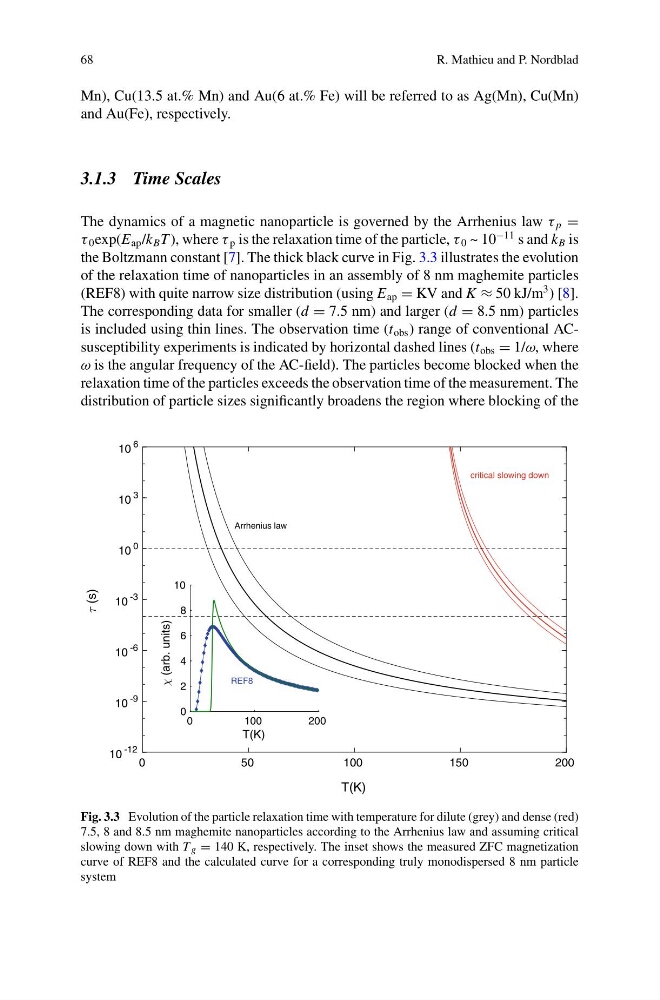
The dynamics of a magnetic nanoparticle is governed by the Arrhenius law τ p =
τ 0 exp(E ap /k B T ), where τ p is the relaxation time of the particle, τ 0 ~ 10
−11 s and k B is
the Boltzmann constant [7]. The thick black curve in Fig. 3.3 illustrates the evolution
of the relaxation time of nanoparticles in an assembly of 8 nm maghemite particles
(REF8) with quite narrow size distribution (using E ap = KV and K ≈ 50 kJ/m
3 ) [8].
The corresponding data for smaller (d = 7.5 nm) and larger (d = 8.5 nm) particles
is included using thin lines. The observation time (t obs ) range of conventional ACsusceptibility experiments is indicated by horizontal dashed lines (t obs = 1/ω, where
ω is the angular frequency of the AC-field). The particles become blocked when the
relaxation time of the particles exceeds the observation time of the measurement. The
distribution of particle sizes significantly broadens the region where blocking of the
0
50
100
150
200
T(K)
10
-12
10
-9
10
-6
10
-3
10
0
10
3
10
6
(s)
0
100
200
T(K)
0
2
4
6
8
10
(arb. units)
critical slowing down
REF8
Arrhenius law
Fig. 3.3 Evolution of the particle relaxation time with temperature for dilute (grey) and dense (red)
7.5, 8 and 8.5 nm maghemite nanoparticles according to the Arrhenius law and assuming critical
slowing down with T g = 140 K, respectively. The inset shows the measured ZFC magnetization
curve of REF8 and the calculated curve for a corresponding truly monodispersed 8 nm particle
system
R. Mathieu and P. Nordblad
Mn), Cu(13.5 at.% Mn) and Au(6 at.% Fe) will be referred to as Ag(Mn), Cu(Mn)
and Au(Fe), respectively.
3.1.3 Time Scales
The dynamics of a magnetic nanoparticle is governed by the Arrhenius law τ p =
τ 0 exp(E ap /k B T ), where τ p is the relaxation time of the particle, τ 0 ~ 10
−11 s and k B is
the Boltzmann constant [7]. The thick black curve in Fig. 3.3 illustrates the evolution
of the relaxation time of nanoparticles in an assembly of 8 nm maghemite particles
(REF8) with quite narrow size distribution (using E ap = KV and K ≈ 50 kJ/m
3 ) [8].
The corresponding data for smaller (d = 7.5 nm) and larger (d = 8.5 nm) particles
is included using thin lines. The observation time (t obs ) range of conventional ACsusceptibility experiments is indicated by horizontal dashed lines (t obs = 1/ω, where
ω is the angular frequency of the AC-field). The particles become blocked when the
relaxation time of the particles exceeds the observation time of the measurement. The
distribution of particle sizes significantly broadens the region where blocking of the
0
50
100
150
200
T(K)
10
-12
10
-9
10
-6
10
-3
10
0
10
3
10
6
(s)
0
100
200
T(K)
0
2
4
6
8
10
(arb. units)
critical slowing down
REF8
Arrhenius law
Fig. 3.3 Evolution of the particle relaxation time with temperature for dilute (grey) and dense (red)
7.5, 8 and 8.5 nm maghemite nanoparticles according to the Arrhenius law and assuming critical
slowing down with T g = 140 K, respectively. The inset shows the measured ZFC magnetization
curve of REF8 and the calculated curve for a corresponding truly monodispersed 8 nm particle
system