

66
R. Mathieu and P. Nordblad
0
50
100
150
200
T(K)
0
2
4
6
8
10
12
14
M/H (arb. units)
0.01
1
100
concentration (%)
0
50
100
150
T
max
(K)
dense assembly
dilute assembly
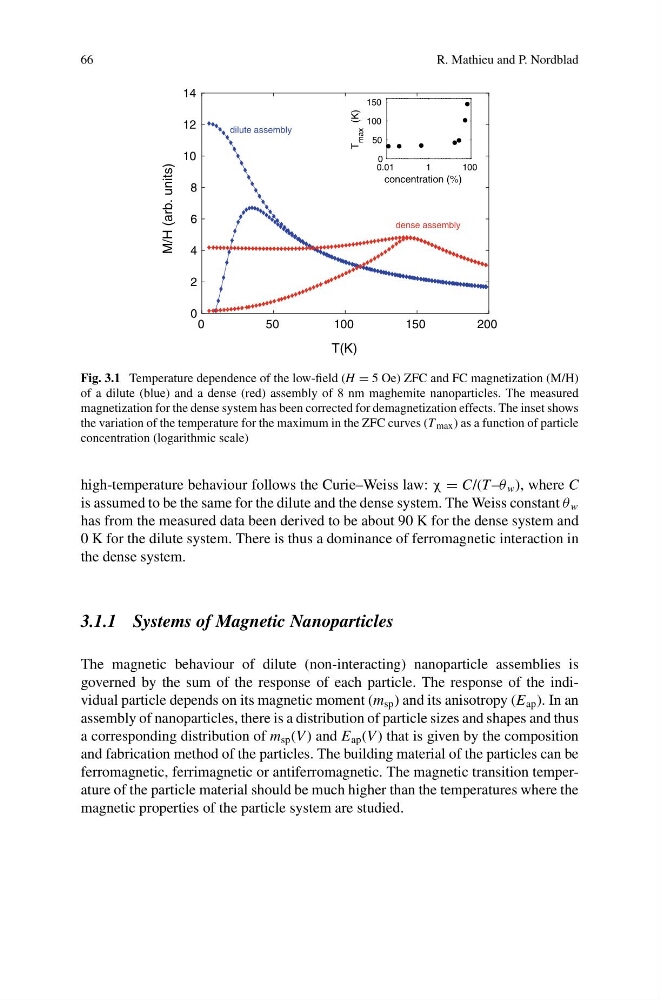
Fig. 3.1 Temperature dependence of the low-field (H = 5 Oe) ZFC and FC magnetization (M/H)
of a dilute (blue) and a dense (red) assembly of 8 nm maghemite nanoparticles. The measured
magnetization for the dense system has been corrected for demagnetization effects. The inset shows
the variation of the temperature for the maximum in the ZFC curves (T max ) as a function of particle
concentration (logarithmic scale)
high-temperature behaviour follows the Curie–Weiss law: χ = C/(T –θ w ), where C
is assumed to be the same for the dilute and the dense system. The Weiss constant θ w
has from the measured data been derived to be about 90 K for the dense system and
0 K for the dilute system. There is thus a dominance of ferromagnetic interaction in
the dense system.
3.1.1 Systems of Magnetic Nanoparticles
The magnetic behaviour of dilute (non-interacting) nanoparticle assemblies is
governed by the sum of the response of each particle. The response of the individual particle depends on its magnetic moment (m sp ) and its anisotropy (E ap ). In an
assembly of nanoparticles, there is a distribution of particle sizes and shapes and thus
a corresponding distribution of m sp (V ) and E ap (V ) that is given by the composition
and fabrication method of the particles. The building material of the particles can be
ferromagnetic, ferrimagnetic or antiferromagnetic. The magnetic transition temperature of the particle material should be much higher than the temperatures where the
magnetic properties of the particle system are studied.
R. Mathieu and P. Nordblad
0
50
100
150
200
T(K)
0
2
4
6
8
10
12
14
M/H (arb. units)
0.01
1
100
concentration (%)
0
50
100
150
T
max
(K)
dense assembly
dilute assembly
Fig. 3.1 Temperature dependence of the low-field (H = 5 Oe) ZFC and FC magnetization (M/H)
of a dilute (blue) and a dense (red) assembly of 8 nm maghemite nanoparticles. The measured
magnetization for the dense system has been corrected for demagnetization effects. The inset shows
the variation of the temperature for the maximum in the ZFC curves (T max ) as a function of particle
concentration (logarithmic scale)
high-temperature behaviour follows the Curie–Weiss law: χ = C/(T –θ w ), where C
is assumed to be the same for the dilute and the dense system. The Weiss constant θ w
has from the measured data been derived to be about 90 K for the dense system and
0 K for the dilute system. There is thus a dominance of ferromagnetic interaction in
the dense system.
3.1.1 Systems of Magnetic Nanoparticles
The magnetic behaviour of dilute (non-interacting) nanoparticle assemblies is
governed by the sum of the response of each particle. The response of the individual particle depends on its magnetic moment (m sp ) and its anisotropy (E ap ). In an
assembly of nanoparticles, there is a distribution of particle sizes and shapes and thus
a corresponding distribution of m sp (V ) and E ap (V ) that is given by the composition
and fabrication method of the particles. The building material of the particles can be
ferromagnetic, ferrimagnetic or antiferromagnetic. The magnetic transition temperature of the particle material should be much higher than the temperatures where the
magnetic properties of the particle system are studied.