

2 Interparticle Interactions: Theory and Mesoscopic Modeling
49
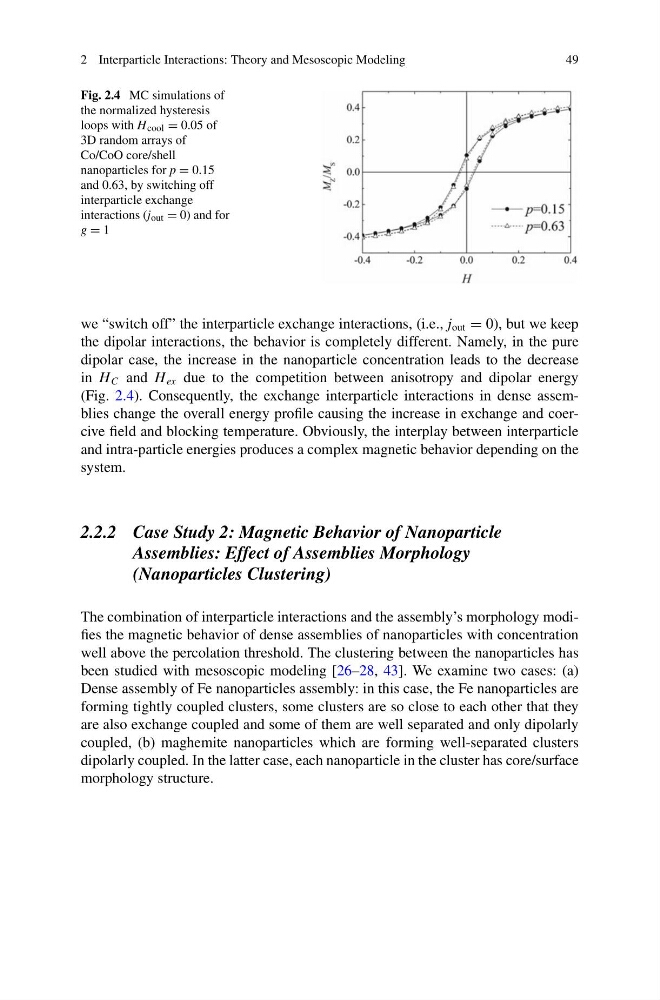
Fig. 2.4 MC simulations of
the normalized hysteresis
loops with H cool = 0.05 of
3D random arrays of
Co/CoO core/shell
nanoparticles for p = 0.15
and 0.63, by switching off
interparticle exchange
interactions (j out = 0) and for
g = 1
we “switch off” the interparticle exchange interactions, (i.e., j out = 0), but we keep
the dipolar interactions, the behavior is completely different. Namely, in the pure
dipolar case, the increase in the nanoparticle concentration leads to the decrease
in H C and H ex due to the competition between anisotropy and dipolar energy
(Fig. 2.4). Consequently, the exchange interparticle interactions in dense assemblies change the overall energy profile causing the increase in exchange and coercive field and blocking temperature. Obviously, the interplay between interparticle
and intra-particle energies produces a complex magnetic behavior depending on the
system.
2.2.2 Case Study 2: Magnetic Behavior of Nanoparticle
Assemblies: Effect of Assemblies Morphology
(Nanoparticles Clustering)
The combination of interparticle interactions and the assembly’s morphology modifies the magnetic behavior of dense assemblies of nanoparticles with concentration
well above the percolation threshold. The clustering between the nanoparticles has
been studied with mesoscopic modeling [26–28, 43]. We examine two cases: (a)
Dense assembly of Fe nanoparticles assembly: in this case, the Fe nanoparticles are
forming tightly coupled clusters, some clusters are so close to each other that they
are also exchange coupled and some of them are well separated and only dipolarly
coupled, (b) maghemite nanoparticles which are forming well-separated clusters
dipolarly coupled. In the latter case, each nanoparticle in the cluster has core/surface
morphology structure.
49
Fig. 2.4 MC simulations of
the normalized hysteresis
loops with H cool = 0.05 of
3D random arrays of
Co/CoO core/shell
nanoparticles for p = 0.15
and 0.63, by switching off
interparticle exchange
interactions (j out = 0) and for
g = 1
we “switch off” the interparticle exchange interactions, (i.e., j out = 0), but we keep
the dipolar interactions, the behavior is completely different. Namely, in the pure
dipolar case, the increase in the nanoparticle concentration leads to the decrease
in H C and H ex due to the competition between anisotropy and dipolar energy
(Fig. 2.4). Consequently, the exchange interparticle interactions in dense assemblies change the overall energy profile causing the increase in exchange and coercive field and blocking temperature. Obviously, the interplay between interparticle
and intra-particle energies produces a complex magnetic behavior depending on the
system.
2.2.2 Case Study 2: Magnetic Behavior of Nanoparticle
Assemblies: Effect of Assemblies Morphology
(Nanoparticles Clustering)
The combination of interparticle interactions and the assembly’s morphology modifies the magnetic behavior of dense assemblies of nanoparticles with concentration
well above the percolation threshold. The clustering between the nanoparticles has
been studied with mesoscopic modeling [26–28, 43]. We examine two cases: (a)
Dense assembly of Fe nanoparticles assembly: in this case, the Fe nanoparticles are
forming tightly coupled clusters, some clusters are so close to each other that they
are also exchange coupled and some of them are well separated and only dipolarly
coupled, (b) maghemite nanoparticles which are forming well-separated clusters
dipolarly coupled. In the latter case, each nanoparticle in the cluster has core/surface
morphology structure.