

50
M. Vasilakaki et al.
2.2.2.1 The Model
We have developed a model of a non-uniform assembly of NPs with density
well above the percolation threshold that includes explicitly the nanoparticles
anisotropies, the dipolar interactions and the interparticle exchange interactions in
case of nanoparticles that are in close contact, as it is described in Sect. 2.1.1. We
are using the Monte Carlo simulations technique based on the Metropolis algorithm,
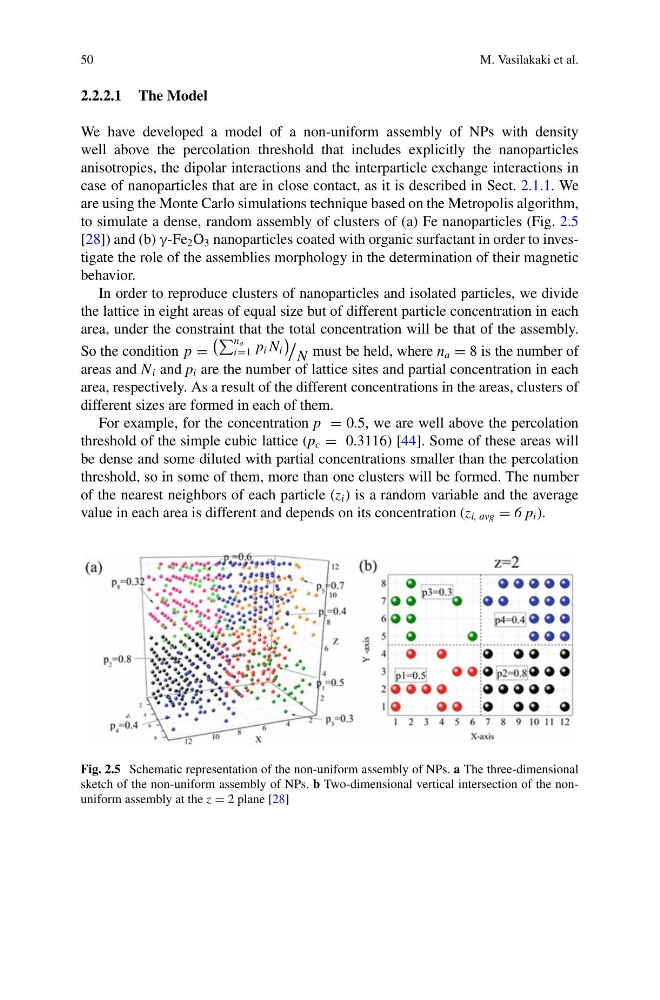
to simulate a dense, random assembly of clusters of (a) Fe nanoparticles (Fig. 2.5
[28]) and (b) γ-Fe 2 O 3 nanoparticles coated with organic surfactant in order to investigate the role of the assemblies morphology in the determination of their magnetic
behavior.
In order to reproduce clusters of nanoparticles and isolated particles, we divide
the lattice in eight areas of equal size but of different particle concentration in each
area, under the constraint that the total concentration will be that of the assembly.
So the condition p =
n a
i=1 p i N i
N must be held, where n a = 8 is the number of
areas and N i and p i are the number of lattice sites and partial concentration in each
area, respectively. As a result of the different concentrations in the areas, clusters of
different sizes are formed in each of them.
For example, for the concentration p = 0.5, we are well above the percolation
threshold of the simple cubic lattice (p c = 0.3116) [44]. Some of these areas will
be dense and some diluted with partial concentrations smaller than the percolation
threshold, so in some of them, more than one clusters will be formed. The number
of the nearest neighbors of each particle (z i ) is a random variable and the average
value in each area is different and depends on its concentration (z i, avg = 6 p i ).
Fig. 2.5 Schematic representation of the non-uniform assembly of NPs. a The three-dimensional
sketch of the non-uniform assembly of NPs. b Two-dimensional vertical intersection of the nonuniform assembly at the z = 2 plane [28]
M. Vasilakaki et al.
2.2.2.1 The Model
We have developed a model of a non-uniform assembly of NPs with density
well above the percolation threshold that includes explicitly the nanoparticles
anisotropies, the dipolar interactions and the interparticle exchange interactions in
case of nanoparticles that are in close contact, as it is described in Sect. 2.1.1. We
are using the Monte Carlo simulations technique based on the Metropolis algorithm,
to simulate a dense, random assembly of clusters of (a) Fe nanoparticles (Fig. 2.5
[28]) and (b) γ-Fe 2 O 3 nanoparticles coated with organic surfactant in order to investigate the role of the assemblies morphology in the determination of their magnetic
behavior.
In order to reproduce clusters of nanoparticles and isolated particles, we divide
the lattice in eight areas of equal size but of different particle concentration in each
area, under the constraint that the total concentration will be that of the assembly.
So the condition p =
n a
i=1 p i N i
N must be held, where n a = 8 is the number of
areas and N i and p i are the number of lattice sites and partial concentration in each
area, respectively. As a result of the different concentrations in the areas, clusters of
different sizes are formed in each of them.
For example, for the concentration p = 0.5, we are well above the percolation
threshold of the simple cubic lattice (p c = 0.3116) [44]. Some of these areas will
be dense and some diluted with partial concentrations smaller than the percolation
threshold, so in some of them, more than one clusters will be formed. The number
of the nearest neighbors of each particle (z i ) is a random variable and the average
value in each area is different and depends on its concentration (z i, avg = 6 p i ).
Fig. 2.5 Schematic representation of the non-uniform assembly of NPs. a The three-dimensional
sketch of the non-uniform assembly of NPs. b Two-dimensional vertical intersection of the nonuniform assembly at the z = 2 plane [28]