

48
M. Vasilakaki et al.
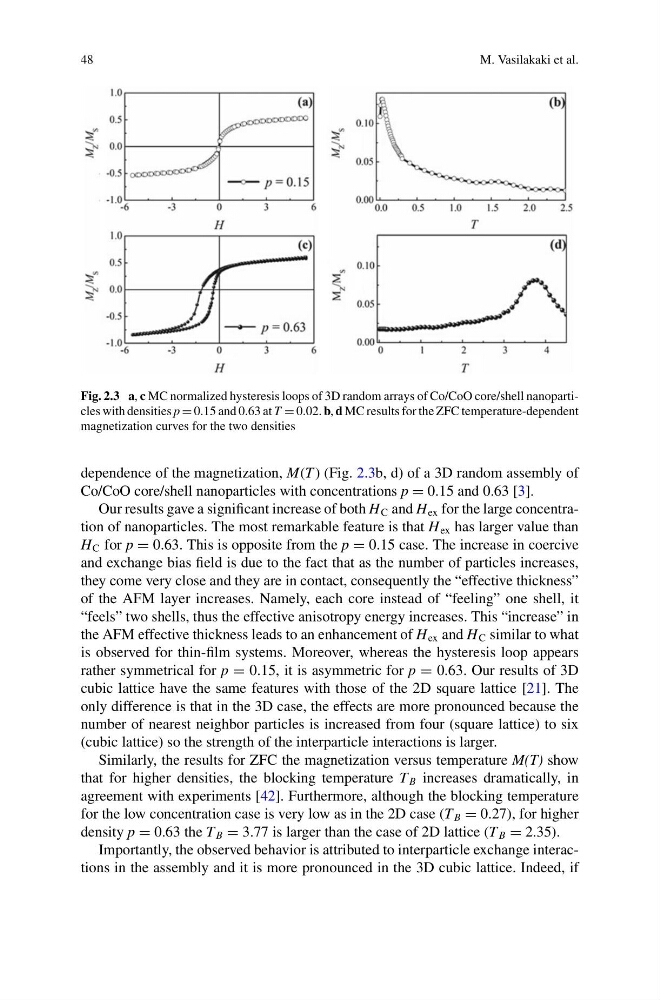
Fig. 2.3 a, c MC normalized hysteresis loops of 3D random arrays of Co/CoO core/shell nanoparticles with densities p = 0.15 and 0.63 at T = 0.02. b, d MC results for the ZFC temperature-dependent
magnetization curves for the two densities
dependence of the magnetization, M(T ) (Fig. 2.3b, d) of a 3D random assembly of
Co/CoO core/shell nanoparticles with concentrations p = 0.15 and 0.63 [3].
Our results gave a significant increase of both H C and H ex for the large concentration of nanoparticles. The most remarkable feature is that H ex has larger value than
H C for p = 0.63. This is opposite from the p = 0.15 case. The increase in coercive
and exchange bias field is due to the fact that as the number of particles increases,
they come very close and they are in contact, consequently the “effective thickness”
of the AFM layer increases. Namely, each core instead of “feeling” one shell, it
“feels” two shells, thus the effective anisotropy energy increases. This “increase” in
the AFM effective thickness leads to an enhancement of H ex and H C similar to what
is observed for thin-film systems. Moreover, whereas the hysteresis loop appears
rather symmetrical for p = 0.15, it is asymmetric for p = 0.63. Our results of 3D
cubic lattice have the same features with those of the 2D square lattice [21]. The
only difference is that in the 3D case, the effects are more pronounced because the
number of nearest neighbor particles is increased from four (square lattice) to six
(cubic lattice) so the strength of the interparticle interactions is larger.
Similarly, the results for ZFC the magnetization versus temperature M(T) show
that for higher densities, the blocking temperature T B increases dramatically, in
agreement with experiments [42]. Furthermore, although the blocking temperature
for the low concentration case is very low as in the 2D case (T B = 0.27), for higher
density p = 0.63 the T B = 3.77 is larger than the case of 2D lattice (T B = 2.35).
Importantly, the observed behavior is attributed to interparticle exchange interactions in the assembly and it is more pronounced in the 3D cubic lattice. Indeed, if
M. Vasilakaki et al.
Fig. 2.3 a, c MC normalized hysteresis loops of 3D random arrays of Co/CoO core/shell nanoparticles with densities p = 0.15 and 0.63 at T = 0.02. b, d MC results for the ZFC temperature-dependent
magnetization curves for the two densities
dependence of the magnetization, M(T ) (Fig. 2.3b, d) of a 3D random assembly of
Co/CoO core/shell nanoparticles with concentrations p = 0.15 and 0.63 [3].
Our results gave a significant increase of both H C and H ex for the large concentration of nanoparticles. The most remarkable feature is that H ex has larger value than
H C for p = 0.63. This is opposite from the p = 0.15 case. The increase in coercive
and exchange bias field is due to the fact that as the number of particles increases,
they come very close and they are in contact, consequently the “effective thickness”
of the AFM layer increases. Namely, each core instead of “feeling” one shell, it
“feels” two shells, thus the effective anisotropy energy increases. This “increase” in
the AFM effective thickness leads to an enhancement of H ex and H C similar to what
is observed for thin-film systems. Moreover, whereas the hysteresis loop appears
rather symmetrical for p = 0.15, it is asymmetric for p = 0.63. Our results of 3D
cubic lattice have the same features with those of the 2D square lattice [21]. The
only difference is that in the 3D case, the effects are more pronounced because the
number of nearest neighbor particles is increased from four (square lattice) to six
(cubic lattice) so the strength of the interparticle interactions is larger.
Similarly, the results for ZFC the magnetization versus temperature M(T) show
that for higher densities, the blocking temperature T B increases dramatically, in
agreement with experiments [42]. Furthermore, although the blocking temperature
for the low concentration case is very low as in the 2D case (T B = 0.27), for higher
density p = 0.63 the T B = 3.77 is larger than the case of 2D lattice (T B = 2.35).
Importantly, the observed behavior is attributed to interparticle exchange interactions in the assembly and it is more pronounced in the 3D cubic lattice. Indeed, if