

28
Ò. Iglesias and H. Kachkachi
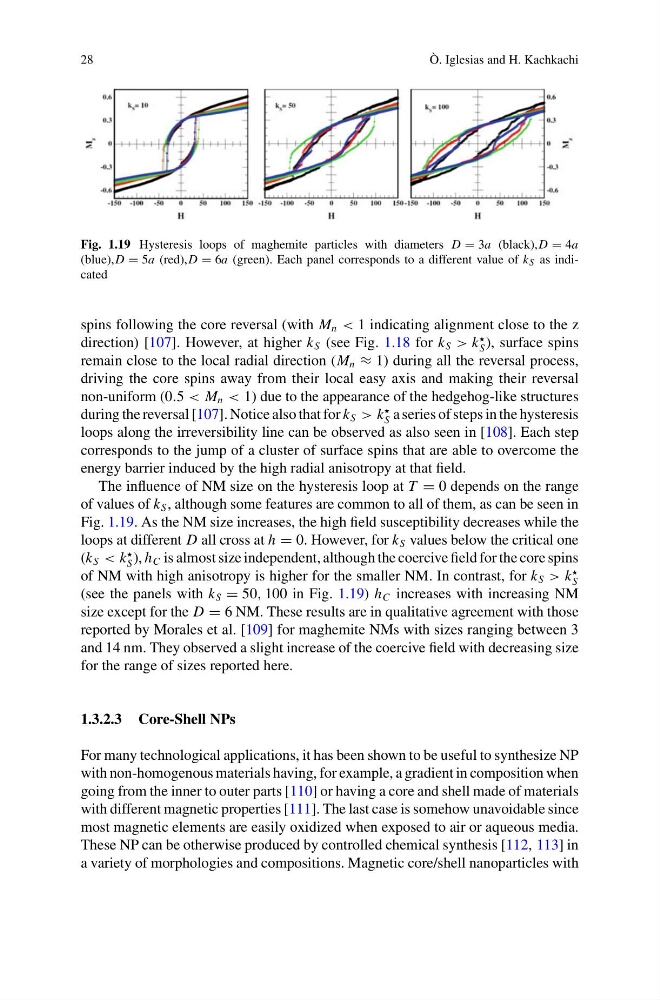
Fig. 1.19 Hysteresis loops of maghemite particles with diameters D = 3a (black),D = 4a
(blue),D = 5a (red),D = 6a (green). Each panel corresponds to a different value of k S as indicated
spins following the core reversal (with M n < 1 indicating alignment close to the z
direction) [107]. However, at higher k S (see Fig. 1.18 for k S > k
S ), surface spins
remain close to the local radial direction (M n ≈ 1) during all the reversal process,
driving the core spins away from their local easy axis and making their reversal
non-uniform (0.5 < M n < 1) due to the appearance of the hedgehog-like structures
during the reversal [107]. Notice also that for k S > k
S a series of steps in the hysteresis
loops along the irreversibility line can be observed as also seen in [108]. Each step
corresponds to the jump of a cluster of surface spins that are able to overcome the
energy barrier induced by the high radial anisotropy at that field.
The influence of NM size on the hysteresis loop at T = 0 depends on the range
of values of k S , although some features are common to all of them, as can be seen in
Fig. 1.19. As the NM size increases, the high field susceptibility decreases while the
loops at different D all cross at h = 0. However, for k S values below the critical one
(k S < k
S ), h C is almost size independent, although the coercive field for the core spins
of NM with high anisotropy is higher for the smaller NM. In contrast, for k S > k
S
(see the panels with k S = 50, 100 in Fig. 1.19) h C increases with increasing NM
size except for the D = 6 NM. These results are in qualitative agreement with those
reported by Morales et al. [109] for maghemite NMs with sizes ranging between 3
and 14 nm. They observed a slight increase of the coercive field with decreasing size
for the range of sizes reported here.
1.3.2.3 Core-Shell NPs
For many technological applications, it has been shown to be useful to synthesize NP
with non-homogenous materials having, for example, a gradient in composition when
going from the inner to outer parts [110] or having a core and shell made of materials
with different magnetic properties [111]. The last case is somehow unavoidable since
most magnetic elements are easily oxidized when exposed to air or aqueous media.
These NP can be otherwise produced by controlled chemical synthesis [112, 113] in
a variety of morphologies and compositions. Magnetic core/shell nanoparticles with
Ò. Iglesias and H. Kachkachi
Fig. 1.19 Hysteresis loops of maghemite particles with diameters D = 3a (black),D = 4a
(blue),D = 5a (red),D = 6a (green). Each panel corresponds to a different value of k S as indicated
spins following the core reversal (with M n < 1 indicating alignment close to the z
direction) [107]. However, at higher k S (see Fig. 1.18 for k S > k
S ), surface spins
remain close to the local radial direction (M n ≈ 1) during all the reversal process,
driving the core spins away from their local easy axis and making their reversal
non-uniform (0.5 < M n < 1) due to the appearance of the hedgehog-like structures
during the reversal [107]. Notice also that for k S > k
S a series of steps in the hysteresis
loops along the irreversibility line can be observed as also seen in [108]. Each step
corresponds to the jump of a cluster of surface spins that are able to overcome the
energy barrier induced by the high radial anisotropy at that field.
The influence of NM size on the hysteresis loop at T = 0 depends on the range
of values of k S , although some features are common to all of them, as can be seen in
Fig. 1.19. As the NM size increases, the high field susceptibility decreases while the
loops at different D all cross at h = 0. However, for k S values below the critical one
(k S < k
S ), h C is almost size independent, although the coercive field for the core spins
of NM with high anisotropy is higher for the smaller NM. In contrast, for k S > k
S
(see the panels with k S = 50, 100 in Fig. 1.19) h C increases with increasing NM
size except for the D = 6 NM. These results are in qualitative agreement with those
reported by Morales et al. [109] for maghemite NMs with sizes ranging between 3
and 14 nm. They observed a slight increase of the coercive field with decreasing size
for the range of sizes reported here.
1.3.2.3 Core-Shell NPs
For many technological applications, it has been shown to be useful to synthesize NP
with non-homogenous materials having, for example, a gradient in composition when
going from the inner to outer parts [110] or having a core and shell made of materials
with different magnetic properties [111]. The last case is somehow unavoidable since
most magnetic elements are easily oxidized when exposed to air or aqueous media.
These NP can be otherwise produced by controlled chemical synthesis [112, 113] in
a variety of morphologies and compositions. Magnetic core/shell nanoparticles with