

1 Single Nanomagnet Behaviour: Surface and Finite-Size Effects
27
-150 -100 -50
0
50 100 150
h
-0.4
-0.2
0
0.2
0.4
M
z
0.6
0.7
0.8
0.9
1
M
n
Surf
-150 -100 -50
0
50 100 150
h
-0.4
-0.2
0
0.2
0.4
M
z
Core
0.4
0.6
0.8
1
M
n
Core
k S =1
k S =100
k S =100
k S =1
k S =1
k S =100
k S =1
k S =100
(c)
(a)
(b)
(d)
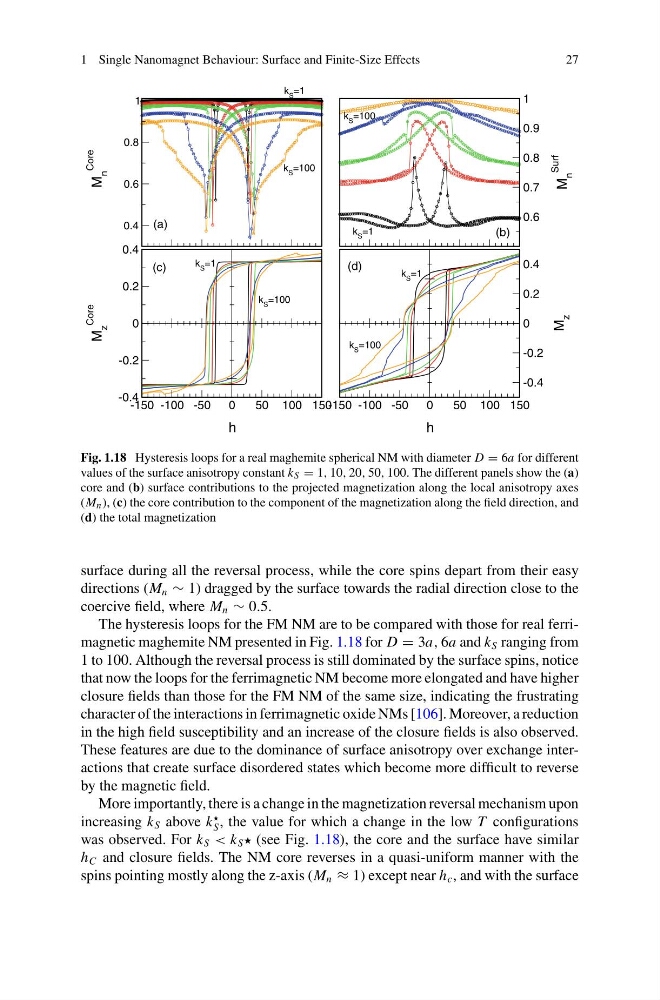
Fig. 1.18 Hysteresis loops for a real maghemite spherical NM with diameter D = 6a for different
values of the surface anisotropy constant k S = 1, 10, 20, 50, 100. The different panels show the (a)
core and (b) surface contributions to the projected magnetization along the local anisotropy axes
(M n ), (c) the core contribution to the component of the magnetization along the field direction, and
(d) the total magnetization
surface during all the reversal process, while the core spins depart from their easy
directions (M n ∼ 1) dragged by the surface towards the radial direction close to the
coercive field, where M n ∼ 0.5.
The hysteresis loops for the FM NM are to be compared with those for real ferrimagnetic maghemite NM presented in Fig. 1.18 for D = 3a, 6a and k S ranging from
1 to 100. Although the reversal process is still dominated by the surface spins, notice
that now the loops for the ferrimagnetic NM become more elongated and have higher
closure fields than those for the FM NM of the same size, indicating the frustrating
character of the interactions in ferrimagnetic oxide NMs [106]. Moreover, a reduction
in the high field susceptibility and an increase of the closure fields is also observed.
These features are due to the dominance of surface anisotropy over exchange interactions that create surface disordered states which become more difficult to reverse
by the magnetic field.
More importantly, there is a change in the magnetization reversal mechanism upon
increasing k S above k
S , the value for which a change in the low T configurations
was observed. For k S < k S (see Fig. 1.18), the core and the surface have similar
h C and closure fields. The NM core reverses in a quasi-uniform manner with the
spins pointing mostly along the z-axis (M n ≈ 1) except near h c , and with the surface
27
-150 -100 -50
0
50 100 150
h
-0.4
-0.2
0
0.2
0.4
M
z
0.6
0.7
0.8
0.9
1
M
n
Surf
-150 -100 -50
0
50 100 150
h
-0.4
-0.2
0
0.2
0.4
M
z
Core
0.4
0.6
0.8
1
M
n
Core
k S =1
k S =100
k S =100
k S =1
k S =1
k S =100
k S =1
k S =100
(c)
(a)
(b)
(d)
Fig. 1.18 Hysteresis loops for a real maghemite spherical NM with diameter D = 6a for different
values of the surface anisotropy constant k S = 1, 10, 20, 50, 100. The different panels show the (a)
core and (b) surface contributions to the projected magnetization along the local anisotropy axes
(M n ), (c) the core contribution to the component of the magnetization along the field direction, and
(d) the total magnetization
surface during all the reversal process, while the core spins depart from their easy
directions (M n ∼ 1) dragged by the surface towards the radial direction close to the
coercive field, where M n ∼ 0.5.
The hysteresis loops for the FM NM are to be compared with those for real ferrimagnetic maghemite NM presented in Fig. 1.18 for D = 3a, 6a and k S ranging from
1 to 100. Although the reversal process is still dominated by the surface spins, notice
that now the loops for the ferrimagnetic NM become more elongated and have higher
closure fields than those for the FM NM of the same size, indicating the frustrating
character of the interactions in ferrimagnetic oxide NMs [106]. Moreover, a reduction
in the high field susceptibility and an increase of the closure fields is also observed.
These features are due to the dominance of surface anisotropy over exchange interactions that create surface disordered states which become more difficult to reverse
by the magnetic field.
More importantly, there is a change in the magnetization reversal mechanism upon
increasing k S above k
S , the value for which a change in the low T configurations
was observed. For k S < k S (see Fig. 1.18), the core and the surface have similar
h C and closure fields. The NM core reverses in a quasi-uniform manner with the
spins pointing mostly along the z-axis (M n ≈ 1) except near h c , and with the surface