

26
Ò. Iglesias and H. Kachkachi
-1
-0.5
0
0.5
1
M
z
Core
0.6
0.7
0.8
0.9
1
M
n
Surf
-10
-5
0
5
10
h (K)
-1
-0.5
0
0.5
1
M
z
Surf
-10
-5
0
5
10
h (K)
0.6
0.7
0.8
0.9
1
M
n
Core
k S =1
k S =1
k S =100
k S =100
k S =1
k S =100
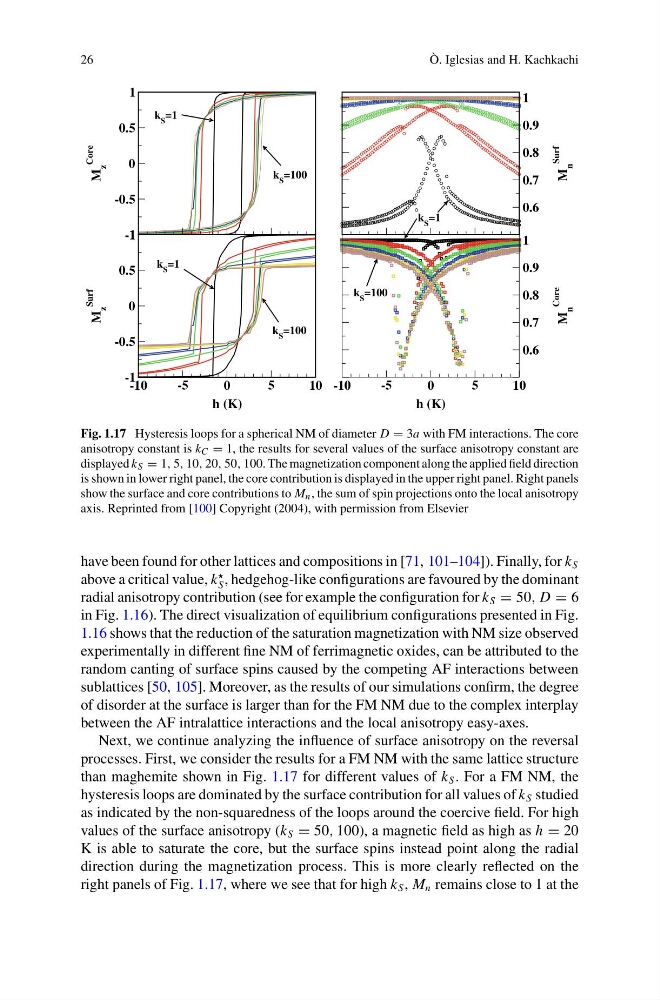
Fig. 1.17 Hysteresis loops for a spherical NM of diameter D = 3a with FM interactions. The core
anisotropy constant is k C = 1, the results for several values of the surface anisotropy constant are
displayed k S = 1, 5, 10, 20, 50, 100. The magnetization component along the applied field direction
is shown in lower right panel, the core contribution is displayed in the upper right panel. Right panels
show the surface and core contributions to M n , the sum of spin projections onto the local anisotropy
axis. Reprinted from [100] Copyright (2004), with permission from Elsevier
have been found for other lattices and compositions in [71, 101–104]). Finally, for k S
above a critical value, k
S , hedgehog-like configurations are favoured by the dominant
radial anisotropy contribution (see for example the configuration for k S = 50, D = 6
in Fig. 1.16). The direct visualization of equilibrium configurations presented in Fig.
1.16 shows that the reduction of the saturation magnetization with NM size observed
experimentally in different fine NM of ferrimagnetic oxides, can be attributed to the
random canting of surface spins caused by the competing AF interactions between
sublattices [50, 105]. Moreover, as the results of our simulations confirm, the degree
of disorder at the surface is larger than for the FM NM due to the complex interplay
between the AF intralattice interactions and the local anisotropy easy-axes.
Next, we continue analyzing the influence of surface anisotropy on the reversal
processes. First, we consider the results for a FM NM with the same lattice structure
than maghemite shown in Fig. 1.17 for different values of k S . For a FM NM, the
hysteresis loops are dominated by the surface contribution for all values of k S studied
as indicated by the non-squaredness of the loops around the coercive field. For high
values of the surface anisotropy (k S = 50, 100), a magnetic field as high as h = 20
K is able to saturate the core, but the surface spins instead point along the radial
direction during the magnetization process. This is more clearly reflected on the
right panels of Fig. 1.17, where we see that for high k S , M n remains close to 1 at the
Ò. Iglesias and H. Kachkachi
-1
-0.5
0
0.5
1
M
z
Core
0.6
0.7
0.8
0.9
1
M
n
Surf
-10
-5
0
5
10
h (K)
-1
-0.5
0
0.5
1
M
z
Surf
-10
-5
0
5
10
h (K)
0.6
0.7
0.8
0.9
1
M
n
Core
k S =1
k S =1
k S =100
k S =100
k S =1
k S =100
Fig. 1.17 Hysteresis loops for a spherical NM of diameter D = 3a with FM interactions. The core
anisotropy constant is k C = 1, the results for several values of the surface anisotropy constant are
displayed k S = 1, 5, 10, 20, 50, 100. The magnetization component along the applied field direction
is shown in lower right panel, the core contribution is displayed in the upper right panel. Right panels
show the surface and core contributions to M n , the sum of spin projections onto the local anisotropy
axis. Reprinted from [100] Copyright (2004), with permission from Elsevier
have been found for other lattices and compositions in [71, 101–104]). Finally, for k S
above a critical value, k
S , hedgehog-like configurations are favoured by the dominant
radial anisotropy contribution (see for example the configuration for k S = 50, D = 6
in Fig. 1.16). The direct visualization of equilibrium configurations presented in Fig.
1.16 shows that the reduction of the saturation magnetization with NM size observed
experimentally in different fine NM of ferrimagnetic oxides, can be attributed to the
random canting of surface spins caused by the competing AF interactions between
sublattices [50, 105]. Moreover, as the results of our simulations confirm, the degree
of disorder at the surface is larger than for the FM NM due to the complex interplay
between the AF intralattice interactions and the local anisotropy easy-axes.
Next, we continue analyzing the influence of surface anisotropy on the reversal
processes. First, we consider the results for a FM NM with the same lattice structure
than maghemite shown in Fig. 1.17 for different values of k S . For a FM NM, the
hysteresis loops are dominated by the surface contribution for all values of k S studied
as indicated by the non-squaredness of the loops around the coercive field. For high
values of the surface anisotropy (k S = 50, 100), a magnetic field as high as h = 20
K is able to saturate the core, but the surface spins instead point along the radial
direction during the magnetization process. This is more clearly reflected on the
right panels of Fig. 1.17, where we see that for high k S , M n remains close to 1 at the