

16 Magnetic Fluids for Thermoelectricity
387
Se
Eq
int =
i z i n i ˆ
S i
e
i z i ξ i n i
(16.12)
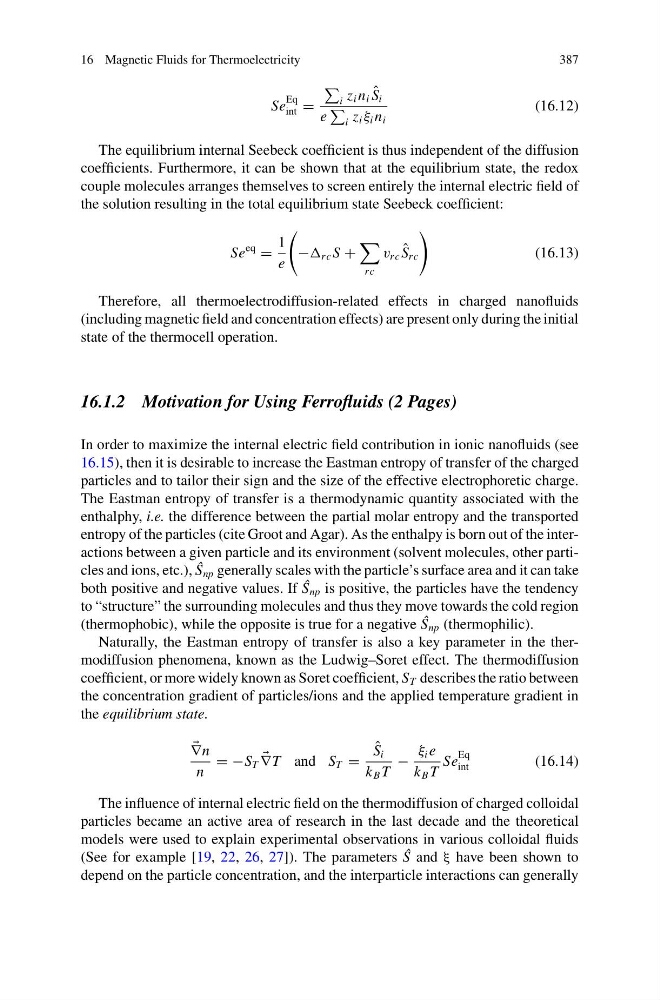
The equilibrium internal Seebeck coefficient is thus independent of the diffusion
coefficients. Furthermore, it can be shown that at the equilibrium state, the redox
couple molecules arranges themselves to screen entirely the internal electric field of
the solution resulting in the total equilibrium state Seebeck coefficient:
Se
eq
=
1
e
− rc S +
rc
v rc ˆ
S rc
(16.13)
Therefore, all thermoelectrodiffusion-related effects in charged nanofluids
(including magnetic field and concentration effects) are present only during the initial
state of the thermocell operation.
16.1.2 Motivation for Using Ferrofluids (2 Pages)
In order to maximize the internal electric field contribution in ionic nanofluids (see
16.15), then it is desirable to increase the Eastman entropy of transfer of the charged
particles and to tailor their sign and the size of the effective electrophoretic charge.
The Eastman entropy of transfer is a thermodynamic quantity associated with the
enthalphy, i.e. the difference between the partial molar entropy and the transported
entropy of the particles (cite Groot and Agar). As the enthalpy is born out of the interactions between a given particle and its environment (solvent molecules, other particles and ions, etc.), ˆ
S np generally scales with the particle’s surface area and it can take
both positive and negative values. If ˆ
S np is positive, the particles have the tendency
to “structure” the surrounding molecules and thus they move towards the cold region
(thermophobic), while the opposite is true for a negative ˆ
S np (thermophilic).
Naturally, the Eastman entropy of transfer is also a key parameter in the thermodiffusion phenomena, known as the Ludwig–Soret effect. The thermodiffusion
coefficient, or more widely known as Soret coefficient, S T describes the ratio between
the concentration gradient of particles/ions and the applied temperature gradient in
the equilibrium state.
∇n
n
= −S T
∇T and S T =
ˆ
S i
k B T
−
ξ i e
k B T
Se
Eq
int
(16.14)
The influence of internal electric field on the thermodiffusion of charged colloidal
particles became an active area of research in the last decade and the theoretical
models were used to explain experimental observations in various colloidal fluids
(See for example [19, 22, 26, 27]). The parameters ˆ
S and ξ have been shown to
depend on the particle concentration, and the interparticle interactions can generally
387
Se
Eq
int =
i z i n i ˆ
S i
e
i z i ξ i n i
(16.12)
The equilibrium internal Seebeck coefficient is thus independent of the diffusion
coefficients. Furthermore, it can be shown that at the equilibrium state, the redox
couple molecules arranges themselves to screen entirely the internal electric field of
the solution resulting in the total equilibrium state Seebeck coefficient:
Se
eq
=
1
e
− rc S +
rc
v rc ˆ
S rc
(16.13)
Therefore, all thermoelectrodiffusion-related effects in charged nanofluids
(including magnetic field and concentration effects) are present only during the initial
state of the thermocell operation.
16.1.2 Motivation for Using Ferrofluids (2 Pages)
In order to maximize the internal electric field contribution in ionic nanofluids (see
16.15), then it is desirable to increase the Eastman entropy of transfer of the charged
particles and to tailor their sign and the size of the effective electrophoretic charge.
The Eastman entropy of transfer is a thermodynamic quantity associated with the
enthalphy, i.e. the difference between the partial molar entropy and the transported
entropy of the particles (cite Groot and Agar). As the enthalpy is born out of the interactions between a given particle and its environment (solvent molecules, other particles and ions, etc.), ˆ
S np generally scales with the particle’s surface area and it can take
both positive and negative values. If ˆ
S np is positive, the particles have the tendency
to “structure” the surrounding molecules and thus they move towards the cold region
(thermophobic), while the opposite is true for a negative ˆ
S np (thermophilic).
Naturally, the Eastman entropy of transfer is also a key parameter in the thermodiffusion phenomena, known as the Ludwig–Soret effect. The thermodiffusion
coefficient, or more widely known as Soret coefficient, S T describes the ratio between
the concentration gradient of particles/ions and the applied temperature gradient in
the equilibrium state.
∇n
n
= −S T
∇T and S T =
ˆ
S i
k B T
−
ξ i e
k B T
Se
Eq
int
(16.14)
The influence of internal electric field on the thermodiffusion of charged colloidal
particles became an active area of research in the last decade and the theoretical
models were used to explain experimental observations in various colloidal fluids
(See for example [19, 22, 26, 27]). The parameters ˆ
S and ξ have been shown to
depend on the particle concentration, and the interparticle interactions can generally