

386
S. Nakamae
J i = −D i
n i
ˆ
S i
k B T
∇T − n i
ξ i e
k B T
E
ini
int
(16.7)
In an open-circuit configuration, the total electric current is null,
i z i e
∇n i =
0,
where z i is the effective static charge. (For small ions, z i and ξ i are equal, but they
can take different values for charged nanoparticles and large molecules.) This leads
to the expression for the initial internal electric field:
E
ini
int = −
i
t i
ˆ
S i
ξ i e
∇T with t i = −
z i ξ i e
2 n i D i
i z i ξ i e 2 n i D i
=
σ i
σ total
(16.8)
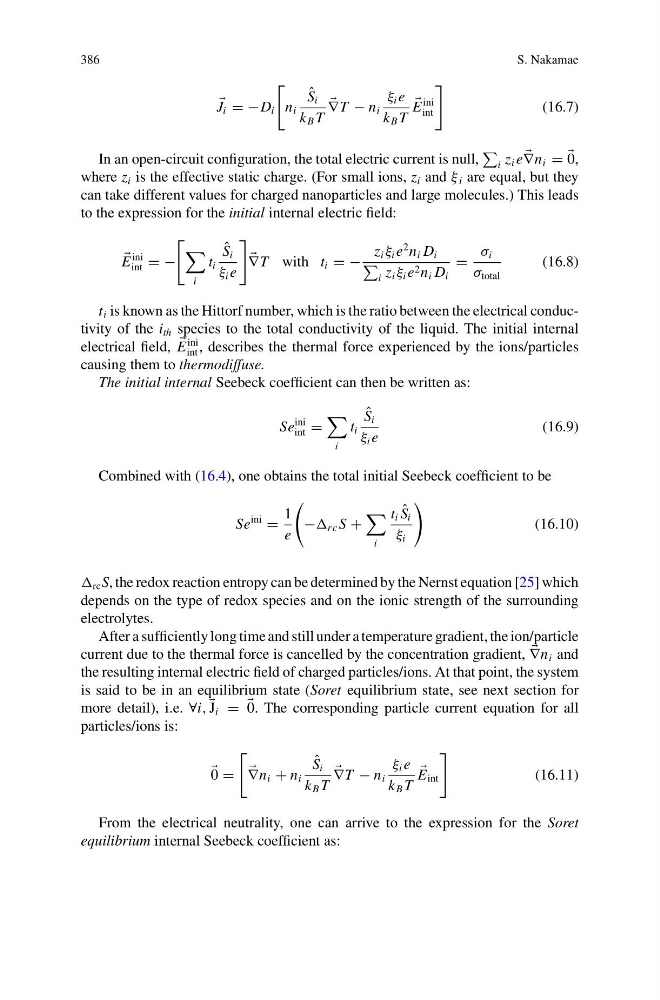
t i is known as the Hittorf number, which is the ratio between the electrical conductivity of the i th species to the total conductivity of the liquid. The initial internal
electrical field,
E
ini
int , describes the thermal force experienced by the ions/particles
causing them to thermodiffuse.
The initial internal Seebeck coefficient can then be written as:
Se
ini
int =
i
t i
ˆ
S i
ξ i e
(16.9)
Combined with (16.4), one obtains the total initial Seebeck coefficient to be
Se
ini
=
1
e
− rc S +
i
t i ˆ
S i
ξ i
(16.10)
rc S, the redox reaction entropy can be determined by the Nernst equation [25] which
depends on the type of redox species and on the ionic strength of the surrounding
electrolytes.
After a sufficiently long time and still under a temperature gradient, the ion/particle
current due to the thermal force is cancelled by the concentration gradient,
∇n i and
the resulting internal electric field of charged particles/ions. At that point, the system
is said to be in an equilibrium state (Soret equilibrium state, see next section for
more detail), i.e. ∀i, J i =
0. The corresponding particle current equation for all
particles/ions is:
0 =
∇n i + n i
ˆ
S i
k B T
∇T − n i
ξ i e
k B T
E int
(16.11)
From the electrical neutrality, one can arrive to the expression for the Soret
equilibrium internal Seebeck coefficient as:
S. Nakamae
J i = −D i
n i
ˆ
S i
k B T
∇T − n i
ξ i e
k B T
E
ini
int
(16.7)
In an open-circuit configuration, the total electric current is null,
i z i e
∇n i =
0,
where z i is the effective static charge. (For small ions, z i and ξ i are equal, but they
can take different values for charged nanoparticles and large molecules.) This leads
to the expression for the initial internal electric field:
E
ini
int = −
i
t i
ˆ
S i
ξ i e
∇T with t i = −
z i ξ i e
2 n i D i
i z i ξ i e 2 n i D i
=
σ i
σ total
(16.8)
t i is known as the Hittorf number, which is the ratio between the electrical conductivity of the i th species to the total conductivity of the liquid. The initial internal
electrical field,
E
ini
int , describes the thermal force experienced by the ions/particles
causing them to thermodiffuse.
The initial internal Seebeck coefficient can then be written as:
Se
ini
int =
i
t i
ˆ
S i
ξ i e
(16.9)
Combined with (16.4), one obtains the total initial Seebeck coefficient to be
Se
ini
=
1
e
− rc S +
i
t i ˆ
S i
ξ i
(16.10)
rc S, the redox reaction entropy can be determined by the Nernst equation [25] which
depends on the type of redox species and on the ionic strength of the surrounding
electrolytes.
After a sufficiently long time and still under a temperature gradient, the ion/particle
current due to the thermal force is cancelled by the concentration gradient,
∇n i and
the resulting internal electric field of charged particles/ions. At that point, the system
is said to be in an equilibrium state (Soret equilibrium state, see next section for
more detail), i.e. ∀i, J i =
0. The corresponding particle current equation for all
particles/ions is:
0 =
∇n i + n i
ˆ
S i
k B T
∇T − n i
ξ i e
k B T
E int
(16.11)
From the electrical neutrality, one can arrive to the expression for the Soret
equilibrium internal Seebeck coefficient as: