

16 Magnetic Fluids for Thermoelectricity
385
V =
rc v rc μ rc
e
T − Se int ..T
(16.4)
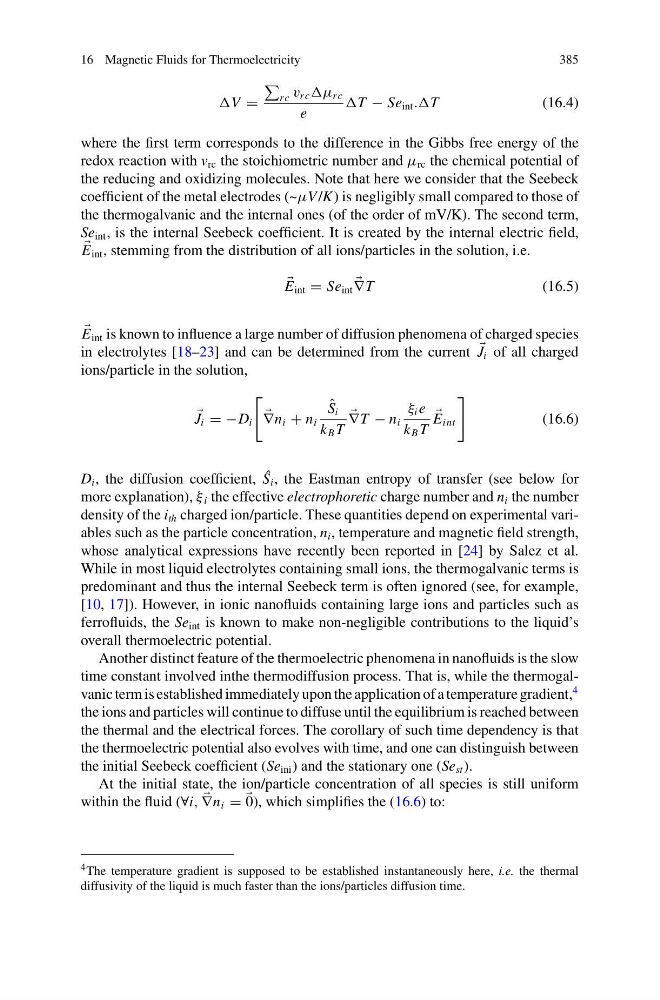
where the first term corresponds to the difference in the Gibbs free energy of the
redox reaction with v rc the stoichiometric number and μ rc the chemical potential of
the reducing and oxidizing molecules. Note that here we consider that the Seebeck
coefficient of the metal electrodes (~μV /K) is negligibly small compared to those of
the thermogalvanic and the internal ones (of the order of mV/K). The second term,
Se int , is the internal Seebeck coefficient. It is created by the internal electric field,
E int , stemming from the distribution of all ions/particles in the solution, i.e.
E int = Se int
∇T
(16.5)
E int is known to influence a large number of diffusion phenomena of charged species
in electrolytes [18–23] and can be determined from the current
J i of all charged
ions/particle in the solution,
J i = −D i
∇n i + n i
ˆ
S i
k B T
∇T − n i
ξ i e
k B T
E int
(16.6)
D i , the diffusion coefficient, ˆ
S i , the Eastman entropy of transfer (see below for
more explanation), ξ i the effective electrophoretic charge number and n i the number
density of the i th charged ion/particle. These quantities depend on experimental variables such as the particle concentration, n i , temperature and magnetic field strength,
whose analytical expressions have recently been reported in [24] by Salez et al.
While in most liquid electrolytes containing small ions, the thermogalvanic terms is
predominant and thus the internal Seebeck term is often ignored (see, for example,
[10, 17]). However, in ionic nanofluids containing large ions and particles such as
ferrofluids, the Se int is known to make non-negligible contributions to the liquid’s
overall thermoelectric potential.
Another distinct feature of the thermoelectric phenomena in nanofluids is the slow
time constant involved inthe thermodiffusion process. That is, while the thermogalvanic term is established immediately upon the application of a temperature gradient,
4
the ions and particles will continue to diffuse until the equilibrium is reached between
the thermal and the electrical forces. The corollary of such time dependency is that
the thermoelectric potential also evolves with time, and one can distinguish between
the initial Seebeck coefficient (Se ini ) and the stationary one (Se st ).
At the initial state, the ion/particle concentration of all species is still uniform
within the fluid (∀i,
∇n i =
0), which simplifies the (16.6) to:
4 The temperature gradient is supposed to be established instantaneously here, i.e. the thermal
diffusivity of the liquid is much faster than the ions/particles diffusion time.
385
V =
rc v rc μ rc
e
T − Se int ..T
(16.4)
where the first term corresponds to the difference in the Gibbs free energy of the
redox reaction with v rc the stoichiometric number and μ rc the chemical potential of
the reducing and oxidizing molecules. Note that here we consider that the Seebeck
coefficient of the metal electrodes (~μV /K) is negligibly small compared to those of
the thermogalvanic and the internal ones (of the order of mV/K). The second term,
Se int , is the internal Seebeck coefficient. It is created by the internal electric field,
E int , stemming from the distribution of all ions/particles in the solution, i.e.
E int = Se int
∇T
(16.5)
E int is known to influence a large number of diffusion phenomena of charged species
in electrolytes [18–23] and can be determined from the current
J i of all charged
ions/particle in the solution,
J i = −D i
∇n i + n i
ˆ
S i
k B T
∇T − n i
ξ i e
k B T
E int
(16.6)
D i , the diffusion coefficient, ˆ
S i , the Eastman entropy of transfer (see below for
more explanation), ξ i the effective electrophoretic charge number and n i the number
density of the i th charged ion/particle. These quantities depend on experimental variables such as the particle concentration, n i , temperature and magnetic field strength,
whose analytical expressions have recently been reported in [24] by Salez et al.
While in most liquid electrolytes containing small ions, the thermogalvanic terms is
predominant and thus the internal Seebeck term is often ignored (see, for example,
[10, 17]). However, in ionic nanofluids containing large ions and particles such as
ferrofluids, the Se int is known to make non-negligible contributions to the liquid’s
overall thermoelectric potential.
Another distinct feature of the thermoelectric phenomena in nanofluids is the slow
time constant involved inthe thermodiffusion process. That is, while the thermogalvanic term is established immediately upon the application of a temperature gradient,
4
the ions and particles will continue to diffuse until the equilibrium is reached between
the thermal and the electrical forces. The corollary of such time dependency is that
the thermoelectric potential also evolves with time, and one can distinguish between
the initial Seebeck coefficient (Se ini ) and the stationary one (Se st ).
At the initial state, the ion/particle concentration of all species is still uniform
within the fluid (∀i,
∇n i =
0), which simplifies the (16.6) to:
4 The temperature gradient is supposed to be established instantaneously here, i.e. the thermal
diffusivity of the liquid is much faster than the ions/particles diffusion time.