

388
S. Nakamae
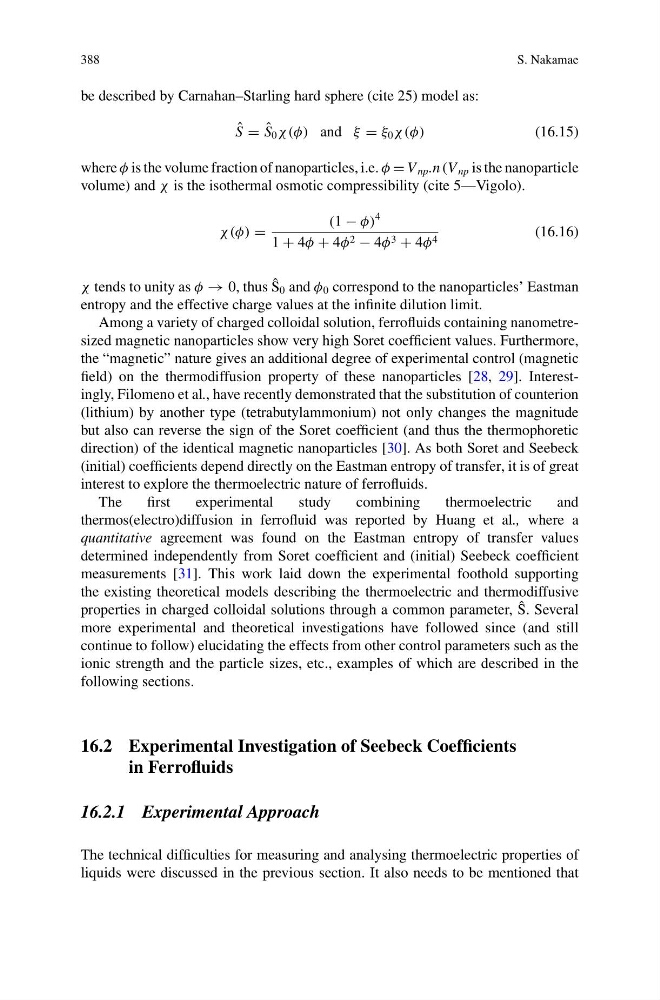
be described by Carnahan–Starling hard sphere (cite 25) model as:
ˆ
S = ˆ
S 0 χ (φ) and ξ = ξ 0 χ (φ)
(16.15)
where φ is the volume fraction of nanoparticles, i.e. φ = V np .n (V np is the nanoparticle
volume) and χ is the isothermal osmotic compressibility (cite 5—Vigolo).
χ (φ) =
(1 − φ)
4
1 + 4φ + 4φ 2 − 4φ 3 + 4φ 4
(16.16)
χ tends to unity as φ → 0, thus ˆ
S 0 and φ 0 correspond to the nanoparticles’ Eastman
entropy and the effective charge values at the infinite dilution limit.
Among a variety of charged colloidal solution, ferrofluids containing nanometresized magnetic nanoparticles show very high Soret coefficient values. Furthermore,
the “magnetic” nature gives an additional degree of experimental control (magnetic
field) on the thermodiffusion property of these nanoparticles [28, 29]. Interestingly, Filomeno et al., have recently demonstrated that the substitution of counterion
(lithium) by another type (tetrabutylammonium) not only changes the magnitude
but also can reverse the sign of the Soret coefficient (and thus the thermophoretic
direction) of the identical magnetic nanoparticles [30]. As both Soret and Seebeck
(initial) coefficients depend directly on the Eastman entropy of transfer, it is of great
interest to explore the thermoelectric nature of ferrofluids.
The
first
experimental
study
combining
thermoelectric
and
thermos(electro)diffusion in ferrofluid was reported by Huang et al., where a
quantitative agreement was found on the Eastman entropy of transfer values
determined independently from Soret coefficient and (initial) Seebeck coefficient
measurements [31]. This work laid down the experimental foothold supporting
the existing theoretical models describing the thermoelectric and thermodiffusive
properties in charged colloidal solutions through a common parameter, ˆ
S. Several
more experimental and theoretical investigations have followed since (and still
continue to follow) elucidating the effects from other control parameters such as the
ionic strength and the particle sizes, etc., examples of which are described in the
following sections.
16.2 Experimental Investigation of Seebeck Coefficients
in Ferrofluids
16.2.1 Experimental Approach
The technical difficulties for measuring and analysing thermoelectric properties of
liquids were discussed in the previous section. It also needs to be mentioned that
S. Nakamae
be described by Carnahan–Starling hard sphere (cite 25) model as:
ˆ
S = ˆ
S 0 χ (φ) and ξ = ξ 0 χ (φ)
(16.15)
where φ is the volume fraction of nanoparticles, i.e. φ = V np .n (V np is the nanoparticle
volume) and χ is the isothermal osmotic compressibility (cite 5—Vigolo).
χ (φ) =
(1 − φ)
4
1 + 4φ + 4φ 2 − 4φ 3 + 4φ 4
(16.16)
χ tends to unity as φ → 0, thus ˆ
S 0 and φ 0 correspond to the nanoparticles’ Eastman
entropy and the effective charge values at the infinite dilution limit.
Among a variety of charged colloidal solution, ferrofluids containing nanometresized magnetic nanoparticles show very high Soret coefficient values. Furthermore,
the “magnetic” nature gives an additional degree of experimental control (magnetic
field) on the thermodiffusion property of these nanoparticles [28, 29]. Interestingly, Filomeno et al., have recently demonstrated that the substitution of counterion
(lithium) by another type (tetrabutylammonium) not only changes the magnitude
but also can reverse the sign of the Soret coefficient (and thus the thermophoretic
direction) of the identical magnetic nanoparticles [30]. As both Soret and Seebeck
(initial) coefficients depend directly on the Eastman entropy of transfer, it is of great
interest to explore the thermoelectric nature of ferrofluids.
The
first
experimental
study
combining
thermoelectric
and
thermos(electro)diffusion in ferrofluid was reported by Huang et al., where a
quantitative agreement was found on the Eastman entropy of transfer values
determined independently from Soret coefficient and (initial) Seebeck coefficient
measurements [31]. This work laid down the experimental foothold supporting
the existing theoretical models describing the thermoelectric and thermodiffusive
properties in charged colloidal solutions through a common parameter, ˆ
S. Several
more experimental and theoretical investigations have followed since (and still
continue to follow) elucidating the effects from other control parameters such as the
ionic strength and the particle sizes, etc., examples of which are described in the
following sections.
16.2 Experimental Investigation of Seebeck Coefficients
in Ferrofluids
16.2.1 Experimental Approach
The technical difficulties for measuring and analysing thermoelectric properties of
liquids were discussed in the previous section. It also needs to be mentioned that