

18
Ò. Iglesias and H. Kachkachi
Then, in Fig. 1.10 we show hysteresis loops at different temperatures for NM
with diameters D = 3a, 6a. First of all, we note that the saturation field and the
high-field susceptibility increase as the NM size is reduced, since these quantities
are mainly associated with the progressive alignment of the surface spins towards
the field direction. Thus, the loops of the smallest NM resemble those found in
ferrimagnetic NM [50–52] and other bulk systems with disorder [53, 54], increasing
their squaredness (associated with the reversal of M as a whole) with the size. In
fact, by plotting separately the contributions of the core and the surface to the total
magnetization (see Fig. 1.10, dashed lines), we see that the loop of the core is almost
perfectly squared independently of temperature and NM size, indicating a reversal of
its magnetization with a well-defined ferrimagnetic moment. Instead, the loop of the
surface reveals a progressive reversal of M, which is a typical feature associated to
disordered or frustrated systems [53]. Nonetheless, for a wide range of temperatures
and NM sizes, it is the reversal of the surface spins that triggers the reversal of the
core. This is indicated by the fact that the coercive field of the core is slightly higher
but very similar that of the surface. At zero temperature it was shown in [37] that the
surface switches before the core in spherical NM with moderate surface anisotropy.
1.3.1.2 Magnetization Thermal Behaviour
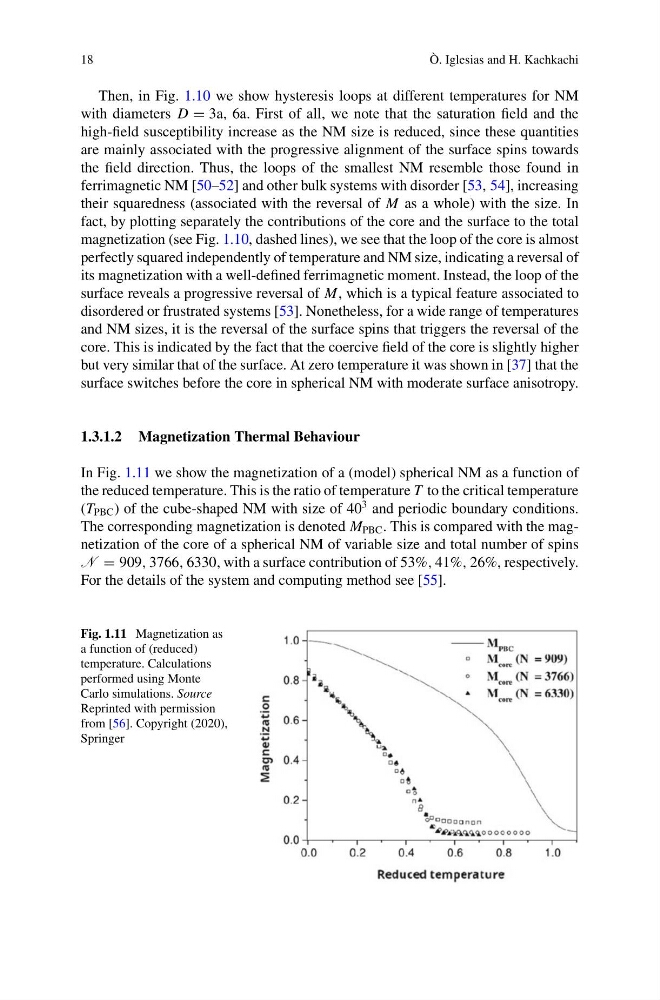
In Fig. 1.11 we show the magnetization of a (model) spherical NM as a function of
the reduced temperature. This is the ratio of temperature T to the critical temperature
(T PBC ) of the cube-shaped NM with size of 40
3 and periodic boundary conditions.
The corresponding magnetization is denoted M PBC . This is compared with the magnetization of the core of a spherical NM of variable size and total number of spins
N = 909, 3766, 6330, with a surface contribution of 53%, 41%, 26%, respectively.
For the details of the system and computing method see [55].
Fig. 1.11 Magnetization as
a function of (reduced)
temperature. Calculations
performed using Monte
Carlo simulations. Source
Reprinted with permission
from [56]. Copyright (2020),
Springer
Ò. Iglesias and H. Kachkachi
Then, in Fig. 1.10 we show hysteresis loops at different temperatures for NM
with diameters D = 3a, 6a. First of all, we note that the saturation field and the
high-field susceptibility increase as the NM size is reduced, since these quantities
are mainly associated with the progressive alignment of the surface spins towards
the field direction. Thus, the loops of the smallest NM resemble those found in
ferrimagnetic NM [50–52] and other bulk systems with disorder [53, 54], increasing
their squaredness (associated with the reversal of M as a whole) with the size. In
fact, by plotting separately the contributions of the core and the surface to the total
magnetization (see Fig. 1.10, dashed lines), we see that the loop of the core is almost
perfectly squared independently of temperature and NM size, indicating a reversal of
its magnetization with a well-defined ferrimagnetic moment. Instead, the loop of the
surface reveals a progressive reversal of M, which is a typical feature associated to
disordered or frustrated systems [53]. Nonetheless, for a wide range of temperatures
and NM sizes, it is the reversal of the surface spins that triggers the reversal of the
core. This is indicated by the fact that the coercive field of the core is slightly higher
but very similar that of the surface. At zero temperature it was shown in [37] that the
surface switches before the core in spherical NM with moderate surface anisotropy.
1.3.1.2 Magnetization Thermal Behaviour
In Fig. 1.11 we show the magnetization of a (model) spherical NM as a function of
the reduced temperature. This is the ratio of temperature T to the critical temperature
(T PBC ) of the cube-shaped NM with size of 40
3 and periodic boundary conditions.
The corresponding magnetization is denoted M PBC . This is compared with the magnetization of the core of a spherical NM of variable size and total number of spins
N = 909, 3766, 6330, with a surface contribution of 53%, 41%, 26%, respectively.
For the details of the system and computing method see [55].
Fig. 1.11 Magnetization as
a function of (reduced)
temperature. Calculations
performed using Monte
Carlo simulations. Source
Reprinted with permission
from [56]. Copyright (2020),
Springer