

1 Single Nanomagnet Behaviour: Surface and Finite-Size Effects
19
0
50
100
150
200
T (K)
0.0
1.0
2.0
M
0.0
0.1
0.2
0.3
1/D
80
90
100
110
120
130
T
C
(K)
0.0
0.1
0.2
0.3
1/D
0.2
0.3
M/3M
Unc
0
40
80
120
T(K)
0
0.1
0.2
0.3
M/3M
Unc
0
40
80
120
T (K)
0
0.1
0.2
0.3
0
0.1
0.2
0.3
(a)
(c)
(b)
(d)
C
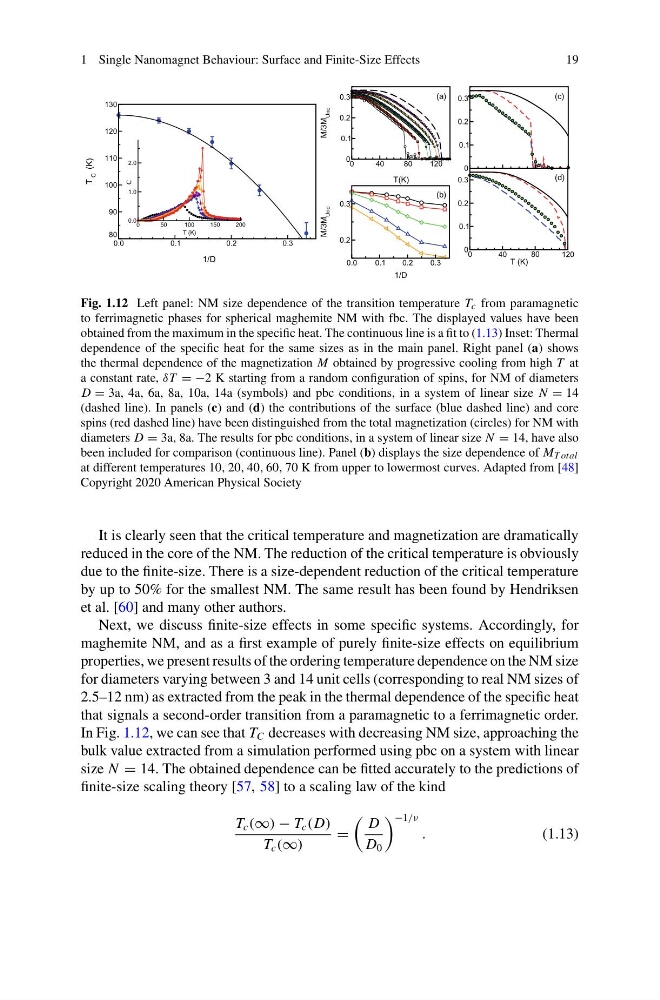
Fig. 1.12 Left panel: NM size dependence of the transition temperature T c from paramagnetic
to ferrimagnetic phases for spherical maghemite NM with fbc. The displayed values have been
obtained from the maximum in the specific heat. The continuous line is a fit to (1.13) Inset: Thermal
dependence of the specific heat for the same sizes as in the main panel. Right panel (a) shows
the thermal dependence of the magnetization M obtained by progressive cooling from high T at
a constant rate, δT = −2 K starting from a random configuration of spins, for NM of diameters
D = 3a, 4a, 6a, 8a, 10a, 14a (symbols) and pbc conditions, in a system of linear size N = 14
(dashed line). In panels (c) and (d) the contributions of the surface (blue dashed line) and core
spins (red dashed line) have been distinguished from the total magnetization (circles) for NM with
diameters D = 3a, 8a. The results for pbc conditions, in a system of linear size N = 14, have also
been included for comparison (continuous line). Panel (b) displays the size dependence of M T otal
at different temperatures 10, 20, 40, 60, 70 K from upper to lowermost curves. Adapted from [48]
Copyright 2020 American Physical Society
It is clearly seen that the critical temperature and magnetization are dramatically
reduced in the core of the NM. The reduction of the critical temperature is obviously
due to the finite-size. There is a size-dependent reduction of the critical temperature
by up to 50% for the smallest NM. The same result has been found by Hendriksen
et al. [60] and many other authors.
Next, we discuss finite-size effects in some specific systems. Accordingly, for
maghemite NM, and as a first example of purely finite-size effects on equilibrium
properties, we present results of the ordering temperature dependence on the NM size
for diameters varying between 3 and 14 unit cells (corresponding to real NM sizes of
2.5–12 nm) as extracted from the peak in the thermal dependence of the specific heat
that signals a second-order transition from a paramagnetic to a ferrimagnetic order.
In Fig. 1.12, we can see that T C decreases with decreasing NM size, approaching the
bulk value extracted from a simulation performed using pbc on a system with linear
size N = 14. The obtained dependence can be fitted accurately to the predictions of
finite-size scaling theory [57, 58] to a scaling law of the kind
T c (∞) − T c (D)
T c (∞)
=
D
D 0
−1/ν
.
(1.13)
19
0
50
100
150
200
T (K)
0.0
1.0
2.0
M
0.0
0.1
0.2
0.3
1/D
80
90
100
110
120
130
T
C
(K)
0.0
0.1
0.2
0.3
1/D
0.2
0.3
M/3M
Unc
0
40
80
120
T(K)
0
0.1
0.2
0.3
M/3M
Unc
0
40
80
120
T (K)
0
0.1
0.2
0.3
0
0.1
0.2
0.3
(a)
(c)
(b)
(d)
C
Fig. 1.12 Left panel: NM size dependence of the transition temperature T c from paramagnetic
to ferrimagnetic phases for spherical maghemite NM with fbc. The displayed values have been
obtained from the maximum in the specific heat. The continuous line is a fit to (1.13) Inset: Thermal
dependence of the specific heat for the same sizes as in the main panel. Right panel (a) shows
the thermal dependence of the magnetization M obtained by progressive cooling from high T at
a constant rate, δT = −2 K starting from a random configuration of spins, for NM of diameters
D = 3a, 4a, 6a, 8a, 10a, 14a (symbols) and pbc conditions, in a system of linear size N = 14
(dashed line). In panels (c) and (d) the contributions of the surface (blue dashed line) and core
spins (red dashed line) have been distinguished from the total magnetization (circles) for NM with
diameters D = 3a, 8a. The results for pbc conditions, in a system of linear size N = 14, have also
been included for comparison (continuous line). Panel (b) displays the size dependence of M T otal
at different temperatures 10, 20, 40, 60, 70 K from upper to lowermost curves. Adapted from [48]
Copyright 2020 American Physical Society
It is clearly seen that the critical temperature and magnetization are dramatically
reduced in the core of the NM. The reduction of the critical temperature is obviously
due to the finite-size. There is a size-dependent reduction of the critical temperature
by up to 50% for the smallest NM. The same result has been found by Hendriksen
et al. [60] and many other authors.
Next, we discuss finite-size effects in some specific systems. Accordingly, for
maghemite NM, and as a first example of purely finite-size effects on equilibrium
properties, we present results of the ordering temperature dependence on the NM size
for diameters varying between 3 and 14 unit cells (corresponding to real NM sizes of
2.5–12 nm) as extracted from the peak in the thermal dependence of the specific heat
that signals a second-order transition from a paramagnetic to a ferrimagnetic order.
In Fig. 1.12, we can see that T C decreases with decreasing NM size, approaching the
bulk value extracted from a simulation performed using pbc on a system with linear
size N = 14. The obtained dependence can be fitted accurately to the predictions of
finite-size scaling theory [57, 58] to a scaling law of the kind
T c (∞) − T c (D)
T c (∞)
=
D
D 0
−1/ν
.
(1.13)