

1 Single Nanomagnet Behaviour: Surface and Finite-Size Effects
17
-100 -50
0
50 100
h (K)
-0.6
-0.3
0.0
0.3
0.6
M
(b)
(c)
-0.6
-0.3
0.0
0.3
0.6
M
(a)
-100 -50
0
50 100
h (K)
(d)
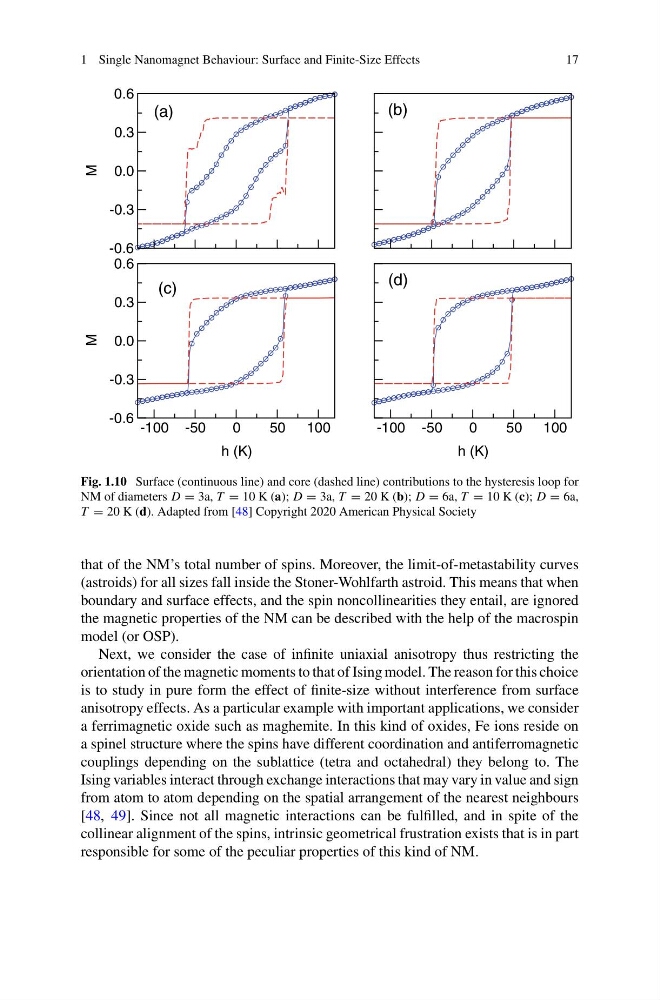
Fig. 1.10 Surface (continuous line) and core (dashed line) contributions to the hysteresis loop for
NM of diameters D = 3a, T = 10 K (a); D = 3a, T = 20 K (b); D = 6a, T = 10 K (c); D = 6a,
T = 20 K (d). Adapted from [48] Copyright 2020 American Physical Society
that of the NM’s total number of spins. Moreover, the limit-of-metastability curves
(astroids) for all sizes fall inside the Stoner-Wohlfarth astroid. This means that when
boundary and surface effects, and the spin noncollinearities they entail, are ignored
the magnetic properties of the NM can be described with the help of the macrospin
model (or OSP).
Next, we consider the case of infinite uniaxial anisotropy thus restricting the
orientation of the magnetic moments to that of Ising model. The reason for this choice
is to study in pure form the effect of finite-size without interference from surface
anisotropy effects. As a particular example with important applications, we consider
a ferrimagnetic oxide such as maghemite. In this kind of oxides, Fe ions reside on
a spinel structure where the spins have different coordination and antiferromagnetic
couplings depending on the sublattice (tetra and octahedral) they belong to. The
Ising variables interact through exchange interactions that may vary in value and sign
from atom to atom depending on the spatial arrangement of the nearest neighbours
[48, 49]. Since not all magnetic interactions can be fulfilled, and in spite of the
collinear alignment of the spins, intrinsic geometrical frustration exists that is in part
responsible for some of the peculiar properties of this kind of NM.
17
-100 -50
0
50 100
h (K)
-0.6
-0.3
0.0
0.3
0.6
M
(b)
(c)
-0.6
-0.3
0.0
0.3
0.6
M
(a)
-100 -50
0
50 100
h (K)
(d)
Fig. 1.10 Surface (continuous line) and core (dashed line) contributions to the hysteresis loop for
NM of diameters D = 3a, T = 10 K (a); D = 3a, T = 20 K (b); D = 6a, T = 10 K (c); D = 6a,
T = 20 K (d). Adapted from [48] Copyright 2020 American Physical Society
that of the NM’s total number of spins. Moreover, the limit-of-metastability curves
(astroids) for all sizes fall inside the Stoner-Wohlfarth astroid. This means that when
boundary and surface effects, and the spin noncollinearities they entail, are ignored
the magnetic properties of the NM can be described with the help of the macrospin
model (or OSP).
Next, we consider the case of infinite uniaxial anisotropy thus restricting the
orientation of the magnetic moments to that of Ising model. The reason for this choice
is to study in pure form the effect of finite-size without interference from surface
anisotropy effects. As a particular example with important applications, we consider
a ferrimagnetic oxide such as maghemite. In this kind of oxides, Fe ions reside on
a spinel structure where the spins have different coordination and antiferromagnetic
couplings depending on the sublattice (tetra and octahedral) they belong to. The
Ising variables interact through exchange interactions that may vary in value and sign
from atom to atom depending on the spatial arrangement of the nearest neighbours
[48, 49]. Since not all magnetic interactions can be fulfilled, and in spite of the
collinear alignment of the spins, intrinsic geometrical frustration exists that is in part
responsible for some of the peculiar properties of this kind of NM.