

334
M. Avolio et al.
μ 0 μH 0 /k B T 1, where K is the anisotropy constant, V and μ are the mean
volume and magnetic moment of the MNPs, respectively. When these conditions are
met, the dissipated power is given by
SAR =
πνμ 0 H
2
0
ρ
· χ
=
πνμ
2
0 H
2
0 M
2
S V
3ρk B T
·
2πντ eff
1 + (2πντ eff )
2
(14.7)
where ρ is the density of the material, and τ eff is the effective relaxation time of
the magnetization, which, for an MNP system suspended in a fluid matrix, is
1
τ eff
=
1
τ N
+
1
τ B
(14.8)
where τ N = τ 0 e
K V
k B T , is Néel (or “internal”) relaxation time, and τ B =
3ηV H
k B T
, is the
Brown relaxation, where V H is the hydrodynamic volume and η the viscosity.
Equation (14.7) allows one to foresee the conditions for SAR maximization, occurring when 2πντ eff = ωτ eff = 1, namely when the relaxation time is equal to the
characteristic time of the measurement (in this case the inverse of the applied field
angular frequency, 2π ν). With the aid of (14.7), the role of the parameters which
mostly influence the heat power dissipation (saturation magnetization, magnetic
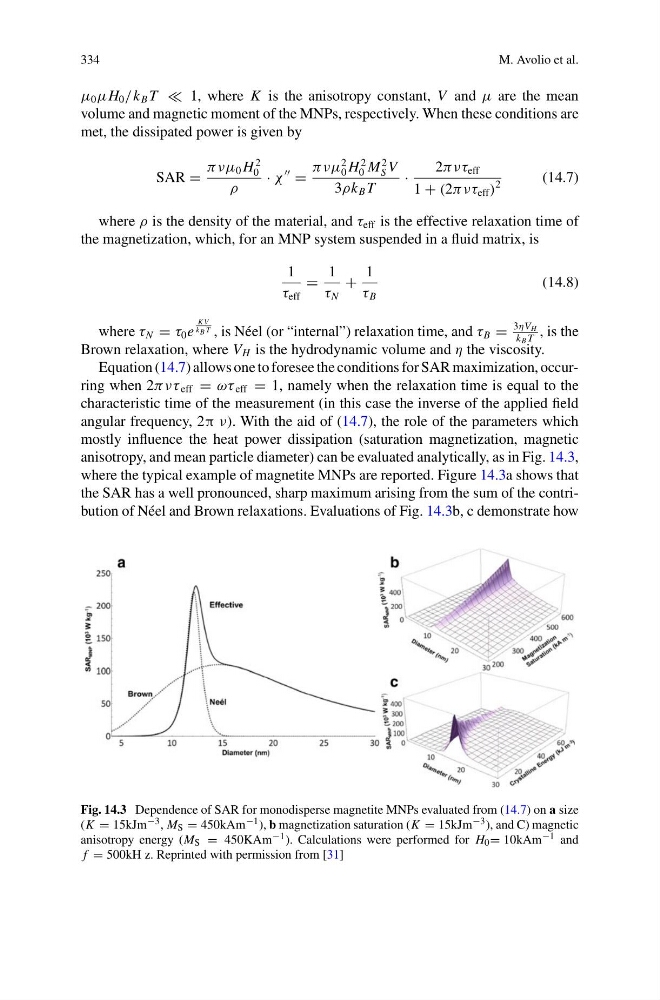
anisotropy, and mean particle diameter) can be evaluated analytically, as in Fig. 14.3,
where the typical example of magnetite MNPs are reported. Figure 14.3a shows that
the SAR has a well pronounced, sharp maximum arising from the sum of the contribution of Néel and Brown relaxations. Evaluations of Fig. 14.3b, c demonstrate how
Fig. 14.3 Dependence of SAR for monodisperse magnetite MNPs evaluated from (14.7) on a size
(K = 15kJm −3 , M S = 450kAm −1 ), b magnetization saturation (K = 15kJm −3 ), and C) magnetic
anisotropy energy (M S = 450KAm −1 ). Calculations were performed for H 0 = 10kAm −1 and
f = 500kH z. Reprinted with permission from [31]
M. Avolio et al.
μ 0 μH 0 /k B T 1, where K is the anisotropy constant, V and μ are the mean
volume and magnetic moment of the MNPs, respectively. When these conditions are
met, the dissipated power is given by
SAR =
πνμ 0 H
2
0
ρ
· χ
=
πνμ
2
0 H
2
0 M
2
S V
3ρk B T
·
2πντ eff
1 + (2πντ eff )
2
(14.7)
where ρ is the density of the material, and τ eff is the effective relaxation time of
the magnetization, which, for an MNP system suspended in a fluid matrix, is
1
τ eff
=
1
τ N
+
1
τ B
(14.8)
where τ N = τ 0 e
K V
k B T , is Néel (or “internal”) relaxation time, and τ B =
3ηV H
k B T
, is the
Brown relaxation, where V H is the hydrodynamic volume and η the viscosity.
Equation (14.7) allows one to foresee the conditions for SAR maximization, occurring when 2πντ eff = ωτ eff = 1, namely when the relaxation time is equal to the
characteristic time of the measurement (in this case the inverse of the applied field
angular frequency, 2π ν). With the aid of (14.7), the role of the parameters which
mostly influence the heat power dissipation (saturation magnetization, magnetic
anisotropy, and mean particle diameter) can be evaluated analytically, as in Fig. 14.3,
where the typical example of magnetite MNPs are reported. Figure 14.3a shows that
the SAR has a well pronounced, sharp maximum arising from the sum of the contribution of Néel and Brown relaxations. Evaluations of Fig. 14.3b, c demonstrate how
Fig. 14.3 Dependence of SAR for monodisperse magnetite MNPs evaluated from (14.7) on a size
(K = 15kJm −3 , M S = 450kAm −1 ), b magnetization saturation (K = 15kJm −3 ), and C) magnetic
anisotropy energy (M S = 450KAm −1 ). Calculations were performed for H 0 = 10kAm −1 and
f = 500kH z. Reprinted with permission from [31]