

14 Medical Applications of Magnetic Nanoparticles
333
the real space through an inverse FT operation (Fig. 14.2). For the sake of clarity, it
is necessary to note that this formalism can be applied only if the k-space is sampled
continuously. This is not the common case, since the k-space is generally sampled
discretely at k intervals. It is therefore necessary to modify the previous expressions
to consider a Discrete Fast Fourier Transform (DFFT) operation, which produces a
matrix of voxels in the 3D space.
14.3.2 Magnetic Fluid Hyperthermia
The capability of superparamagnetic materials to absorb energy from an external
alternating magnetic field (AMF) is due to the hysteretic behavior induced by the lag
of the magnetization to follow the external field. Unlike bulk ferro/ferromagnetic
materials, for which the magnetic hysteresis depends on the instantaneous reorientation of the magnetic domains, single domain MNPs present magnetic irreversibility only if the field variation is faster than the characteristic time of the
magnetization reversal. In both cases, however, the energy stored for each field cycle
can be quantified by the hysteresis area. In a very general way, thus, the heating
efficiency, or SAR, i.e., the energy adsorbed and converted in full into heat per unit
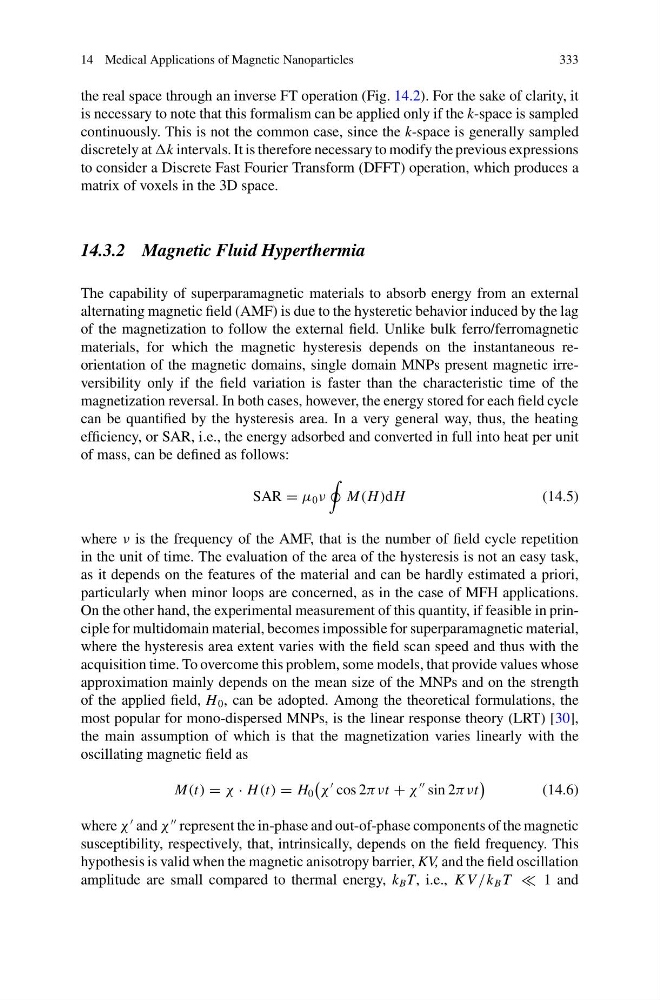
of mass, can be defined as follows:
SAR = μ 0 ν
M(H )dH
(14.5)
where ν is the frequency of the AMF, that is the number of field cycle repetition
in the unit of time. The evaluation of the area of the hysteresis is not an easy task,
as it depends on the features of the material and can be hardly estimated a priori,
particularly when minor loops are concerned, as in the case of MFH applications.
On the other hand, the experimental measurement of this quantity, if feasible in principle for multidomain material, becomes impossible for superparamagnetic material,
where the hysteresis area extent varies with the field scan speed and thus with the
acquisition time. To overcome this problem, some models, that provide values whose
approximation mainly depends on the mean size of the MNPs and on the strength
of the applied field, H 0 , can be adopted. Among the theoretical formulations, the
most popular for mono-dispersed MNPs, is the linear response theory (LRT) [30],
the main assumption of which is that the magnetization varies linearly with the
oscillating magnetic field as
M(t) = χ · H (t) = H 0
χ
cos 2πνt + χ
sin 2πνt
(14.6)
where χ
and χ
represent the in-phase and out-of-phase components of the magnetic
susceptibility, respectively, that, intrinsically, depends on the field frequency. This
hypothesis is valid when the magnetic anisotropy barrier, KV, and the field oscillation
amplitude are small compared to thermal energy, k B T, i.e., K V /k B T 1 and
333
the real space through an inverse FT operation (Fig. 14.2). For the sake of clarity, it
is necessary to note that this formalism can be applied only if the k-space is sampled
continuously. This is not the common case, since the k-space is generally sampled
discretely at k intervals. It is therefore necessary to modify the previous expressions
to consider a Discrete Fast Fourier Transform (DFFT) operation, which produces a
matrix of voxels in the 3D space.
14.3.2 Magnetic Fluid Hyperthermia
The capability of superparamagnetic materials to absorb energy from an external
alternating magnetic field (AMF) is due to the hysteretic behavior induced by the lag
of the magnetization to follow the external field. Unlike bulk ferro/ferromagnetic
materials, for which the magnetic hysteresis depends on the instantaneous reorientation of the magnetic domains, single domain MNPs present magnetic irreversibility only if the field variation is faster than the characteristic time of the
magnetization reversal. In both cases, however, the energy stored for each field cycle
can be quantified by the hysteresis area. In a very general way, thus, the heating
efficiency, or SAR, i.e., the energy adsorbed and converted in full into heat per unit
of mass, can be defined as follows:
SAR = μ 0 ν
M(H )dH
(14.5)
where ν is the frequency of the AMF, that is the number of field cycle repetition
in the unit of time. The evaluation of the area of the hysteresis is not an easy task,
as it depends on the features of the material and can be hardly estimated a priori,
particularly when minor loops are concerned, as in the case of MFH applications.
On the other hand, the experimental measurement of this quantity, if feasible in principle for multidomain material, becomes impossible for superparamagnetic material,
where the hysteresis area extent varies with the field scan speed and thus with the
acquisition time. To overcome this problem, some models, that provide values whose
approximation mainly depends on the mean size of the MNPs and on the strength
of the applied field, H 0 , can be adopted. Among the theoretical formulations, the
most popular for mono-dispersed MNPs, is the linear response theory (LRT) [30],
the main assumption of which is that the magnetization varies linearly with the
oscillating magnetic field as
M(t) = χ · H (t) = H 0
χ
cos 2πνt + χ
sin 2πνt
(14.6)
where χ
and χ
represent the in-phase and out-of-phase components of the magnetic
susceptibility, respectively, that, intrinsically, depends on the field frequency. This
hypothesis is valid when the magnetic anisotropy barrier, KV, and the field oscillation
amplitude are small compared to thermal energy, k B T, i.e., K V /k B T 1 and