

12
Ò. Iglesias and H. Kachkachi
1.2.2.2 Weak Surface Effects
The study of the dynamics of NMs in the many-spin approach, along what was
discussed in Sect. 1.2.1, presents tremendous difficulties related with the analysis
of the energyscape (minima, maxima and saddle points), which is a crucial step in
the calculation of relaxation rates and investigation of the magnetization reversal at
finite temperatures. One may then address the question as to whether it is possible
to establish some conditions under which one may adopt a (simpler) macroscopic
approach and avail oneself from the corresponding full-fledged theory of magnetization dynamics. An answer to this question was provided in [23, 24] in the case of
not-too-strong surface effects, i.e. when the surface anisotropy is not strong enough
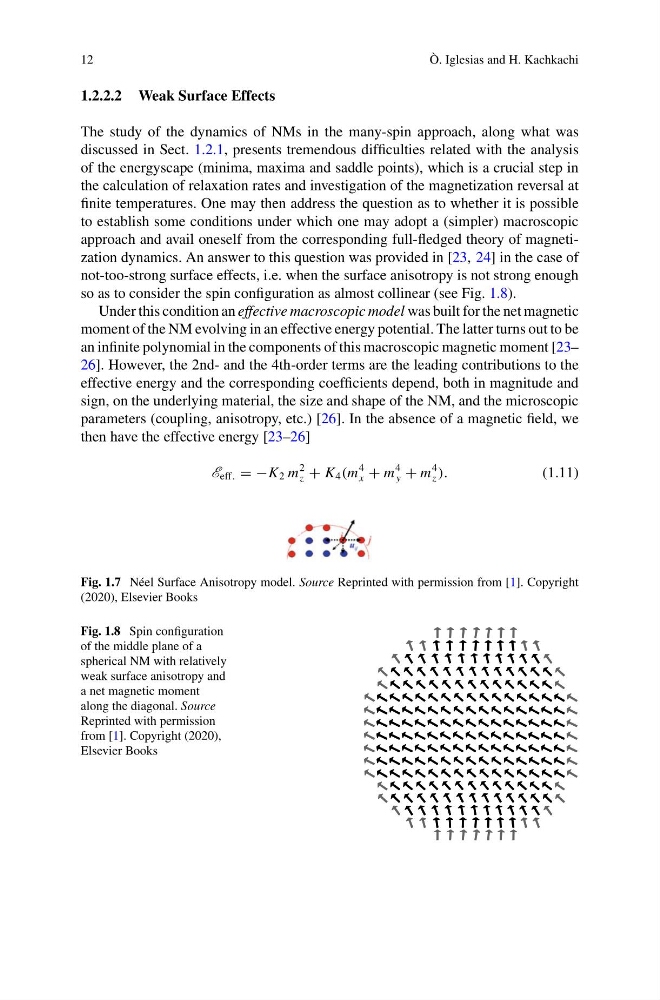
so as to consider the spin configuration as almost collinear (see Fig. 1.8).
Under this condition an effective macroscopic model was built for the net magnetic
moment of the NM evolving in an effective energy potential. The latter turns out to be
an infinite polynomial in the components of this macroscopic magnetic moment [23–
26]. However, the 2nd- and the 4th-order terms are the leading contributions to the
effective energy and the corresponding coefficients depend, both in magnitude and
sign, on the underlying material, the size and shape of the NM, and the microscopic
parameters (coupling, anisotropy, etc.) [26]. In the absence of a magnetic field, we
then have the effective energy [23–26]
E eff. = −K 2 m
2
z + K 4 (m
4
x + m
4
y + m
4
z ).
(1.11)
Fig. 1.7 Néel Surface Anisotropy model. Source Reprinted with permission from [1]. Copyright
(2020), Elsevier Books
Fig. 1.8 Spin configuration
of the middle plane of a
spherical NM with relatively
weak surface anisotropy and
a net magnetic moment
along the diagonal. Source
Reprinted with permission
from [1]. Copyright (2020),
Elsevier Books
Ò. Iglesias and H. Kachkachi
1.2.2.2 Weak Surface Effects
The study of the dynamics of NMs in the many-spin approach, along what was
discussed in Sect. 1.2.1, presents tremendous difficulties related with the analysis
of the energyscape (minima, maxima and saddle points), which is a crucial step in
the calculation of relaxation rates and investigation of the magnetization reversal at
finite temperatures. One may then address the question as to whether it is possible
to establish some conditions under which one may adopt a (simpler) macroscopic
approach and avail oneself from the corresponding full-fledged theory of magnetization dynamics. An answer to this question was provided in [23, 24] in the case of
not-too-strong surface effects, i.e. when the surface anisotropy is not strong enough
so as to consider the spin configuration as almost collinear (see Fig. 1.8).
Under this condition an effective macroscopic model was built for the net magnetic
moment of the NM evolving in an effective energy potential. The latter turns out to be
an infinite polynomial in the components of this macroscopic magnetic moment [23–
26]. However, the 2nd- and the 4th-order terms are the leading contributions to the
effective energy and the corresponding coefficients depend, both in magnitude and
sign, on the underlying material, the size and shape of the NM, and the microscopic
parameters (coupling, anisotropy, etc.) [26]. In the absence of a magnetic field, we
then have the effective energy [23–26]
E eff. = −K 2 m
2
z + K 4 (m
4
x + m
4
y + m
4
z ).
(1.11)
Fig. 1.7 Néel Surface Anisotropy model. Source Reprinted with permission from [1]. Copyright
(2020), Elsevier Books
Fig. 1.8 Spin configuration
of the middle plane of a
spherical NM with relatively
weak surface anisotropy and
a net magnetic moment
along the diagonal. Source
Reprinted with permission
from [1]. Copyright (2020),
Elsevier Books