

1 Single Nanomagnet Behaviour: Surface and Finite-Size Effects
11
a different coupling for core-core (J cc ), core-surface (J cs ) and surface-surface (J ss )
links.
2
Next,
H Z = −(gμ B )H ·
N
i=1
s i
(1.8)
is the Zeeman energy of interaction of the external magnetic field H with all atomic
magnetic moments m i . Finally, H an in (1.7) is the (uniaxial) single-site anisotropy
energy
H an = −
i
K i (s i · e i )
2
,
(1.9)
with easy axis e i and constant K i > 0. If the site i is located in the core, the anisotropy
axis e i is taken along some reference z axis and K i = K c . In fact, K c is the effective
anisotropy constant and e i is the easy axis of the effective anisotropy that is usually
assumed to include the NM’s shape anisotropy. For NMs grown out of a magnetic
material with cubic anisotropy, the term H an may also comprise a cubic contribution.
Altogether, in the absence of experimental data, the anisotropy constant K c and
easy direction are often assumed to be the same as those of the underlying bulk
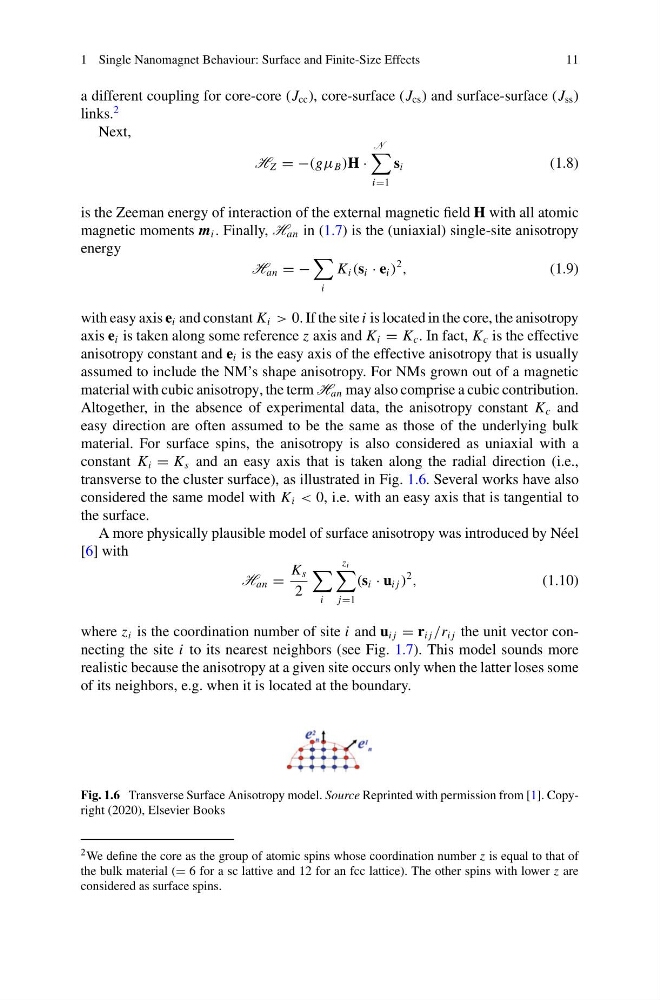
material. For surface spins, the anisotropy is also considered as uniaxial with a
constant K i = K s and an easy axis that is taken along the radial direction (i.e.,
transverse to the cluster surface), as illustrated in Fig. 1.6. Several works have also
considered the same model with K i < 0, i.e. with an easy axis that is tangential to
the surface.
A more physically plausible model of surface anisotropy was introduced by Néel
[6] with
H an =
K s
2
i
z i
j=1
(s i · u i j )
2
,
(1.10)
where z i is the coordination number of site i and u i j = r i j /r i j the unit vector connecting the site i to its nearest neighbors (see Fig. 1.7). This model sounds more
realistic because the anisotropy at a given site occurs only when the latter loses some
of its neighbors, e.g. when it is located at the boundary.
Fig. 1.6 Transverse Surface Anisotropy model. Source Reprinted with permission from [1]. Copyright (2020), Elsevier Books
2 We define the core as the group of atomic spins whose coordination number z is equal to that of
the bulk material (= 6 for a sc lattive and 12 for an fcc lattice). The other spins with lower z are
considered as surface spins.
11
a different coupling for core-core (J cc ), core-surface (J cs ) and surface-surface (J ss )
links.
2
Next,
H Z = −(gμ B )H ·
N
i=1
s i
(1.8)
is the Zeeman energy of interaction of the external magnetic field H with all atomic
magnetic moments m i . Finally, H an in (1.7) is the (uniaxial) single-site anisotropy
energy
H an = −
i
K i (s i · e i )
2
,
(1.9)
with easy axis e i and constant K i > 0. If the site i is located in the core, the anisotropy
axis e i is taken along some reference z axis and K i = K c . In fact, K c is the effective
anisotropy constant and e i is the easy axis of the effective anisotropy that is usually
assumed to include the NM’s shape anisotropy. For NMs grown out of a magnetic
material with cubic anisotropy, the term H an may also comprise a cubic contribution.
Altogether, in the absence of experimental data, the anisotropy constant K c and
easy direction are often assumed to be the same as those of the underlying bulk
material. For surface spins, the anisotropy is also considered as uniaxial with a
constant K i = K s and an easy axis that is taken along the radial direction (i.e.,
transverse to the cluster surface), as illustrated in Fig. 1.6. Several works have also
considered the same model with K i < 0, i.e. with an easy axis that is tangential to
the surface.
A more physically plausible model of surface anisotropy was introduced by Néel
[6] with
H an =
K s
2
i
z i
j=1
(s i · u i j )
2
,
(1.10)
where z i is the coordination number of site i and u i j = r i j /r i j the unit vector connecting the site i to its nearest neighbors (see Fig. 1.7). This model sounds more
realistic because the anisotropy at a given site occurs only when the latter loses some
of its neighbors, e.g. when it is located at the boundary.
Fig. 1.6 Transverse Surface Anisotropy model. Source Reprinted with permission from [1]. Copyright (2020), Elsevier Books
2 We define the core as the group of atomic spins whose coordination number z is equal to that of
the bulk material (= 6 for a sc lattive and 12 for an fcc lattice). The other spins with lower z are
considered as surface spins.