

10
Ò. Iglesias and H. Kachkachi
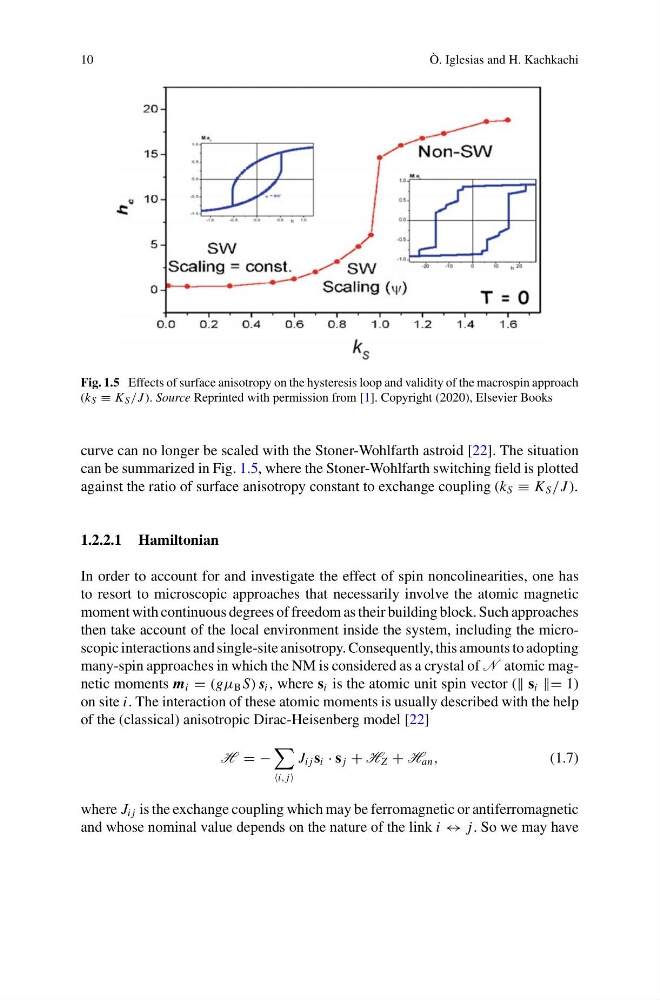
Fig. 1.5 Effects of surface anisotropy on the hysteresis loop and validity of the macrospin approach
(k S ≡ K S /J ). Source Reprinted with permission from [1]. Copyright (2020), Elsevier Books
curve can no longer be scaled with the Stoner-Wohlfarth astroid [22]. The situation
can be summarized in Fig. 1.5, where the Stoner-Wohlfarth switching field is plotted
against the ratio of surface anisotropy constant to exchange coupling (k S ≡ K S /J ).
1.2.2.1 Hamiltonian
In order to account for and investigate the effect of spin noncolinearities, one has
to resort to microscopic approaches that necessarily involve the atomic magnetic
moment with continuous degrees of freedom as their building block. Such approaches
then take account of the local environment inside the system, including the microscopic interactions and single-site anisotropy. Consequently, this amounts to adopting
many-spin approaches in which the NM is considered as a crystal of N atomic magnetic moments m i = (gμ B S) s i , where s i is the atomic unit spin vector ( s i = 1)
on site i. The interaction of these atomic moments is usually described with the help
of the (classical) anisotropic Dirac-Heisenberg model [22]
H = −
i, j
J i j s i · s j + H Z + H an ,
(1.7)
where J i j is the exchange coupling which may be ferromagnetic or antiferromagnetic
and whose nominal value depends on the nature of the link i ↔ j. So we may have
Ò. Iglesias and H. Kachkachi
Fig. 1.5 Effects of surface anisotropy on the hysteresis loop and validity of the macrospin approach
(k S ≡ K S /J ). Source Reprinted with permission from [1]. Copyright (2020), Elsevier Books
curve can no longer be scaled with the Stoner-Wohlfarth astroid [22]. The situation
can be summarized in Fig. 1.5, where the Stoner-Wohlfarth switching field is plotted
against the ratio of surface anisotropy constant to exchange coupling (k S ≡ K S /J ).
1.2.2.1 Hamiltonian
In order to account for and investigate the effect of spin noncolinearities, one has
to resort to microscopic approaches that necessarily involve the atomic magnetic
moment with continuous degrees of freedom as their building block. Such approaches
then take account of the local environment inside the system, including the microscopic interactions and single-site anisotropy. Consequently, this amounts to adopting
many-spin approaches in which the NM is considered as a crystal of N atomic magnetic moments m i = (gμ B S) s i , where s i is the atomic unit spin vector ( s i = 1)
on site i. The interaction of these atomic moments is usually described with the help
of the (classical) anisotropic Dirac-Heisenberg model [22]
H = −
i, j
J i j s i · s j + H Z + H an ,
(1.7)
where J i j is the exchange coupling which may be ferromagnetic or antiferromagnetic
and whose nominal value depends on the nature of the link i ↔ j. So we may have