

1 Single Nanomagnet Behaviour: Surface and Finite-Size Effects
13
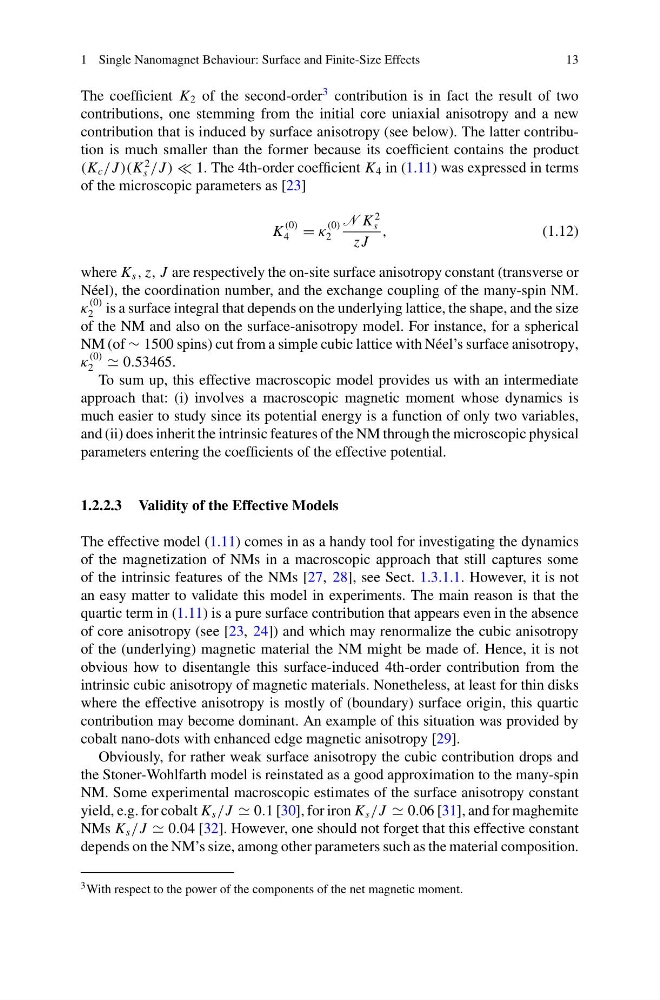
The coefficient K 2 of the second-order
3 contribution is in fact the result of two
contributions, one stemming from the initial core uniaxial anisotropy and a new
contribution that is induced by surface anisotropy (see below). The latter contribution is much smaller than the former because its coefficient contains the product
(K c /J )(K
2
s /J ) 1. The 4th-order coefficient K 4 in (1.11) was expressed in terms
of the microscopic parameters as [23]
K
(0)
4 = κ
(0)
2
N K
2
s
z J
,
(1.12)
where K s , z, J are respectively the on-site surface anisotropy constant (transverse or
Néel), the coordination number, and the exchange coupling of the many-spin NM.
κ
(0)
2 is a surface integral that depends on the underlying lattice, the shape, and the size
of the NM and also on the surface-anisotropy model. For instance, for a spherical
NM (of ∼ 1500 spins) cut from a simple cubic lattice with Néel’s surface anisotropy,
κ
(0)
2 0.53465.
To sum up, this effective macroscopic model provides us with an intermediate
approach that: (i) involves a macroscopic magnetic moment whose dynamics is
much easier to study since its potential energy is a function of only two variables,
and (ii) does inherit the intrinsic features of the NM through the microscopic physical
parameters entering the coefficients of the effective potential.
1.2.2.3 Validity of the Effective Models
The effective model (1.11) comes in as a handy tool for investigating the dynamics
of the magnetization of NMs in a macroscopic approach that still captures some
of the intrinsic features of the NMs [27, 28], see Sect. 1.3.1.1. However, it is not
an easy matter to validate this model in experiments. The main reason is that the
quartic term in (1.11) is a pure surface contribution that appears even in the absence
of core anisotropy (see [23, 24]) and which may renormalize the cubic anisotropy
of the (underlying) magnetic material the NM might be made of. Hence, it is not
obvious how to disentangle this surface-induced 4th-order contribution from the
intrinsic cubic anisotropy of magnetic materials. Nonetheless, at least for thin disks
where the effective anisotropy is mostly of (boundary) surface origin, this quartic
contribution may become dominant. An example of this situation was provided by
cobalt nano-dots with enhanced edge magnetic anisotropy [29].
Obviously, for rather weak surface anisotropy the cubic contribution drops and
the Stoner-Wohlfarth model is reinstated as a good approximation to the many-spin
NM. Some experimental macroscopic estimates of the surface anisotropy constant
yield, e.g. for cobalt K s /J 0.1 [30], for iron K s /J 0.06 [31], and for maghemite
NMs K s /J 0.04 [32]. However, one should not forget that this effective constant
depends on the NM’s size, among other parameters such as the material composition.
3 With respect to the power of the components of the net magnetic moment.
13
The coefficient K 2 of the second-order
3 contribution is in fact the result of two
contributions, one stemming from the initial core uniaxial anisotropy and a new
contribution that is induced by surface anisotropy (see below). The latter contribution is much smaller than the former because its coefficient contains the product
(K c /J )(K
2
s /J ) 1. The 4th-order coefficient K 4 in (1.11) was expressed in terms
of the microscopic parameters as [23]
K
(0)
4 = κ
(0)
2
N K
2
s
z J
,
(1.12)
where K s , z, J are respectively the on-site surface anisotropy constant (transverse or
Néel), the coordination number, and the exchange coupling of the many-spin NM.
κ
(0)
2 is a surface integral that depends on the underlying lattice, the shape, and the size
of the NM and also on the surface-anisotropy model. For instance, for a spherical
NM (of ∼ 1500 spins) cut from a simple cubic lattice with Néel’s surface anisotropy,
κ
(0)
2 0.53465.
To sum up, this effective macroscopic model provides us with an intermediate
approach that: (i) involves a macroscopic magnetic moment whose dynamics is
much easier to study since its potential energy is a function of only two variables,
and (ii) does inherit the intrinsic features of the NM through the microscopic physical
parameters entering the coefficients of the effective potential.
1.2.2.3 Validity of the Effective Models
The effective model (1.11) comes in as a handy tool for investigating the dynamics
of the magnetization of NMs in a macroscopic approach that still captures some
of the intrinsic features of the NMs [27, 28], see Sect. 1.3.1.1. However, it is not
an easy matter to validate this model in experiments. The main reason is that the
quartic term in (1.11) is a pure surface contribution that appears even in the absence
of core anisotropy (see [23, 24]) and which may renormalize the cubic anisotropy
of the (underlying) magnetic material the NM might be made of. Hence, it is not
obvious how to disentangle this surface-induced 4th-order contribution from the
intrinsic cubic anisotropy of magnetic materials. Nonetheless, at least for thin disks
where the effective anisotropy is mostly of (boundary) surface origin, this quartic
contribution may become dominant. An example of this situation was provided by
cobalt nano-dots with enhanced edge magnetic anisotropy [29].
Obviously, for rather weak surface anisotropy the cubic contribution drops and
the Stoner-Wohlfarth model is reinstated as a good approximation to the many-spin
NM. Some experimental macroscopic estimates of the surface anisotropy constant
yield, e.g. for cobalt K s /J 0.1 [30], for iron K s /J 0.06 [31], and for maghemite
NMs K s /J 0.04 [32]. However, one should not forget that this effective constant
depends on the NM’s size, among other parameters such as the material composition.
3 With respect to the power of the components of the net magnetic moment.