

250
C. Binns et al.
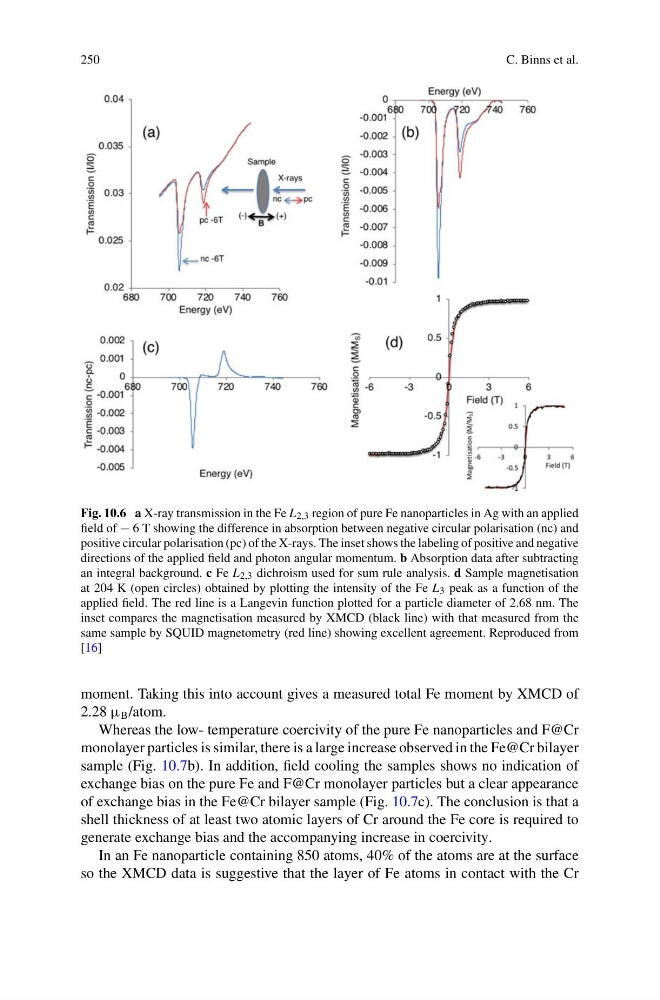
Fig. 10.6 a X-ray transmission in the Fe L 2,3 region of pure Fe nanoparticles in Ag with an applied
field of − 6 T showing the difference in absorption between negative circular polarisation (nc) and
positive circular polarisation (pc) of the X-rays. The inset shows the labeling of positive and negative
directions of the applied field and photon angular momentum. b Absorption data after subtracting
an integral background. c Fe L 2,3 dichroism used for sum rule analysis. d Sample magnetisation
at 204 K (open circles) obtained by plotting the intensity of the Fe L 3 peak as a function of the
applied field. The red line is a Langevin function plotted for a particle diameter of 2.68 nm. The
inset compares the magnetisation measured by XMCD (black line) with that measured from the
same sample by SQUID magnetometry (red line) showing excellent agreement. Reproduced from
[16]
moment. Taking this into account gives a measured total Fe moment by XMCD of
2.28 μ B /atom.
Whereas the low- temperature coercivity of the pure Fe nanoparticles and F@Cr
monolayer particles is similar, there is a large increase observed in the Fe@Cr bilayer
sample (Fig. 10.7b). In addition, field cooling the samples shows no indication of
exchange bias on the pure Fe and F@Cr monolayer particles but a clear appearance
of exchange bias in the Fe@Cr bilayer sample (Fig. 10.7c). The conclusion is that a
shell thickness of at least two atomic layers of Cr around the Fe core is required to
generate exchange bias and the accompanying increase in coercivity.
In an Fe nanoparticle containing 850 atoms, 40% of the atoms are at the surface
so the XMCD data is suggestive that the layer of Fe atoms in contact with the Cr
C. Binns et al.
Fig. 10.6 a X-ray transmission in the Fe L 2,3 region of pure Fe nanoparticles in Ag with an applied
field of − 6 T showing the difference in absorption between negative circular polarisation (nc) and
positive circular polarisation (pc) of the X-rays. The inset shows the labeling of positive and negative
directions of the applied field and photon angular momentum. b Absorption data after subtracting
an integral background. c Fe L 2,3 dichroism used for sum rule analysis. d Sample magnetisation
at 204 K (open circles) obtained by plotting the intensity of the Fe L 3 peak as a function of the
applied field. The red line is a Langevin function plotted for a particle diameter of 2.68 nm. The
inset compares the magnetisation measured by XMCD (black line) with that measured from the
same sample by SQUID magnetometry (red line) showing excellent agreement. Reproduced from
[16]
moment. Taking this into account gives a measured total Fe moment by XMCD of
2.28 μ B /atom.
Whereas the low- temperature coercivity of the pure Fe nanoparticles and F@Cr
monolayer particles is similar, there is a large increase observed in the Fe@Cr bilayer
sample (Fig. 10.7b). In addition, field cooling the samples shows no indication of
exchange bias on the pure Fe and F@Cr monolayer particles but a clear appearance
of exchange bias in the Fe@Cr bilayer sample (Fig. 10.7c). The conclusion is that a
shell thickness of at least two atomic layers of Cr around the Fe core is required to
generate exchange bias and the accompanying increase in coercivity.
In an Fe nanoparticle containing 850 atoms, 40% of the atoms are at the surface
so the XMCD data is suggestive that the layer of Fe atoms in contact with the Cr