

10 Measuring Atomic Magnetic Moments in Magnetic Nanostructures …
251
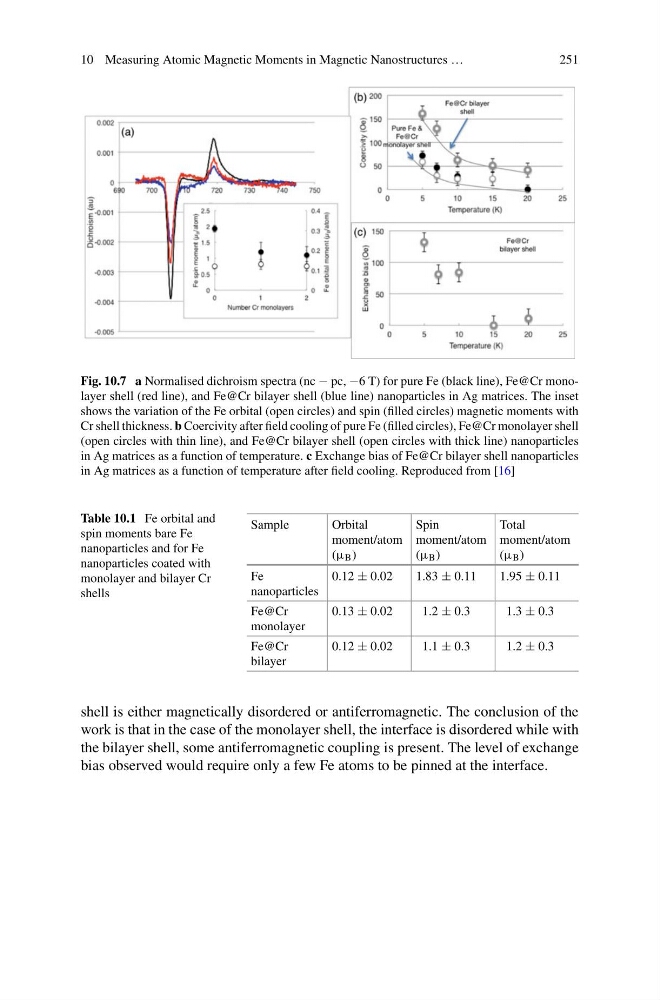
Fig. 10.7 a Normalised dichroism spectra (nc − pc, −6 T) for pure Fe (black line), Fe@Cr monolayer shell (red line), and Fe@Cr bilayer shell (blue line) nanoparticles in Ag matrices. The inset
shows the variation of the Fe orbital (open circles) and spin (filled circles) magnetic moments with
Cr shell thickness. b Coercivity after field cooling of pure Fe (filled circles), Fe@Cr monolayer shell
(open circles with thin line), and Fe@Cr bilayer shell (open circles with thick line) nanoparticles
in Ag matrices as a function of temperature. c Exchange bias of Fe@Cr bilayer shell nanoparticles
in Ag matrices as a function of temperature after field cooling. Reproduced from [16]
Table 10.1 Fe orbital and
spin moments bare Fe
nanoparticles and for Fe
nanoparticles coated with
monolayer and bilayer Cr
shells
Sample
Orbital
moment/atom
(μ B )
Spin
moment/atom
(μ B )
Total
moment/atom
(μ B )
Fe
nanoparticles
0.12 ± 0.02
1.83 ± 0.11
1.95 ± 0.11
Fe@Cr
monolayer
0.13 ± 0.02
1.2 ± 0.3
1.3 ± 0.3
Fe@Cr
bilayer
0.12 ± 0.02
1.1 ± 0.3
1.2 ± 0.3
shell is either magnetically disordered or antiferromagnetic. The conclusion of the
work is that in the case of the monolayer shell, the interface is disordered while with
the bilayer shell, some antiferromagnetic coupling is present. The level of exchange
bias observed would require only a few Fe atoms to be pinned at the interface.
251
Fig. 10.7 a Normalised dichroism spectra (nc − pc, −6 T) for pure Fe (black line), Fe@Cr monolayer shell (red line), and Fe@Cr bilayer shell (blue line) nanoparticles in Ag matrices. The inset
shows the variation of the Fe orbital (open circles) and spin (filled circles) magnetic moments with
Cr shell thickness. b Coercivity after field cooling of pure Fe (filled circles), Fe@Cr monolayer shell
(open circles with thin line), and Fe@Cr bilayer shell (open circles with thick line) nanoparticles
in Ag matrices as a function of temperature. c Exchange bias of Fe@Cr bilayer shell nanoparticles
in Ag matrices as a function of temperature after field cooling. Reproduced from [16]
Table 10.1 Fe orbital and
spin moments bare Fe
nanoparticles and for Fe
nanoparticles coated with
monolayer and bilayer Cr
shells
Sample
Orbital
moment/atom
(μ B )
Spin
moment/atom
(μ B )
Total
moment/atom
(μ B )
Fe
nanoparticles
0.12 ± 0.02
1.83 ± 0.11
1.95 ± 0.11
Fe@Cr
monolayer
0.13 ± 0.02
1.2 ± 0.3
1.3 ± 0.3
Fe@Cr
bilayer
0.12 ± 0.02
1.1 ± 0.3
1.2 ± 0.3
shell is either magnetically disordered or antiferromagnetic. The conclusion of the
work is that in the case of the monolayer shell, the interface is disordered while with
the bilayer shell, some antiferromagnetic coupling is present. The level of exchange
bias observed would require only a few Fe atoms to be pinned at the interface.