

10 Measuring Atomic Magnetic Moments in Magnetic Nanostructures …
243
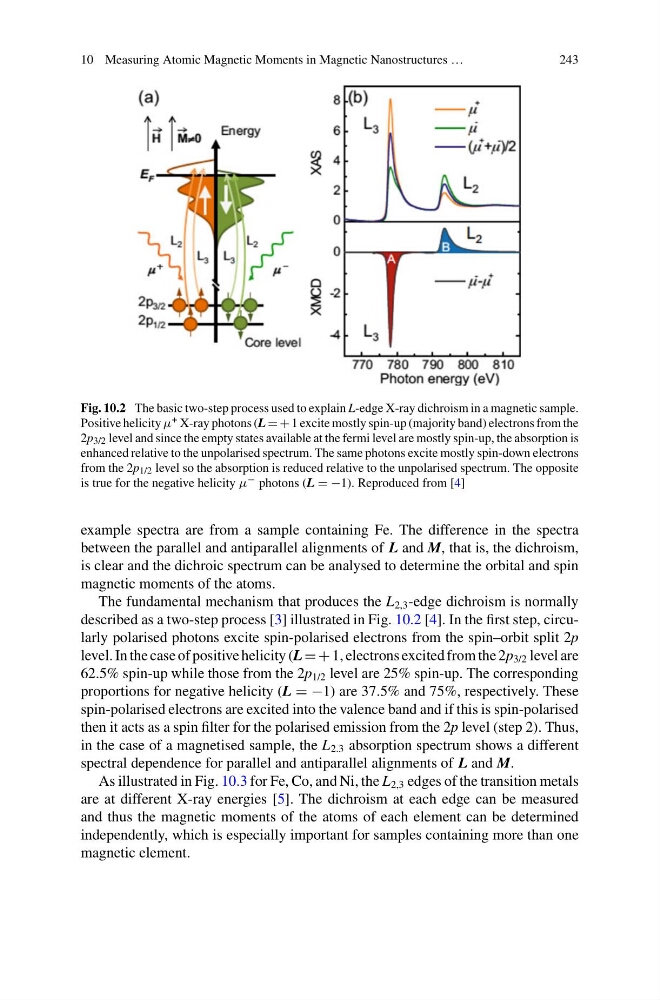
Fig. 10.2 The basic two-step process used to explain L-edge X-ray dichroism in a magnetic sample.
Positive helicity μ + X-ray photons (L = + 1 excite mostly spin-up (majority band) electrons from the
2p 3/2 level and since the empty states available at the fermi level are mostly spin-up, the absorption is
enhanced relative to the unpolarised spectrum. The same photons excite mostly spin-down electrons
from the 2p 1/2 level so the absorption is reduced relative to the unpolarised spectrum. The opposite
is true for the negative helicity μ − photons (L = −1). Reproduced from [4]
example spectra are from a sample containing Fe. The difference in the spectra
between the parallel and antiparallel alignments of L and M, that is, the dichroism,
is clear and the dichroic spectrum can be analysed to determine the orbital and spin
magnetic moments of the atoms.
The fundamental mechanism that produces the L 2,3 -edge dichroism is normally
described as a two-step process [3] illustrated in Fig. 10.2 [4]. In the first step, circularly polarised photons excite spin-polarised electrons from the spin–orbit split 2p
level. In the case of positive helicity (L = + 1, electrons excited from the 2p 3/2 level are
62.5% spin-up while those from the 2p 1/2 level are 25% spin-up. The corresponding
proportions for negative helicity (L = −1) are 37.5% and 75%, respectively. These
spin-polarised electrons are excited into the valence band and if this is spin-polarised
then it acts as a spin filter for the polarised emission from the 2p level (step 2). Thus,
in the case of a magnetised sample, the L 2.3 absorption spectrum shows a different
spectral dependence for parallel and antiparallel alignments of L and M.
As illustrated in Fig. 10.3 for Fe, Co, and Ni, the L 2,3 edges of the transition metals
are at different X-ray energies [5]. The dichroism at each edge can be measured
and thus the magnetic moments of the atoms of each element can be determined
independently, which is especially important for samples containing more than one
magnetic element.
243
Fig. 10.2 The basic two-step process used to explain L-edge X-ray dichroism in a magnetic sample.
Positive helicity μ + X-ray photons (L = + 1 excite mostly spin-up (majority band) electrons from the
2p 3/2 level and since the empty states available at the fermi level are mostly spin-up, the absorption is
enhanced relative to the unpolarised spectrum. The same photons excite mostly spin-down electrons
from the 2p 1/2 level so the absorption is reduced relative to the unpolarised spectrum. The opposite
is true for the negative helicity μ − photons (L = −1). Reproduced from [4]
example spectra are from a sample containing Fe. The difference in the spectra
between the parallel and antiparallel alignments of L and M, that is, the dichroism,
is clear and the dichroic spectrum can be analysed to determine the orbital and spin
magnetic moments of the atoms.
The fundamental mechanism that produces the L 2,3 -edge dichroism is normally
described as a two-step process [3] illustrated in Fig. 10.2 [4]. In the first step, circularly polarised photons excite spin-polarised electrons from the spin–orbit split 2p
level. In the case of positive helicity (L = + 1, electrons excited from the 2p 3/2 level are
62.5% spin-up while those from the 2p 1/2 level are 25% spin-up. The corresponding
proportions for negative helicity (L = −1) are 37.5% and 75%, respectively. These
spin-polarised electrons are excited into the valence band and if this is spin-polarised
then it acts as a spin filter for the polarised emission from the 2p level (step 2). Thus,
in the case of a magnetised sample, the L 2.3 absorption spectrum shows a different
spectral dependence for parallel and antiparallel alignments of L and M.
As illustrated in Fig. 10.3 for Fe, Co, and Ni, the L 2,3 edges of the transition metals
are at different X-ray energies [5]. The dichroism at each edge can be measured
and thus the magnetic moments of the atoms of each element can be determined
independently, which is especially important for samples containing more than one
magnetic element.