

244
C. Binns et al.
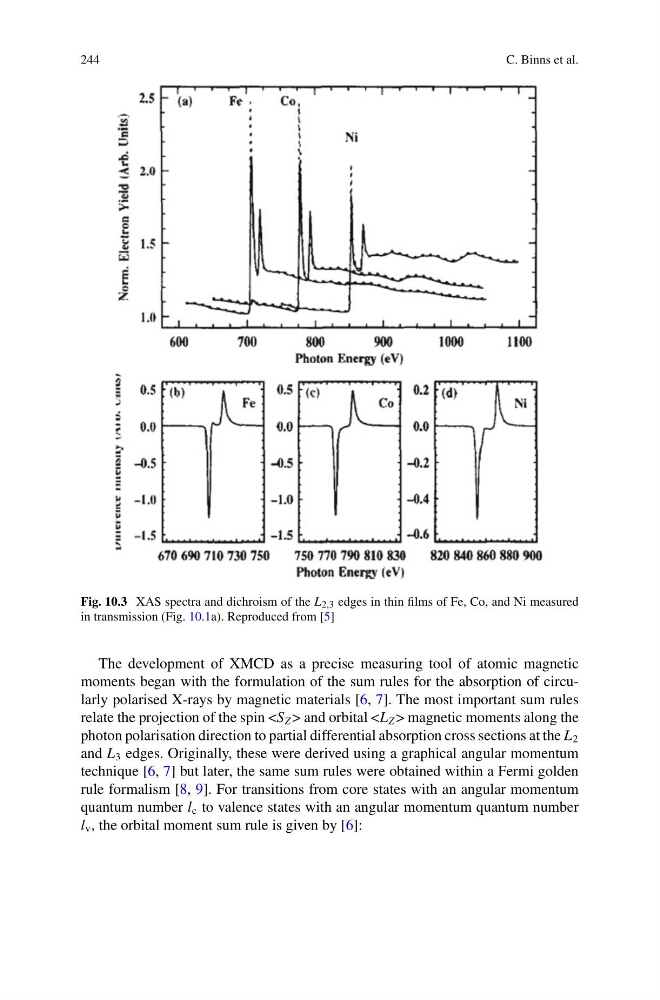
Fig. 10.3 XAS spectra and dichroism of the L 2,3 edges in thin films of Fe, Co, and Ni measured
in transmission (Fig. 10.1a). Reproduced from [5]
The development of XMCD as a precise measuring tool of atomic magnetic
moments began with the formulation of the sum rules for the absorption of circularly polarised X-rays by magnetic materials [6, 7]. The most important sum rules
relate the projection of the spin and orbital magnetic moments along the
photon polarisation direction to partial differential absorption cross sections at the L 2
and L 3 edges. Originally, these were derived using a graphical angular momentum
technique [6, 7] but later, the same sum rules were obtained within a Fermi golden
rule formalism [8, 9]. For transitions from core states with an angular momentum
quantum number l c to valence states with an angular momentum quantum number
l v , the orbital moment sum rule is given by [6]:
C. Binns et al.
Fig. 10.3 XAS spectra and dichroism of the L 2,3 edges in thin films of Fe, Co, and Ni measured
in transmission (Fig. 10.1a). Reproduced from [5]
The development of XMCD as a precise measuring tool of atomic magnetic
moments began with the formulation of the sum rules for the absorption of circularly polarised X-rays by magnetic materials [6, 7]. The most important sum rules
relate the projection of the spin
photon polarisation direction to partial differential absorption cross sections at the L 2
and L 3 edges. Originally, these were derived using a graphical angular momentum
technique [6, 7] but later, the same sum rules were obtained within a Fermi golden
rule formalism [8, 9]. For transitions from core states with an angular momentum
quantum number l c to valence states with an angular momentum quantum number
l v , the orbital moment sum rule is given by [6]: