

168
M. L. Fdez-Gubieda et al.
-50
-25
0
25
50
0
0 . 1
0 . 2
0 . 3
M (Am
2 /kg)
μ
0
H(T)
IRM
DCD
(a)
-1
0
1
0
0 . 5
1
m
DCD
m
IRM
0
1000
2000
3000
0
0 . 1
0 . 2
0 . 3
χ
irr, IRM
χ
irr, DCD
χ
irr
(Am
2 /kgT)
μ
0
H(T)
(b)
-0.15
-0.1
-0.05
0
0
0 . 1
0 . 2
0 . 3
δm
μ
0
H(T)
(c)
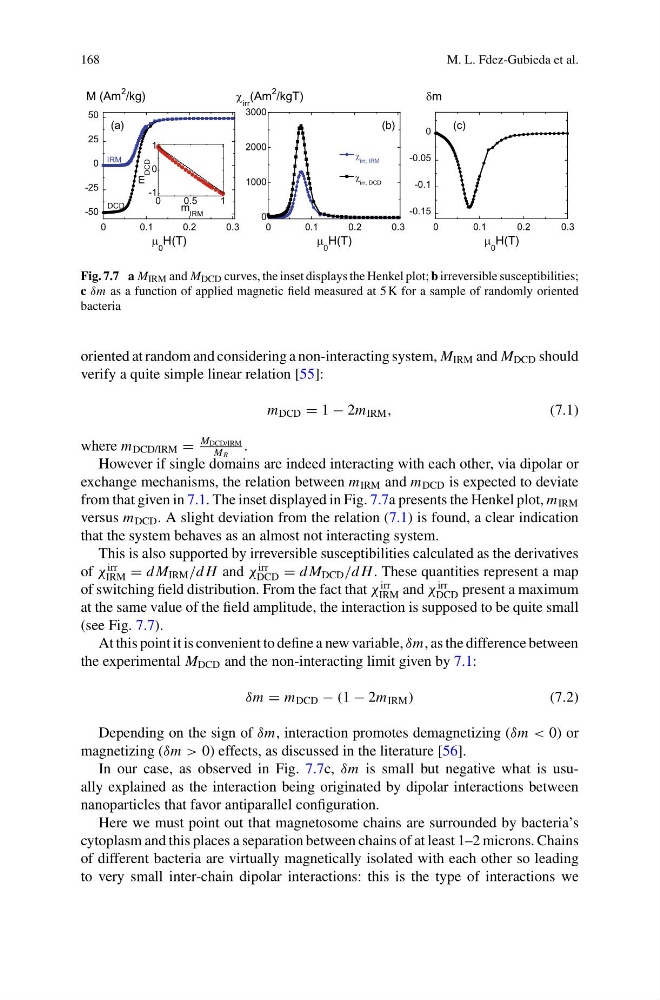
Fig. 7.7 a M IRM and M DCD curves, the inset displays the Henkel plot; b irreversible susceptibilities;
c δm as a function of applied magnetic field measured at 5 K for a sample of randomly oriented
bacteria
oriented at random and considering a non-interacting system, M IRM and M DCD should
verify a quite simple linear relation [55]:
m DCD = 1 − 2m IRM ,
(7.1)
where m DCD/IRM =
M DCD/IRM
M R
.
However if single domains are indeed interacting with each other, via dipolar or
exchange mechanisms, the relation between m IRM and m DCD is expected to deviate
from that given in 7.1. The inset displayed in Fig. 7.7a presents the Henkel plot, m IRM
versus m DCD . A slight deviation from the relation (7.1) is found, a clear indication
that the system behaves as an almost not interacting system.
This is also supported by irreversible susceptibilities calculated as the derivatives
of χ
irr
IRM = d M IRM /d H and χ
irr
DCD = d M DCD /d H. These quantities represent a map
of switching field distribution. From the fact that χ
irr
IRM and χ
irr
DCD present a maximum
at the same value of the field amplitude, the interaction is supposed to be quite small
(see Fig. 7.7).
At this point it is convenient to define a new variable, δm, as the difference between
the experimental M DCD and the non-interacting limit given by 7.1:
δm = m DCD − (1 − 2m IRM )
(7.2)
Depending on the sign of δm, interaction promotes demagnetizing (δm < 0) or
magnetizing (δm > 0) effects, as discussed in the literature [56].
In our case, as observed in Fig. 7.7c, δm is small but negative what is usually explained as the interaction being originated by dipolar interactions between
nanoparticles that favor antiparallel configuration.
Here we must point out that magnetosome chains are surrounded by bacteria’s
cytoplasm and this places a separation between chains of at least 1–2 microns. Chains
of different bacteria are virtually magnetically isolated with each other so leading
to very small inter-chain dipolar interactions: this is the type of interactions we
M. L. Fdez-Gubieda et al.
-50
-25
0
25
50
0
0 . 1
0 . 2
0 . 3
M (Am
2 /kg)
μ
0
H(T)
IRM
DCD
(a)
-1
0
1
0
0 . 5
1
m
DCD
m
IRM
0
1000
2000
3000
0
0 . 1
0 . 2
0 . 3
χ
irr, IRM
χ
irr, DCD
χ
irr
(Am
2 /kgT)
μ
0
H(T)
(b)
-0.15
-0.1
-0.05
0
0
0 . 1
0 . 2
0 . 3
δm
μ
0
H(T)
(c)
Fig. 7.7 a M IRM and M DCD curves, the inset displays the Henkel plot; b irreversible susceptibilities;
c δm as a function of applied magnetic field measured at 5 K for a sample of randomly oriented
bacteria
oriented at random and considering a non-interacting system, M IRM and M DCD should
verify a quite simple linear relation [55]:
m DCD = 1 − 2m IRM ,
(7.1)
where m DCD/IRM =
M DCD/IRM
M R
.
However if single domains are indeed interacting with each other, via dipolar or
exchange mechanisms, the relation between m IRM and m DCD is expected to deviate
from that given in 7.1. The inset displayed in Fig. 7.7a presents the Henkel plot, m IRM
versus m DCD . A slight deviation from the relation (7.1) is found, a clear indication
that the system behaves as an almost not interacting system.
This is also supported by irreversible susceptibilities calculated as the derivatives
of χ
irr
IRM = d M IRM /d H and χ
irr
DCD = d M DCD /d H. These quantities represent a map
of switching field distribution. From the fact that χ
irr
IRM and χ
irr
DCD present a maximum
at the same value of the field amplitude, the interaction is supposed to be quite small
(see Fig. 7.7).
At this point it is convenient to define a new variable, δm, as the difference between
the experimental M DCD and the non-interacting limit given by 7.1:
δm = m DCD − (1 − 2m IRM )
(7.2)
Depending on the sign of δm, interaction promotes demagnetizing (δm < 0) or
magnetizing (δm > 0) effects, as discussed in the literature [56].
In our case, as observed in Fig. 7.7c, δm is small but negative what is usually explained as the interaction being originated by dipolar interactions between
nanoparticles that favor antiparallel configuration.
Here we must point out that magnetosome chains are surrounded by bacteria’s
cytoplasm and this places a separation between chains of at least 1–2 microns. Chains
of different bacteria are virtually magnetically isolated with each other so leading
to very small inter-chain dipolar interactions: this is the type of interactions we