

146
H. Khurshid et al.
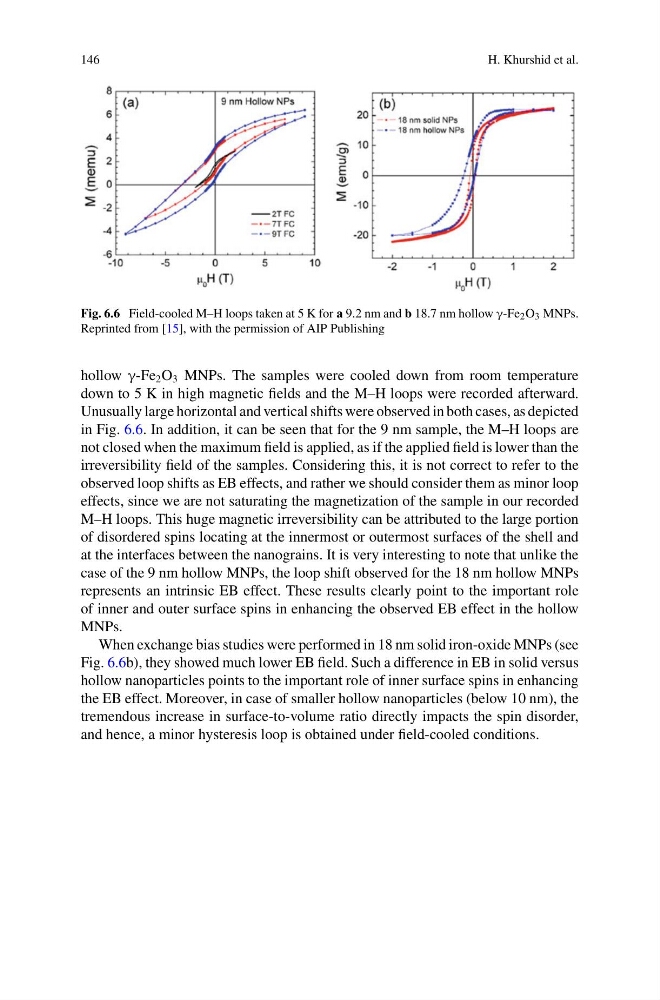
Fig. 6.6 Field-cooled M–H loops taken at 5 K for a 9.2 nm and b 18.7 nm hollow γ-Fe 2 O 3 MNPs.
Reprinted from [15], with the permission of AIP Publishing
hollow γ-Fe 2 O 3 MNPs. The samples were cooled down from room temperature
down to 5 K in high magnetic fields and the M–H loops were recorded afterward.
Unusually large horizontal and vertical shifts were observed in both cases, as depicted
in Fig. 6.6. In addition, it can be seen that for the 9 nm sample, the M–H loops are
not closed when the maximum field is applied, as if the applied field is lower than the
irreversibility field of the samples. Considering this, it is not correct to refer to the
observed loop shifts as EB effects, and rather we should consider them as minor loop
effects, since we are not saturating the magnetization of the sample in our recorded
M–H loops. This huge magnetic irreversibility can be attributed to the large portion
of disordered spins locating at the innermost or outermost surfaces of the shell and
at the interfaces between the nanograins. It is very interesting to note that unlike the
case of the 9 nm hollow MNPs, the loop shift observed for the 18 nm hollow MNPs
represents an intrinsic EB effect. These results clearly point to the important role
of inner and outer surface spins in enhancing the observed EB effect in the hollow
MNPs.
When exchange bias studies were performed in 18 nm solid iron-oxide MNPs (see
Fig. 6.6b), they showed much lower EB field. Such a difference in EB in solid versus
hollow nanoparticles points to the important role of inner surface spins in enhancing
the EB effect. Moreover, in case of smaller hollow nanoparticles (below 10 nm), the
tremendous increase in surface-to-volume ratio directly impacts the spin disorder,
and hence, a minor hysteresis loop is obtained under field-cooled conditions.
H. Khurshid et al.
Fig. 6.6 Field-cooled M–H loops taken at 5 K for a 9.2 nm and b 18.7 nm hollow γ-Fe 2 O 3 MNPs.
Reprinted from [15], with the permission of AIP Publishing
hollow γ-Fe 2 O 3 MNPs. The samples were cooled down from room temperature
down to 5 K in high magnetic fields and the M–H loops were recorded afterward.
Unusually large horizontal and vertical shifts were observed in both cases, as depicted
in Fig. 6.6. In addition, it can be seen that for the 9 nm sample, the M–H loops are
not closed when the maximum field is applied, as if the applied field is lower than the
irreversibility field of the samples. Considering this, it is not correct to refer to the
observed loop shifts as EB effects, and rather we should consider them as minor loop
effects, since we are not saturating the magnetization of the sample in our recorded
M–H loops. This huge magnetic irreversibility can be attributed to the large portion
of disordered spins locating at the innermost or outermost surfaces of the shell and
at the interfaces between the nanograins. It is very interesting to note that unlike the
case of the 9 nm hollow MNPs, the loop shift observed for the 18 nm hollow MNPs
represents an intrinsic EB effect. These results clearly point to the important role
of inner and outer surface spins in enhancing the observed EB effect in the hollow
MNPs.
When exchange bias studies were performed in 18 nm solid iron-oxide MNPs (see
Fig. 6.6b), they showed much lower EB field. Such a difference in EB in solid versus
hollow nanoparticles points to the important role of inner surface spins in enhancing
the EB effect. Moreover, in case of smaller hollow nanoparticles (below 10 nm), the
tremendous increase in surface-to-volume ratio directly impacts the spin disorder,
and hence, a minor hysteresis loop is obtained under field-cooled conditions.