

6 Hollow Magnetic Nanoparticles
147
6.4 Evolution from Core–Shell to Core–Void–Shell
to Hollow
Core/shell MNPs are composed of a core and shell with different magnetic phases
such as ferromagnet–antiferromagnet (FM–AFM), ferromagnet/spin glass, ferrimagnet/ferrimagnet, etc. [11, 12, 55–57]. This kind of nanocomposite systems
presents great potential for a wide range of applications: for example, Fe–Fe oxide
core/shell MNPs have been studied for biomedical applications motivated by the
increase in magnetization due to the Fe core, while keeping the intrinsic biocompatibility of the Fe oxide due to the shell [53, 58]. In addition, core/shell MNPs can
exhibit exchange bias (EB), which is a byproduct of the coupling of the core–shell
interface and gives rise to a horizontal shift in the hysteresis loop after cooling in a
magnetic field [59, 60]. This phenomenon has attracted great interest in the recent
years since it has been proposed as a promising approach to overcome the superparamagnetic limit in MNPs, a critical bottleneck for magnetic data storage applications
[12].
One of the most commonly employed methods to obtain hollow MNPs is via the
nanoscale Kirkendall effect. As was mentioned before, this effect can be employed
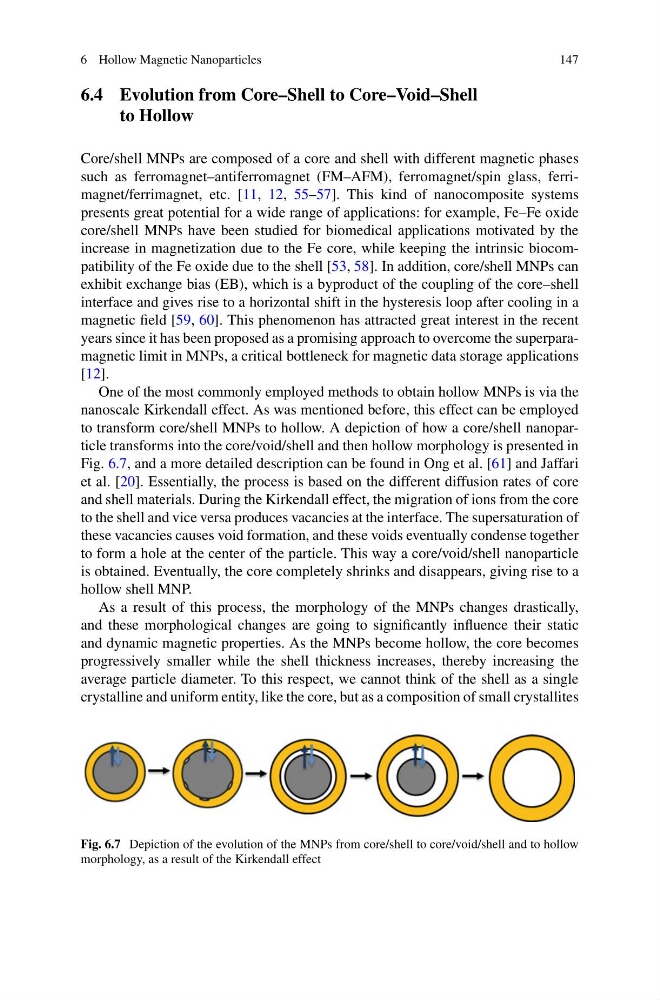
to transform core/shell MNPs to hollow. A depiction of how a core/shell nanoparticle transforms into the core/void/shell and then hollow morphology is presented in
Fig. 6.7, and a more detailed description can be found in Ong et al. [61] and Jaffari
et al. [20]. Essentially, the process is based on the different diffusion rates of core
and shell materials. During the Kirkendall effect, the migration of ions from the core
to the shell and vice versa produces vacancies at the interface. The supersaturation of
these vacancies causes void formation, and these voids eventually condense together
to form a hole at the center of the particle. This way a core/void/shell nanoparticle
is obtained. Eventually, the core completely shrinks and disappears, giving rise to a
hollow shell MNP.
As a result of this process, the morphology of the MNPs changes drastically,
and these morphological changes are going to significantly influence their static
and dynamic magnetic properties. As the MNPs become hollow, the core becomes
progressively smaller while the shell thickness increases, thereby increasing the
average particle diameter. To this respect, we cannot think of the shell as a single
crystalline and uniform entity, like the core, but as a composition of small crystallites
Fig. 6.7 Depiction of the evolution of the MNPs from core/shell to core/void/shell and to hollow
morphology, as a result of the Kirkendall effect
147
6.4 Evolution from Core–Shell to Core–Void–Shell
to Hollow
Core/shell MNPs are composed of a core and shell with different magnetic phases
such as ferromagnet–antiferromagnet (FM–AFM), ferromagnet/spin glass, ferrimagnet/ferrimagnet, etc. [11, 12, 55–57]. This kind of nanocomposite systems
presents great potential for a wide range of applications: for example, Fe–Fe oxide
core/shell MNPs have been studied for biomedical applications motivated by the
increase in magnetization due to the Fe core, while keeping the intrinsic biocompatibility of the Fe oxide due to the shell [53, 58]. In addition, core/shell MNPs can
exhibit exchange bias (EB), which is a byproduct of the coupling of the core–shell
interface and gives rise to a horizontal shift in the hysteresis loop after cooling in a
magnetic field [59, 60]. This phenomenon has attracted great interest in the recent
years since it has been proposed as a promising approach to overcome the superparamagnetic limit in MNPs, a critical bottleneck for magnetic data storage applications
[12].
One of the most commonly employed methods to obtain hollow MNPs is via the
nanoscale Kirkendall effect. As was mentioned before, this effect can be employed
to transform core/shell MNPs to hollow. A depiction of how a core/shell nanoparticle transforms into the core/void/shell and then hollow morphology is presented in
Fig. 6.7, and a more detailed description can be found in Ong et al. [61] and Jaffari
et al. [20]. Essentially, the process is based on the different diffusion rates of core
and shell materials. During the Kirkendall effect, the migration of ions from the core
to the shell and vice versa produces vacancies at the interface. The supersaturation of
these vacancies causes void formation, and these voids eventually condense together
to form a hole at the center of the particle. This way a core/void/shell nanoparticle
is obtained. Eventually, the core completely shrinks and disappears, giving rise to a
hollow shell MNP.
As a result of this process, the morphology of the MNPs changes drastically,
and these morphological changes are going to significantly influence their static
and dynamic magnetic properties. As the MNPs become hollow, the core becomes
progressively smaller while the shell thickness increases, thereby increasing the
average particle diameter. To this respect, we cannot think of the shell as a single
crystalline and uniform entity, like the core, but as a composition of small crystallites
Fig. 6.7 Depiction of the evolution of the MNPs from core/shell to core/void/shell and to hollow
morphology, as a result of the Kirkendall effect