

6 Hollow Magnetic Nanoparticles
145
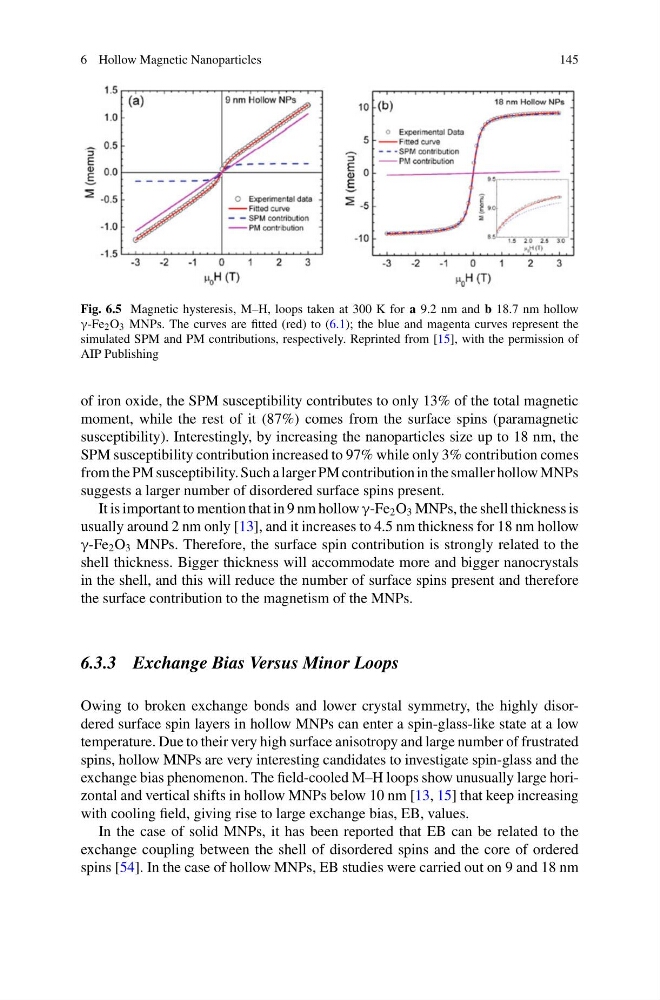
Fig. 6.5 Magnetic hysteresis, M–H, loops taken at 300 K for a 9.2 nm and b 18.7 nm hollow
γ-Fe 2 O 3 MNPs. The curves are fitted (red) to (6.1); the blue and magenta curves represent the
simulated SPM and PM contributions, respectively. Reprinted from [15], with the permission of
AIP Publishing
of iron oxide, the SPM susceptibility contributes to only 13% of the total magnetic
moment, while the rest of it (87%) comes from the surface spins (paramagnetic
susceptibility). Interestingly, by increasing the nanoparticles size up to 18 nm, the
SPM susceptibility contribution increased to 97% while only 3% contribution comes
from the PM susceptibility. Such a larger PM contribution in the smaller hollow MNPs
suggests a larger number of disordered surface spins present.
It is important to mention that in 9 nm hollow γ-Fe 2 O 3 MNPs, the shell thickness is
usually around 2 nm only [13], and it increases to 4.5 nm thickness for 18 nm hollow
γ-Fe 2 O 3 MNPs. Therefore, the surface spin contribution is strongly related to the
shell thickness. Bigger thickness will accommodate more and bigger nanocrystals
in the shell, and this will reduce the number of surface spins present and therefore
the surface contribution to the magnetism of the MNPs.
6.3.3 Exchange Bias Versus Minor Loops
Owing to broken exchange bonds and lower crystal symmetry, the highly disordered surface spin layers in hollow MNPs can enter a spin-glass-like state at a low
temperature. Due to their very high surface anisotropy and large number of frustrated
spins, hollow MNPs are very interesting candidates to investigate spin-glass and the
exchange bias phenomenon. The field-cooled M–H loops show unusually large horizontal and vertical shifts in hollow MNPs below 10 nm [13, 15] that keep increasing
with cooling field, giving rise to large exchange bias, EB, values.
In the case of solid MNPs, it has been reported that EB can be related to the
exchange coupling between the shell of disordered spins and the core of ordered
spins [54]. In the case of hollow MNPs, EB studies were carried out on 9 and 18 nm
145
Fig. 6.5 Magnetic hysteresis, M–H, loops taken at 300 K for a 9.2 nm and b 18.7 nm hollow
γ-Fe 2 O 3 MNPs. The curves are fitted (red) to (6.1); the blue and magenta curves represent the
simulated SPM and PM contributions, respectively. Reprinted from [15], with the permission of
AIP Publishing
of iron oxide, the SPM susceptibility contributes to only 13% of the total magnetic
moment, while the rest of it (87%) comes from the surface spins (paramagnetic
susceptibility). Interestingly, by increasing the nanoparticles size up to 18 nm, the
SPM susceptibility contribution increased to 97% while only 3% contribution comes
from the PM susceptibility. Such a larger PM contribution in the smaller hollow MNPs
suggests a larger number of disordered surface spins present.
It is important to mention that in 9 nm hollow γ-Fe 2 O 3 MNPs, the shell thickness is
usually around 2 nm only [13], and it increases to 4.5 nm thickness for 18 nm hollow
γ-Fe 2 O 3 MNPs. Therefore, the surface spin contribution is strongly related to the
shell thickness. Bigger thickness will accommodate more and bigger nanocrystals
in the shell, and this will reduce the number of surface spins present and therefore
the surface contribution to the magnetism of the MNPs.
6.3.3 Exchange Bias Versus Minor Loops
Owing to broken exchange bonds and lower crystal symmetry, the highly disordered surface spin layers in hollow MNPs can enter a spin-glass-like state at a low
temperature. Due to their very high surface anisotropy and large number of frustrated
spins, hollow MNPs are very interesting candidates to investigate spin-glass and the
exchange bias phenomenon. The field-cooled M–H loops show unusually large horizontal and vertical shifts in hollow MNPs below 10 nm [13, 15] that keep increasing
with cooling field, giving rise to large exchange bias, EB, values.
In the case of solid MNPs, it has been reported that EB can be related to the
exchange coupling between the shell of disordered spins and the core of ordered
spins [54]. In the case of hollow MNPs, EB studies were carried out on 9 and 18 nm