

4 Core/Shell Bimagnetic Nanoparticles
101
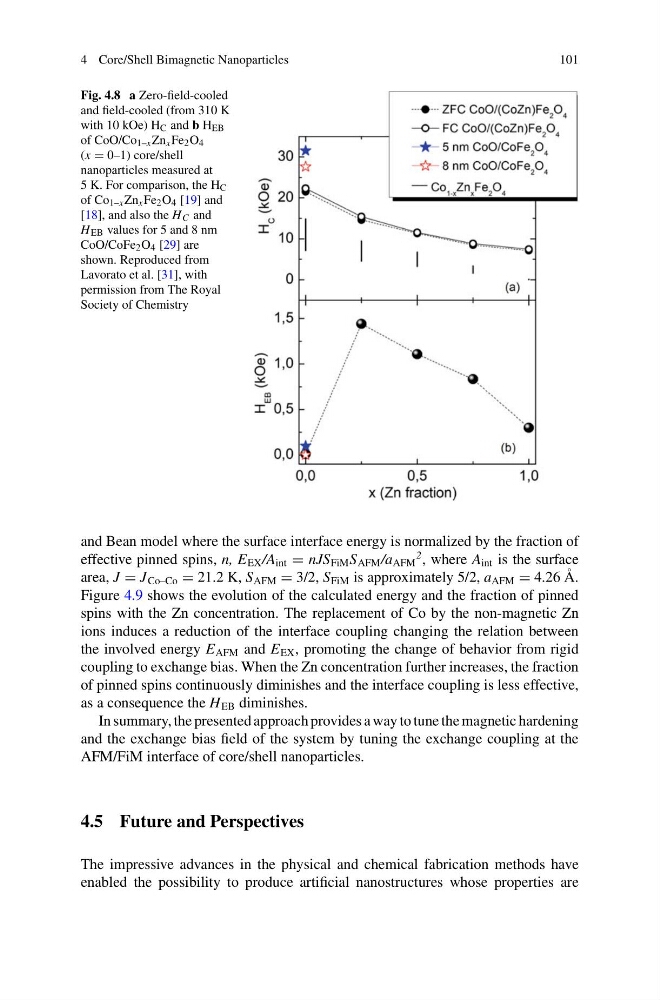
Fig. 4.8 a Zero-field-cooled
and field-cooled (from 310 K
with 10 kOe) H C and b H EB
of CoO/Co 1–x Zn x Fe 2 O 4
(x = 0–1) core/shell
nanoparticles measured at
5 K. For comparison, the H C
of Co 1–x Zn x Fe 2 O 4 [19] and
[18], and also the H C and
H EB values for 5 and 8 nm
CoO/CoFe 2 O 4 [29] are
shown. Reproduced from
Lavorato et al. [31], with
permission from The Royal
Society of Chemistry
and Bean model where the surface interface energy is normalized by the fraction of
effective pinned spins, n, E EX /A int = nJS FiM S AFM /a AFM
2 , where A int is the surface
area, J = J Co–Co = 21.2 K, S AFM = 3/2, S FiM is approximately 5/2, a AFM = 4.26 Å.
Figure 4.9 shows the evolution of the calculated energy and the fraction of pinned
spins with the Zn concentration. The replacement of Co by the non-magnetic Zn
ions induces a reduction of the interface coupling changing the relation between
the involved energy E AFM and E EX , promoting the change of behavior from rigid
coupling to exchange bias. When the Zn concentration further increases, the fraction
of pinned spins continuously diminishes and the interface coupling is less effective,
as a consequence the H EB diminishes.
In summary, the presented approach provides a way to tune the magnetic hardening
and the exchange bias field of the system by tuning the exchange coupling at the
AFM/FiM interface of core/shell nanoparticles.
4.5 Future and Perspectives
The impressive advances in the physical and chemical fabrication methods have
enabled the possibility to produce artificial nanostructures whose properties are
101
Fig. 4.8 a Zero-field-cooled
and field-cooled (from 310 K
with 10 kOe) H C and b H EB
of CoO/Co 1–x Zn x Fe 2 O 4
(x = 0–1) core/shell
nanoparticles measured at
5 K. For comparison, the H C
of Co 1–x Zn x Fe 2 O 4 [19] and
[18], and also the H C and
H EB values for 5 and 8 nm
CoO/CoFe 2 O 4 [29] are
shown. Reproduced from
Lavorato et al. [31], with
permission from The Royal
Society of Chemistry
and Bean model where the surface interface energy is normalized by the fraction of
effective pinned spins, n, E EX /A int = nJS FiM S AFM /a AFM
2 , where A int is the surface
area, J = J Co–Co = 21.2 K, S AFM = 3/2, S FiM is approximately 5/2, a AFM = 4.26 Å.
Figure 4.9 shows the evolution of the calculated energy and the fraction of pinned
spins with the Zn concentration. The replacement of Co by the non-magnetic Zn
ions induces a reduction of the interface coupling changing the relation between
the involved energy E AFM and E EX , promoting the change of behavior from rigid
coupling to exchange bias. When the Zn concentration further increases, the fraction
of pinned spins continuously diminishes and the interface coupling is less effective,
as a consequence the H EB diminishes.
In summary, the presented approach provides a way to tune the magnetic hardening
and the exchange bias field of the system by tuning the exchange coupling at the
AFM/FiM interface of core/shell nanoparticles.
4.5 Future and Perspectives
The impressive advances in the physical and chemical fabrication methods have
enabled the possibility to produce artificial nanostructures whose properties are