

100
E. L. Winkler and R. D. Zysler
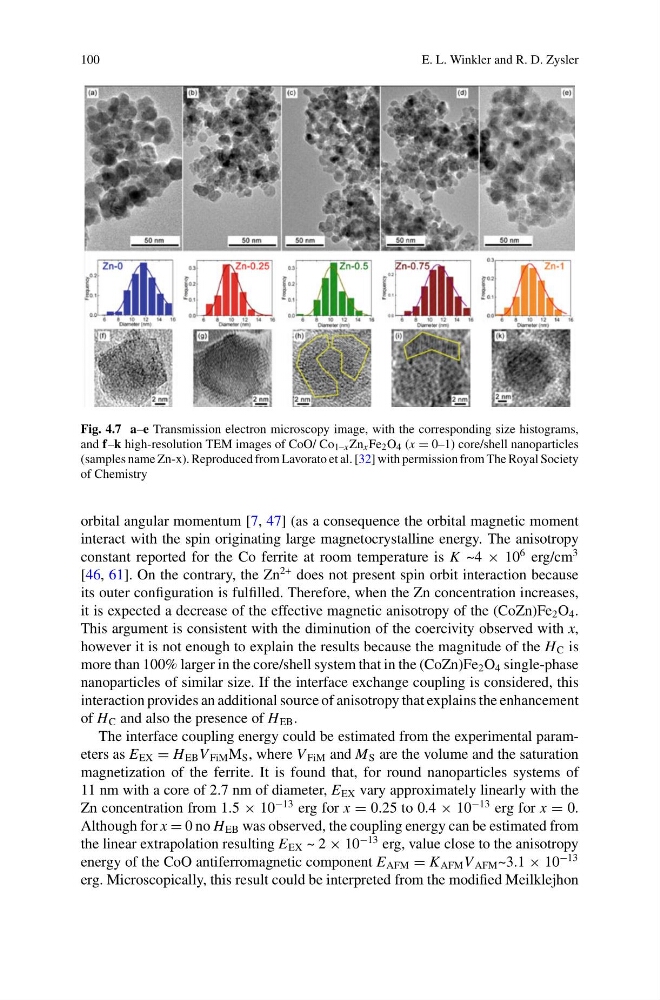
Fig. 4.7 a–e Transmission electron microscopy image, with the corresponding size histograms,
and f–k high-resolution TEM images of CoO/ Co 1–x Zn x Fe 2 O 4 (x = 0–1) core/shell nanoparticles
(samples name Zn-x). Reproduced from Lavorato et al. [32] with permission from The Royal Society
of Chemistry
orbital angular momentum [7, 47] (as a consequence the orbital magnetic moment
interact with the spin originating large magnetocrystalline energy. The anisotropy
constant reported for the Co ferrite at room temperature is K ~4 × 10
6 erg/cm
3
[46, 61]. On the contrary, the Zn
2+ does not present spin orbit interaction because
its outer configuration is fulfilled. Therefore, when the Zn concentration increases,
it is expected a decrease of the effective magnetic anisotropy of the (CoZn)Fe 2 O 4 .
This argument is consistent with the diminution of the coercivity observed with x,
however it is not enough to explain the results because the magnitude of the H C is
more than 100% larger in the core/shell system that in the (CoZn)Fe 2 O 4 single-phase
nanoparticles of similar size. If the interface exchange coupling is considered, this
interaction provides an additional source of anisotropy that explains the enhancement
of H C and also the presence of H EB .
The interface coupling energy could be estimated from the experimental parameters as E EX = H EB V FiM M S , where V FiM and M S are the volume and the saturation
magnetization of the ferrite. It is found that, for round nanoparticles systems of
11 nm with a core of 2.7 nm of diameter, E EX vary approximately linearly with the
Zn concentration from 1.5 × 10
−13 erg for x = 0.25 to 0.4 × 10
−13 erg for x = 0.
Although for x = 0 no H EB was observed, the coupling energy can be estimated from
the linear extrapolation resulting E EX ~ 2 × 10
−13 erg, value close to the anisotropy
energy of the CoO antiferromagnetic component E AFM = K AFM V AFM ~3.1 × 10
−13
erg. Microscopically, this result could be interpreted from the modified Meilklejhon
E. L. Winkler and R. D. Zysler
Fig. 4.7 a–e Transmission electron microscopy image, with the corresponding size histograms,
and f–k high-resolution TEM images of CoO/ Co 1–x Zn x Fe 2 O 4 (x = 0–1) core/shell nanoparticles
(samples name Zn-x). Reproduced from Lavorato et al. [32] with permission from The Royal Society
of Chemistry
orbital angular momentum [7, 47] (as a consequence the orbital magnetic moment
interact with the spin originating large magnetocrystalline energy. The anisotropy
constant reported for the Co ferrite at room temperature is K ~4 × 10
6 erg/cm
3
[46, 61]. On the contrary, the Zn
2+ does not present spin orbit interaction because
its outer configuration is fulfilled. Therefore, when the Zn concentration increases,
it is expected a decrease of the effective magnetic anisotropy of the (CoZn)Fe 2 O 4 .
This argument is consistent with the diminution of the coercivity observed with x,
however it is not enough to explain the results because the magnitude of the H C is
more than 100% larger in the core/shell system that in the (CoZn)Fe 2 O 4 single-phase
nanoparticles of similar size. If the interface exchange coupling is considered, this
interaction provides an additional source of anisotropy that explains the enhancement
of H C and also the presence of H EB .
The interface coupling energy could be estimated from the experimental parameters as E EX = H EB V FiM M S , where V FiM and M S are the volume and the saturation
magnetization of the ferrite. It is found that, for round nanoparticles systems of
11 nm with a core of 2.7 nm of diameter, E EX vary approximately linearly with the
Zn concentration from 1.5 × 10
−13 erg for x = 0.25 to 0.4 × 10
−13 erg for x = 0.
Although for x = 0 no H EB was observed, the coupling energy can be estimated from
the linear extrapolation resulting E EX ~ 2 × 10
−13 erg, value close to the anisotropy
energy of the CoO antiferromagnetic component E AFM = K AFM V AFM ~3.1 × 10
−13
erg. Microscopically, this result could be interpreted from the modified Meilklejhon