

102
E. L. Winkler and R. D. Zysler
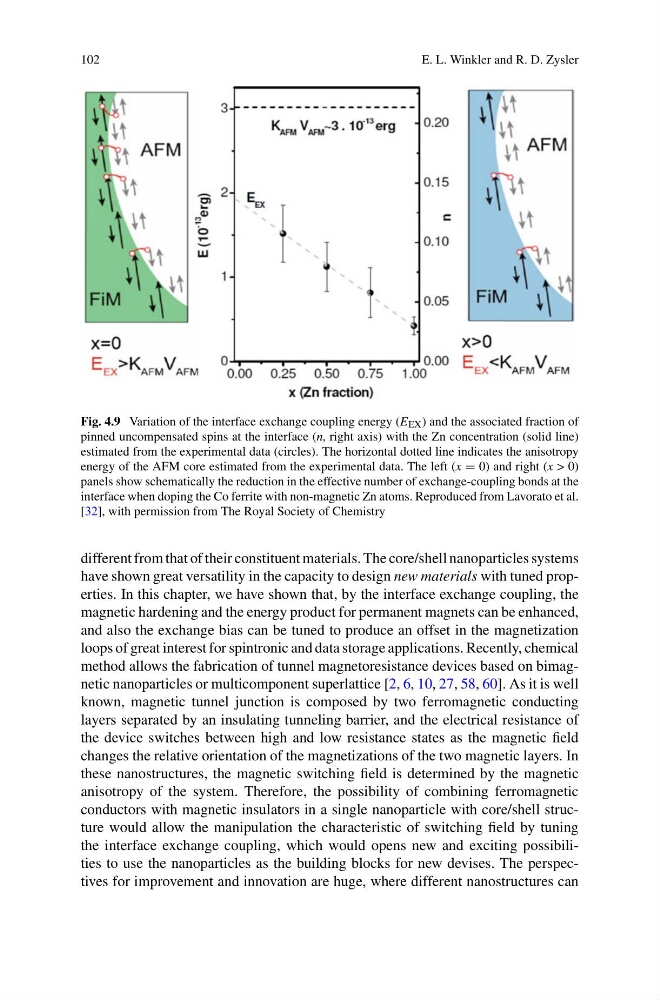
Fig. 4.9 Variation of the interface exchange coupling energy (E EX ) and the associated fraction of
pinned uncompensated spins at the interface (n, right axis) with the Zn concentration (solid line)
estimated from the experimental data (circles). The horizontal dotted line indicates the anisotropy
energy of the AFM core estimated from the experimental data. The left (x = 0) and right (x > 0)
panels show schematically the reduction in the effective number of exchange-coupling bonds at the
interface when doping the Co ferrite with non-magnetic Zn atoms. Reproduced from Lavorato et al.
[32], with permission from The Royal Society of Chemistry
different from that of their constituent materials. The core/shell nanoparticles systems
have shown great versatility in the capacity to design new materials with tuned properties. In this chapter, we have shown that, by the interface exchange coupling, the
magnetic hardening and the energy product for permanent magnets can be enhanced,
and also the exchange bias can be tuned to produce an offset in the magnetization
loops of great interest for spintronic and data storage applications. Recently, chemical
method allows the fabrication of tunnel magnetoresistance devices based on bimagnetic nanoparticles or multicomponent superlattice [2, 6, 10, 27, 58, 60]. As it is well
known, magnetic tunnel junction is composed by two ferromagnetic conducting
layers separated by an insulating tunneling barrier, and the electrical resistance of
the device switches between high and low resistance states as the magnetic field
changes the relative orientation of the magnetizations of the two magnetic layers. In
these nanostructures, the magnetic switching field is determined by the magnetic
anisotropy of the system. Therefore, the possibility of combining ferromagnetic
conductors with magnetic insulators in a single nanoparticle with core/shell structure would allow the manipulation the characteristic of switching field by tuning
the interface exchange coupling, which would opens new and exciting possibilities to use the nanoparticles as the building blocks for new devises. The perspectives for improvement and innovation are huge, where different nanostructures can
E. L. Winkler and R. D. Zysler
Fig. 4.9 Variation of the interface exchange coupling energy (E EX ) and the associated fraction of
pinned uncompensated spins at the interface (n, right axis) with the Zn concentration (solid line)
estimated from the experimental data (circles). The horizontal dotted line indicates the anisotropy
energy of the AFM core estimated from the experimental data. The left (x = 0) and right (x > 0)
panels show schematically the reduction in the effective number of exchange-coupling bonds at the
interface when doping the Co ferrite with non-magnetic Zn atoms. Reproduced from Lavorato et al.
[32], with permission from The Royal Society of Chemistry
different from that of their constituent materials. The core/shell nanoparticles systems
have shown great versatility in the capacity to design new materials with tuned properties. In this chapter, we have shown that, by the interface exchange coupling, the
magnetic hardening and the energy product for permanent magnets can be enhanced,
and also the exchange bias can be tuned to produce an offset in the magnetization
loops of great interest for spintronic and data storage applications. Recently, chemical
method allows the fabrication of tunnel magnetoresistance devices based on bimagnetic nanoparticles or multicomponent superlattice [2, 6, 10, 27, 58, 60]. As it is well
known, magnetic tunnel junction is composed by two ferromagnetic conducting
layers separated by an insulating tunneling barrier, and the electrical resistance of
the device switches between high and low resistance states as the magnetic field
changes the relative orientation of the magnetizations of the two magnetic layers. In
these nanostructures, the magnetic switching field is determined by the magnetic
anisotropy of the system. Therefore, the possibility of combining ferromagnetic
conductors with magnetic insulators in a single nanoparticle with core/shell structure would allow the manipulation the characteristic of switching field by tuning
the interface exchange coupling, which would opens new and exciting possibilities to use the nanoparticles as the building blocks for new devises. The perspectives for improvement and innovation are huge, where different nanostructures can