

4 Core/Shell Bimagnetic Nanoparticles
93
experimental and theoretical approaches show the presence of pinned and unpinned
spins at the interface, where only the AFM pinned spins, exchange coupled with the
FM phase, give place to the loop shift after the field cool process. As a consequence,
the coupling energy should be normalized by replacing it by an effective J EFF value
that accounts for the pinned spins faction ρ, J EFF = ρJ EX , which reduces the surface
exchange energy consistently with the smaller H EB observed [3, 49, 53]. Ohldag and
co-workers [49, 40], from X-ray circular dichroism experiments on exchange bias
multilayers, found that only a small fraction of interfacial spins ~4% is pinned to
the AFM component. Similar results were reported in several core/shell systems
as Fe@Cr [3], MnO@Mn 3 O 4 [53, 67], Fe/γ-Fe 2 O 3 [21], CoO@Co 1–x Zn x Fe 2 O 4
[29]where the strength of the exchange coupling is correlated with the density of
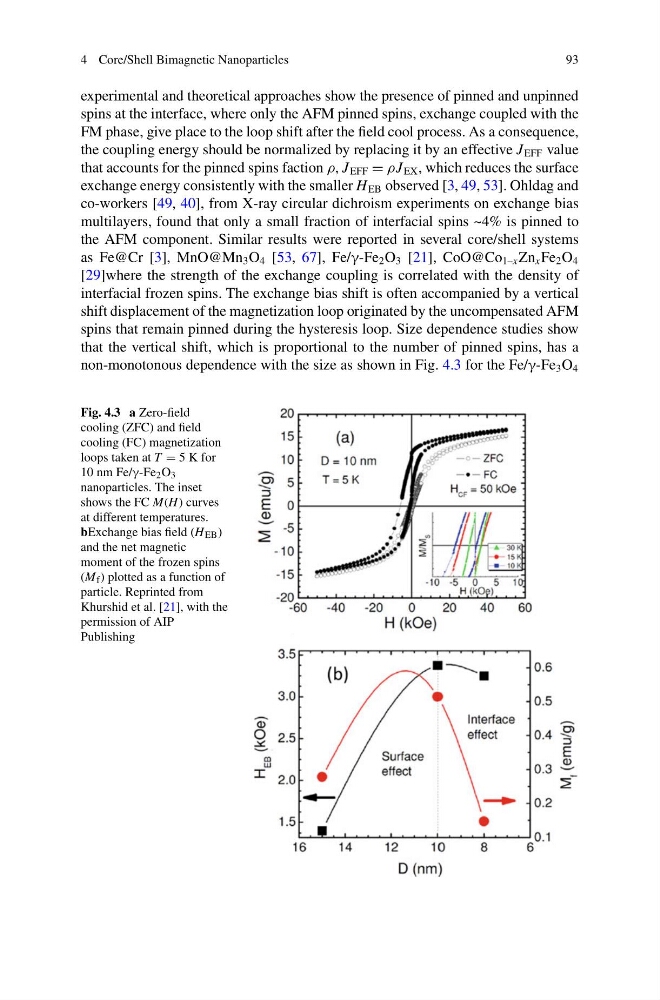
interfacial frozen spins. The exchange bias shift is often accompanied by a vertical
shift displacement of the magnetization loop originated by the uncompensated AFM
spins that remain pinned during the hysteresis loop. Size dependence studies show
that the vertical shift, which is proportional to the number of pinned spins, has a
non-monotonous dependence with the size as shown in Fig. 4.3 for the Fe/γ-Fe 3 O 4
Fig. 4.3 a Zero-field
cooling (ZFC) and field
cooling (FC) magnetization
loops taken at T = 5 K for
10 nm Fe/γ-Fe 2 O 3
nanoparticles. The inset
shows the FC M(H) curves
at different temperatures.
bExchange bias field (H EB )
and the net magnetic
moment of the frozen spins
(M f ) plotted as a function of
particle. Reprinted from
Khurshid et al. [21], with the
permission of AIP
Publishing
93
experimental and theoretical approaches show the presence of pinned and unpinned
spins at the interface, where only the AFM pinned spins, exchange coupled with the
FM phase, give place to the loop shift after the field cool process. As a consequence,
the coupling energy should be normalized by replacing it by an effective J EFF value
that accounts for the pinned spins faction ρ, J EFF = ρJ EX , which reduces the surface
exchange energy consistently with the smaller H EB observed [3, 49, 53]. Ohldag and
co-workers [49, 40], from X-ray circular dichroism experiments on exchange bias
multilayers, found that only a small fraction of interfacial spins ~4% is pinned to
the AFM component. Similar results were reported in several core/shell systems
as Fe@Cr [3], MnO@Mn 3 O 4 [53, 67], Fe/γ-Fe 2 O 3 [21], CoO@Co 1–x Zn x Fe 2 O 4
[29]where the strength of the exchange coupling is correlated with the density of
interfacial frozen spins. The exchange bias shift is often accompanied by a vertical
shift displacement of the magnetization loop originated by the uncompensated AFM
spins that remain pinned during the hysteresis loop. Size dependence studies show
that the vertical shift, which is proportional to the number of pinned spins, has a
non-monotonous dependence with the size as shown in Fig. 4.3 for the Fe/γ-Fe 3 O 4
Fig. 4.3 a Zero-field
cooling (ZFC) and field
cooling (FC) magnetization
loops taken at T = 5 K for
10 nm Fe/γ-Fe 2 O 3
nanoparticles. The inset
shows the FC M(H) curves
at different temperatures.
bExchange bias field (H EB )
and the net magnetic
moment of the frozen spins
(M f ) plotted as a function of
particle. Reprinted from
Khurshid et al. [21], with the
permission of AIP
Publishing