

94
E. L. Winkler and R. D. Zysler
system [21]. However, although these quantities are related, the observation of a H EB
does not necessarily require the existence of uncompensated AFM spins.
Notice that the expression obtained for the exchange bias, within these approximation, does not depend on the magnetic anisotropy neither the size of the AFM phase.
However, experimental evidence [41] shows that an AFM size threshold should be
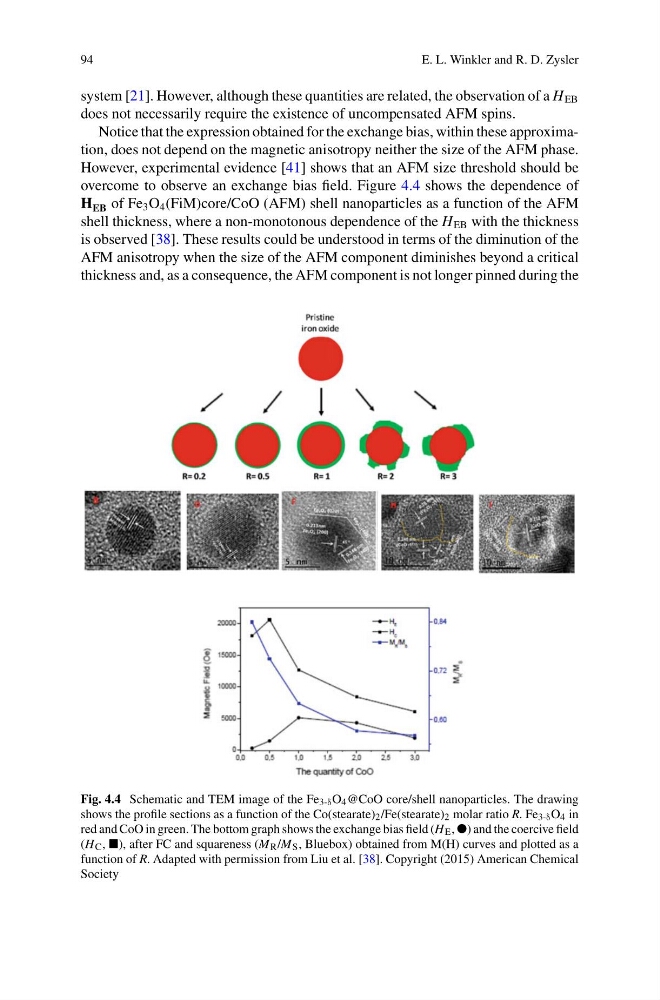
overcome to observe an exchange bias field. Figure 4.4 shows the dependence of
H EB of Fe 3 O 4 (FiM)core/CoO (AFM) shell nanoparticles as a function of the AFM
shell thickness, where a non-monotonous dependence of the H EB with the thickness
is observed [38]. These results could be understood in terms of the diminution of the
AFM anisotropy when the size of the AFM component diminishes beyond a critical
thickness and, as a consequence, the AFM component is not longer pinned during the
Fig. 4.4 Schematic and TEM image of the Fe 3-δ O 4 @CoO core/shell nanoparticles. The drawing
shows the profile sections as a function of the Co(stearate) 2 /Fe(stearate) 2 molar ratio R. Fe 3-δ O 4 in
red and CoO in green. The bottom graph shows the exchange bias field (H E , ●) and the coercive field
(H C , ), after FC and squareness (M R /M S , Bluebox) obtained from M(H) curves and plotted as a
function of R. Adapted with permission from Liu et al. [38]. Copyright (2015) American Chemical
Society
E. L. Winkler and R. D. Zysler
system [21]. However, although these quantities are related, the observation of a H EB
does not necessarily require the existence of uncompensated AFM spins.
Notice that the expression obtained for the exchange bias, within these approximation, does not depend on the magnetic anisotropy neither the size of the AFM phase.
However, experimental evidence [41] shows that an AFM size threshold should be
overcome to observe an exchange bias field. Figure 4.4 shows the dependence of
H EB of Fe 3 O 4 (FiM)core/CoO (AFM) shell nanoparticles as a function of the AFM
shell thickness, where a non-monotonous dependence of the H EB with the thickness
is observed [38]. These results could be understood in terms of the diminution of the
AFM anisotropy when the size of the AFM component diminishes beyond a critical
thickness and, as a consequence, the AFM component is not longer pinned during the
Fig. 4.4 Schematic and TEM image of the Fe 3-δ O 4 @CoO core/shell nanoparticles. The drawing
shows the profile sections as a function of the Co(stearate) 2 /Fe(stearate) 2 molar ratio R. Fe 3-δ O 4 in
red and CoO in green. The bottom graph shows the exchange bias field (H E , ●) and the coercive field
(H C , ), after FC and squareness (M R /M S , Bluebox) obtained from M(H) curves and plotted as a
function of R. Adapted with permission from Liu et al. [38]. Copyright (2015) American Chemical
Society