

3.1 Chemical Profiles of Yerba Mate Infusions
43
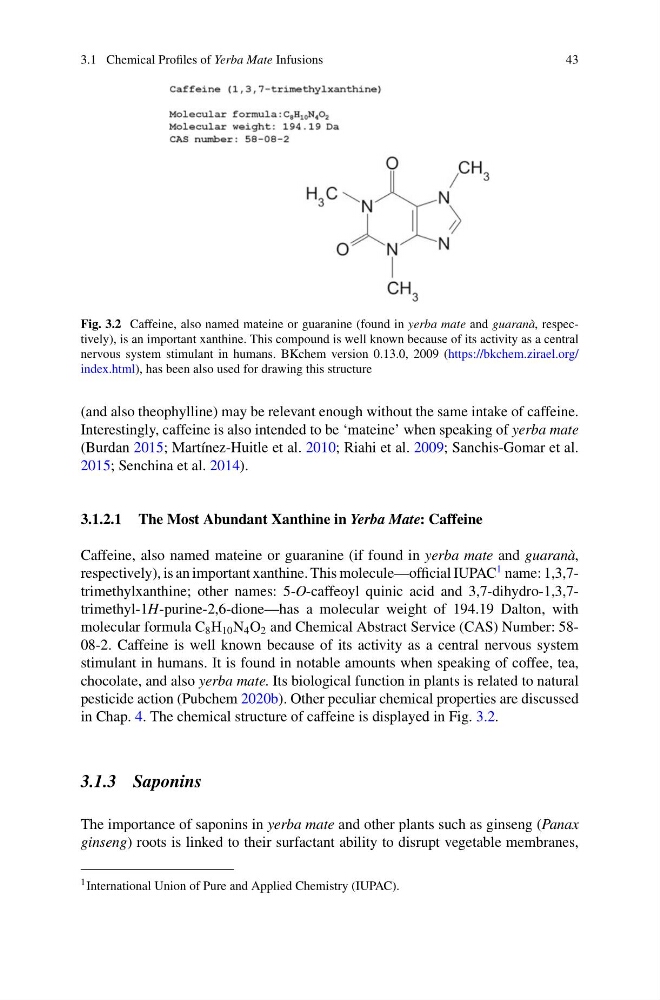
Fig. 3.2 Caffeine, also named mateine or guaranine (found in yerba mate and guaranà, respectively), is an important xanthine. This compound is well known because of its activity as a central
nervous system stimulant in humans. BKchem version 0.13.0, 2009 (https://bkchem.zirael.org/
index.html), has been also used for drawing this structure
(and also theophylline) may be relevant enough without the same intake of caffeine.
Interestingly, caffeine is also intended to be ‘mateine’ when speaking of yerba mate
(Burdan 2015; Martínez-Huitle et al. 2010; Riahi et al. 2009; Sanchis-Gomar et al.
2015; Senchina et al. 2014).
3.1.2.1 The Most Abundant Xanthine in Yerba Mate: Caffeine
Caffeine, also named mateine or guaranine (if found in yerba mate and guaranà,
respectively), is an important xanthine. This molecule—official IUPAC
1 name: 1,3,7trimethylxanthine; other names: 5-O-caffeoyl quinic acid and 3,7-dihydro-1,3,7trimethyl-1H-purine-2,6-dione—has a molecular weight of 194.19 Dalton, with
molecular formula C 8 H 10 N 4 O 2 and Chemical Abstract Service (CAS) Number: 5808-2. Caffeine is well known because of its activity as a central nervous system
stimulant in humans. It is found in notable amounts when speaking of coffee, tea,
chocolate, and also yerba mate. Its biological function in plants is related to natural
pesticide action (Pubchem 2020b). Other peculiar chemical properties are discussed
in Chap. 4. The chemical structure of caffeine is displayed in Fig. 3.2.
3.1.3 Saponins
The importance of saponins in yerba mate and other plants such as ginseng (Panax
ginseng) roots is linked to their surfactant ability to disrupt vegetable membranes,
1 International Union of Pure and Applied Chemistry (IUPAC).
43
Fig. 3.2 Caffeine, also named mateine or guaranine (found in yerba mate and guaranà, respectively), is an important xanthine. This compound is well known because of its activity as a central
nervous system stimulant in humans. BKchem version 0.13.0, 2009 (https://bkchem.zirael.org/
index.html), has been also used for drawing this structure
(and also theophylline) may be relevant enough without the same intake of caffeine.
Interestingly, caffeine is also intended to be ‘mateine’ when speaking of yerba mate
(Burdan 2015; Martínez-Huitle et al. 2010; Riahi et al. 2009; Sanchis-Gomar et al.
2015; Senchina et al. 2014).
3.1.2.1 The Most Abundant Xanthine in Yerba Mate: Caffeine
Caffeine, also named mateine or guaranine (if found in yerba mate and guaranà,
respectively), is an important xanthine. This molecule—official IUPAC
1 name: 1,3,7trimethylxanthine; other names: 5-O-caffeoyl quinic acid and 3,7-dihydro-1,3,7trimethyl-1H-purine-2,6-dione—has a molecular weight of 194.19 Dalton, with
molecular formula C 8 H 10 N 4 O 2 and Chemical Abstract Service (CAS) Number: 5808-2. Caffeine is well known because of its activity as a central nervous system
stimulant in humans. It is found in notable amounts when speaking of coffee, tea,
chocolate, and also yerba mate. Its biological function in plants is related to natural
pesticide action (Pubchem 2020b). Other peculiar chemical properties are discussed
in Chap. 4. The chemical structure of caffeine is displayed in Fig. 3.2.
3.1.3 Saponins
The importance of saponins in yerba mate and other plants such as ginseng (Panax
ginseng) roots is linked to their surfactant ability to disrupt vegetable membranes,
1 International Union of Pure and Applied Chemistry (IUPAC).