

44
3 Chemical Profiles of Yerba Mate Infusions Across …
being so able to create large micelles with bile acids and steroids. This fact may
explain, in part at least, certain features of folk medicines.
In addition, their notable bitterness and the high solubility in water seem to explain
partially the distinct organoleptic features of yerba mate infusions. Chemically, these
compounds are subdivided into steroidal and triterpenoid saponins, depending on the
aglycone skeleton (Heck and De Mejia 2007). In relation to yerba mate, the most
interesting (and perhaps promising) saponins are reported to be matesaponins 1, 2,
3, 4, and 5. Interestingly, the water solubility of these matesaponins is reported to be
close to 100% when speaking of matesaponin 1, while the total amount of extractable
saponins may slightly exceed 23 µg/mL for one gram of dried leaves in 100 mL water
(Heck and De Mejia 2007).
3.1.3.1 The Most Abundant Saponin in Yerba Mate: (+)-Matesaponin 1
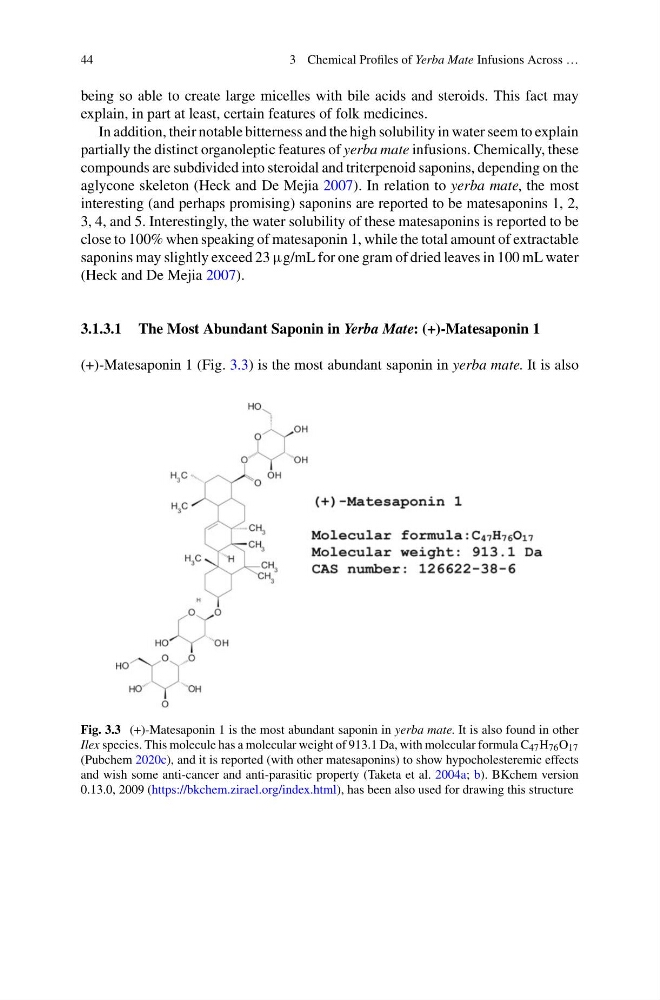
(+)-Matesaponin 1 (Fig. 3.3) is the most abundant saponin in yerba mate. It is also
Fig. 3.3 (+)-Matesaponin 1 is the most abundant saponin in yerba mate. It is also found in other
Ilex species. This molecule has a molecular weight of 913.1 Da, with molecular formula C 47 H 76 O 17
(Pubchem 2020c), and it is reported (with other matesaponins) to show hypocholesteremic effects
and wish some anti-cancer and anti-parasitic property (Taketa et al. 2004a; b). BKchem version
0.13.0, 2009 (https://bkchem.zirael.org/index.html), has been also used for drawing this structure
3 Chemical Profiles of Yerba Mate Infusions Across …
being so able to create large micelles with bile acids and steroids. This fact may
explain, in part at least, certain features of folk medicines.
In addition, their notable bitterness and the high solubility in water seem to explain
partially the distinct organoleptic features of yerba mate infusions. Chemically, these
compounds are subdivided into steroidal and triterpenoid saponins, depending on the
aglycone skeleton (Heck and De Mejia 2007). In relation to yerba mate, the most
interesting (and perhaps promising) saponins are reported to be matesaponins 1, 2,
3, 4, and 5. Interestingly, the water solubility of these matesaponins is reported to be
close to 100% when speaking of matesaponin 1, while the total amount of extractable
saponins may slightly exceed 23 µg/mL for one gram of dried leaves in 100 mL water
(Heck and De Mejia 2007).
3.1.3.1 The Most Abundant Saponin in Yerba Mate: (+)-Matesaponin 1
(+)-Matesaponin 1 (Fig. 3.3) is the most abundant saponin in yerba mate. It is also
Fig. 3.3 (+)-Matesaponin 1 is the most abundant saponin in yerba mate. It is also found in other
Ilex species. This molecule has a molecular weight of 913.1 Da, with molecular formula C 47 H 76 O 17
(Pubchem 2020c), and it is reported (with other matesaponins) to show hypocholesteremic effects
and wish some anti-cancer and anti-parasitic property (Taketa et al. 2004a; b). BKchem version
0.13.0, 2009 (https://bkchem.zirael.org/index.html), has been also used for drawing this structure