

2.2 Critical Mass: Bare Core
61
D =
λ t v neut
3
,
(2.20)
and where τ is the mean time that a neutron will travel before causing a fission:
τ =
λ f
v neut
.
(2.21)
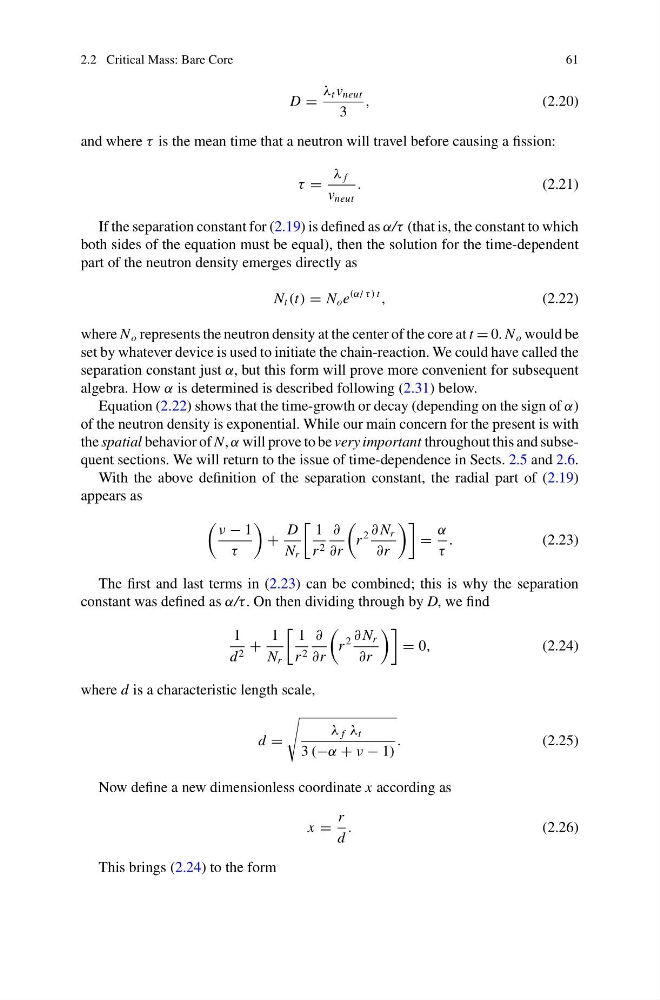
If the separation constant for (2.19) is defined as α/τ (that is, the constant to which
both sides of the equation must be equal), then the solution for the time-dependent
part of the neutron density emerges directly as
N t (t) = N o e
(α/ τ ) t
,
(2.22)
where N o represents the neutron density at the center of the core at t = 0. N o would be
set by whatever device is used to initiate the chain-reaction. We could have called the
separation constant just α, but this form will prove more convenient for subsequent
algebra. How α is determined is described following (2.31) below.
Equation (2.22) shows that the time-growth or decay (depending on the sign of α)
of the neutron density is exponential. While our main concern for the present is with
the spatial behavior of N, α will prove to be very important throughout this and subsequent sections. We will return to the issue of time-dependence in Sects. 2.5 and 2.6.
With the above definition of the separation constant, the radial part of (2.19)
appears as
ν − 1
τ
+
D
N r
1
r 2
∂
∂r
r
2 ∂ N r
∂r
=
α
τ
.
(2.23)
The first and last terms in (2.23) can be combined; this is why the separation
constant was defined as α/τ. On then dividing through by D, we find
1
d 2 +
1
N r
1
r 2
∂
∂r
r
2 ∂ N r
∂r
= 0,
(2.24)
where d is a characteristic length scale,
d =
λ f λ t
3 (−α + ν − 1)
.
(2.25)
Now define a new dimensionless coordinate x according as
x =
r
d
.
(2.26)
This brings (2.24) to the form
61
D =
λ t v neut
3
,
(2.20)
and where τ is the mean time that a neutron will travel before causing a fission:
τ =
λ f
v neut
.
(2.21)
If the separation constant for (2.19) is defined as α/τ (that is, the constant to which
both sides of the equation must be equal), then the solution for the time-dependent
part of the neutron density emerges directly as
N t (t) = N o e
(α/ τ ) t
,
(2.22)
where N o represents the neutron density at the center of the core at t = 0. N o would be
set by whatever device is used to initiate the chain-reaction. We could have called the
separation constant just α, but this form will prove more convenient for subsequent
algebra. How α is determined is described following (2.31) below.
Equation (2.22) shows that the time-growth or decay (depending on the sign of α)
of the neutron density is exponential. While our main concern for the present is with
the spatial behavior of N, α will prove to be very important throughout this and subsequent sections. We will return to the issue of time-dependence in Sects. 2.5 and 2.6.
With the above definition of the separation constant, the radial part of (2.19)
appears as
ν − 1
τ
+
D
N r
1
r 2
∂
∂r
r
2 ∂ N r
∂r
=
α
τ
.
(2.23)
The first and last terms in (2.23) can be combined; this is why the separation
constant was defined as α/τ. On then dividing through by D, we find
1
d 2 +
1
N r
1
r 2
∂
∂r
r
2 ∂ N r
∂r
= 0,
(2.24)
where d is a characteristic length scale,
d =
λ f λ t
3 (−α + ν − 1)
.
(2.25)
Now define a new dimensionless coordinate x according as
x =
r
d
.
(2.26)
This brings (2.24) to the form