

62
2 Critical Mass, Efficiency, and Yield
1
N r
1
x 2
∂
∂ x
x
2 ∂ N r
∂ x
= −1.
(2.27)
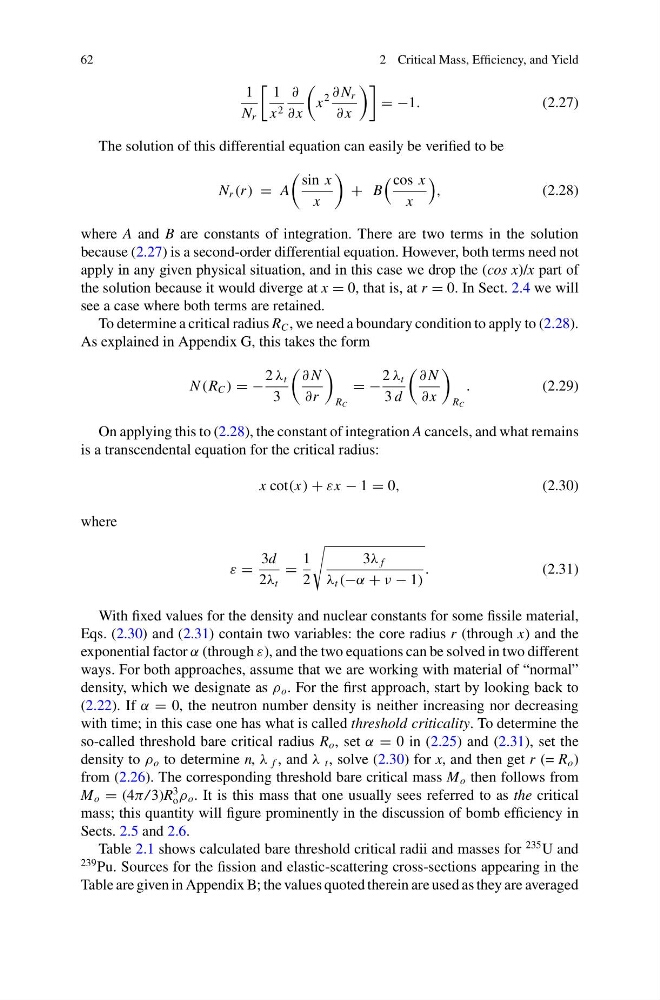
The solution of this differential equation can easily be verified to be
N r (r ) = A
sin x
x
+ B
cos x
x
,
(2.28)
where A and B are constants of integration. There are two terms in the solution
because (2.27) is a second-order differential equation. However, both terms need not
apply in any given physical situation, and in this case we drop the (cos x)/x part of
the solution because it would diverge at x = 0, that is, at r = 0. In Sect. 2.4 we will
see a case where both terms are retained.
To determine a critical radius R C , we need a boundary condition to apply to (2.28).
As explained in Appendix G, this takes the form
N (R C ) = −
2 λ t
3
∂ N
∂r
R C
= −
2 λ t
3 d
∂ N
∂ x
R C
.
(2.29)
On applying this to (2.28), the constant of integration A cancels, and what remains
is a transcendental equation for the critical radius:
x cot(x) + εx − 1 = 0,
(2.30)
where
ε =
3d
2λ t
=
1
2
3λ f
λ t (−α + ν − 1)
.
(2.31)
With fixed values for the density and nuclear constants for some fissile material,
Eqs. (2.30) and (2.31) contain two variables: the core radius r (through x) and the
exponential factor α (through ε), and the two equations can be solved in two different
ways. For both approaches, assume that we are working with material of “normal”
density, which we designate as ρ o . For the first approach, start by looking back to
(2.22). If α = 0, the neutron number density is neither increasing nor decreasing
with time; in this case one has what is called threshold criticality. To determine the
so-called threshold bare critical radius R o , set α = 0 in (2.25) and (2.31), set the
density to ρ o to determine n, λ f , and λ t , solve (2.30) for x, and then get r (= R o )
from (2.26). The corresponding threshold bare critical mass M o then follows from
M o = (4π / 3)R
3
o ρ o . It is this mass that one usually sees referred to as the critical
mass; this quantity will figure prominently in the discussion of bomb efficiency in
Sects. 2.5 and 2.6.
Table 2.1 shows calculated bare threshold critical radii and masses for
235 U and
239 Pu. Sources for the fission and elastic-scattering cross-sections appearing in the
Table are given in Appendix B; the values quoted therein are used as they are averaged
2 Critical Mass, Efficiency, and Yield
1
N r
1
x 2
∂
∂ x
x
2 ∂ N r
∂ x
= −1.
(2.27)
The solution of this differential equation can easily be verified to be
N r (r ) = A
sin x
x
+ B
cos x
x
,
(2.28)
where A and B are constants of integration. There are two terms in the solution
because (2.27) is a second-order differential equation. However, both terms need not
apply in any given physical situation, and in this case we drop the (cos x)/x part of
the solution because it would diverge at x = 0, that is, at r = 0. In Sect. 2.4 we will
see a case where both terms are retained.
To determine a critical radius R C , we need a boundary condition to apply to (2.28).
As explained in Appendix G, this takes the form
N (R C ) = −
2 λ t
3
∂ N
∂r
R C
= −
2 λ t
3 d
∂ N
∂ x
R C
.
(2.29)
On applying this to (2.28), the constant of integration A cancels, and what remains
is a transcendental equation for the critical radius:
x cot(x) + εx − 1 = 0,
(2.30)
where
ε =
3d
2λ t
=
1
2
3λ f
λ t (−α + ν − 1)
.
(2.31)
With fixed values for the density and nuclear constants for some fissile material,
Eqs. (2.30) and (2.31) contain two variables: the core radius r (through x) and the
exponential factor α (through ε), and the two equations can be solved in two different
ways. For both approaches, assume that we are working with material of “normal”
density, which we designate as ρ o . For the first approach, start by looking back to
(2.22). If α = 0, the neutron number density is neither increasing nor decreasing
with time; in this case one has what is called threshold criticality. To determine the
so-called threshold bare critical radius R o , set α = 0 in (2.25) and (2.31), set the
density to ρ o to determine n, λ f , and λ t , solve (2.30) for x, and then get r (= R o )
from (2.26). The corresponding threshold bare critical mass M o then follows from
M o = (4π / 3)R
3
o ρ o . It is this mass that one usually sees referred to as the critical
mass; this quantity will figure prominently in the discussion of bomb efficiency in
Sects. 2.5 and 2.6.
Table 2.1 shows calculated bare threshold critical radii and masses for
235 U and
239 Pu. Sources for the fission and elastic-scattering cross-sections appearing in the
Table are given in Appendix B; the values quoted therein are used as they are averaged