

60
2 Critical Mass, Efficiency, and Yield
where σ t is the so-called total or transport cross-section. If neutron scattering is
isotropic (which we assume), the transport cross-section is given by the sum of the
fission and elastic-scattering cross-sections:
σ t = σ f + σ el .
(2.17)
We do not consider here the role of inelastic scattering, which affects the situation
only indirectly in that it lowers the mean neutron velocity.
1
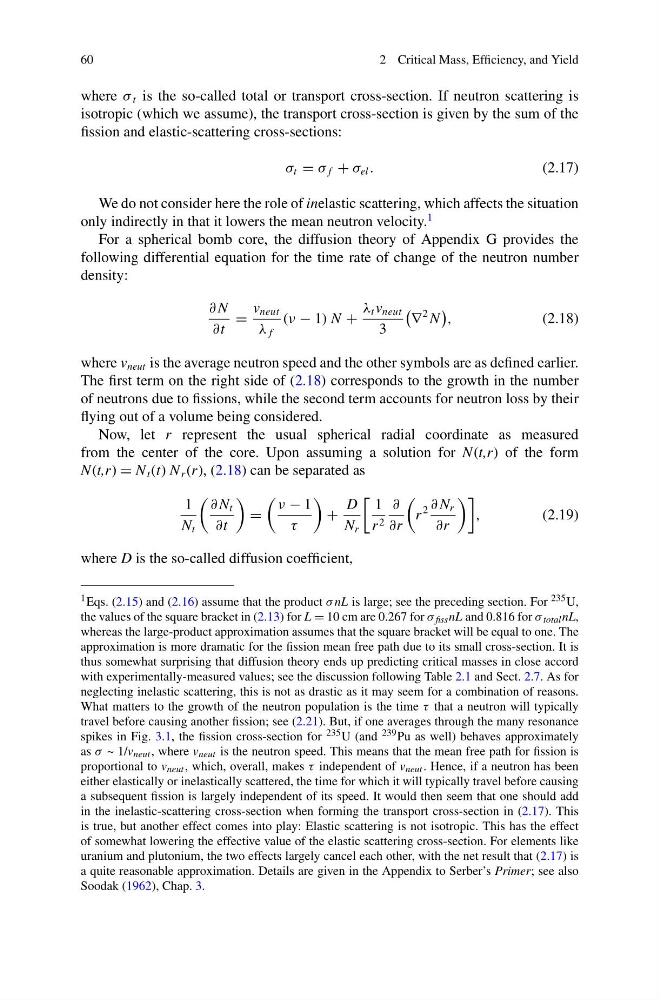
For a spherical bomb core, the diffusion theory of Appendix G provides the
following differential equation for the time rate of change of the neutron number
density:
∂ N
∂t
=
v neut
λ f
(ν − 1) N +
λ t v neut
3
∇
2 N
,
(2.18)
where v neut is the average neutron speed and the other symbols are as defined earlier.
The first term on the right side of (2.18) corresponds to the growth in the number
of neutrons due to fissions, while the second term accounts for neutron loss by their
flying out of a volume being considered.
Now, let r represent the usual spherical radial coordinate as measured
from the center of the core. Upon assuming a solution for N(t,r) of the form
N(t,r) = N t (t) N r (r), (2.18) can be separated as
1
N t
∂ N t
∂t
=
ν − 1
τ
+
D
N r
1
r 2
∂
∂r
r
2 ∂ N r
∂r
,
(2.19)
where D is the so-called diffusion coefficient,
1 Eqs. (2.15) and (2.16) assume that the product σ nL is large; see the preceding section. For 235 U,
the values of the square bracket in (2.13) for L = 10 cm are 0.267 for σ fiss nL and 0.816 for σ total nL,
whereas the large-product approximation assumes that the square bracket will be equal to one. The
approximation is more dramatic for the fission mean free path due to its small cross-section. It is
thus somewhat surprising that diffusion theory ends up predicting critical masses in close accord
with experimentally-measured values; see the discussion following Table 2.1 and Sect. 2.7. As for
neglecting inelastic scattering, this is not as drastic as it may seem for a combination of reasons.
What matters to the growth of the neutron population is the time τ that a neutron will typically
travel before causing another fission; see (2.21). But, if one averages through the many resonance
spikes in Fig. 3.1, the fission cross-section for 235 U (and 239 Pu as well) behaves approximately
as σ ~ 1/v neut , where v neut is the neutron speed. This means that the mean free path for fission is
proportional to v neut , which, overall, makes τ independent of v neut . Hence, if a neutron has been
either elastically or inelastically scattered, the time for which it will typically travel before causing
a subsequent fission is largely independent of its speed. It would then seem that one should add
in the inelastic-scattering cross-section when forming the transport cross-section in (2.17). This
is true, but another effect comes into play: Elastic scattering is not isotropic. This has the effect
of somewhat lowering the effective value of the elastic scattering cross-section. For elements like
uranium and plutonium, the two effects largely cancel each other, with the net result that (2.17) is
a quite reasonable approximation. Details are given in the Appendix to Serber’s Primer; see also
Soodak (1962), Chap. 3.
2 Critical Mass, Efficiency, and Yield
where σ t is the so-called total or transport cross-section. If neutron scattering is
isotropic (which we assume), the transport cross-section is given by the sum of the
fission and elastic-scattering cross-sections:
σ t = σ f + σ el .
(2.17)
We do not consider here the role of inelastic scattering, which affects the situation
only indirectly in that it lowers the mean neutron velocity.
1
For a spherical bomb core, the diffusion theory of Appendix G provides the
following differential equation for the time rate of change of the neutron number
density:
∂ N
∂t
=
v neut
λ f
(ν − 1) N +
λ t v neut
3
∇
2 N
,
(2.18)
where v neut is the average neutron speed and the other symbols are as defined earlier.
The first term on the right side of (2.18) corresponds to the growth in the number
of neutrons due to fissions, while the second term accounts for neutron loss by their
flying out of a volume being considered.
Now, let r represent the usual spherical radial coordinate as measured
from the center of the core. Upon assuming a solution for N(t,r) of the form
N(t,r) = N t (t) N r (r), (2.18) can be separated as
1
N t
∂ N t
∂t
=
ν − 1
τ
+
D
N r
1
r 2
∂
∂r
r
2 ∂ N r
∂r
,
(2.19)
where D is the so-called diffusion coefficient,
1 Eqs. (2.15) and (2.16) assume that the product σ nL is large; see the preceding section. For 235 U,
the values of the square bracket in (2.13) for L = 10 cm are 0.267 for σ fiss nL and 0.816 for σ total nL,
whereas the large-product approximation assumes that the square bracket will be equal to one. The
approximation is more dramatic for the fission mean free path due to its small cross-section. It is
thus somewhat surprising that diffusion theory ends up predicting critical masses in close accord
with experimentally-measured values; see the discussion following Table 2.1 and Sect. 2.7. As for
neglecting inelastic scattering, this is not as drastic as it may seem for a combination of reasons.
What matters to the growth of the neutron population is the time τ that a neutron will typically
travel before causing another fission; see (2.21). But, if one averages through the many resonance
spikes in Fig. 3.1, the fission cross-section for 235 U (and 239 Pu as well) behaves approximately
as σ ~ 1/v neut , where v neut is the neutron speed. This means that the mean free path for fission is
proportional to v neut , which, overall, makes τ independent of v neut . Hence, if a neutron has been
either elastically or inelastically scattered, the time for which it will typically travel before causing
a subsequent fission is largely independent of its speed. It would then seem that one should add
in the inelastic-scattering cross-section when forming the transport cross-section in (2.17). This
is true, but another effect comes into play: Elastic scattering is not isotropic. This has the effect
of somewhat lowering the effective value of the elastic scattering cross-section. For elements like
uranium and plutonium, the two effects largely cancel each other, with the net result that (2.17) is
a quite reasonable approximation. Details are given in the Appendix to Serber’s Primer; see also
Soodak (1962), Chap. 3.