

2.2 Critical Mass: Bare Core
59
calculate the critical masses of so-called “bare” spherical masses of
235 U and
239 Pu,
the main “active materials” used in fission weapons. The term “bare” is the technical
terminology for an untamped core. More correctly, we compute critical radii which
can be transformed into equivalent critical masses upon knowing the densities of the
materials involved.
The development presented here is based on the derivation in Appendix G of
a differential equation which describes the spatiotemporal behavior of the neutron
number density N, that is, the number of neutrons per cubic meter within the core.
The derivation in Appendix G depends upon on some material developed in Sect. 3.5;
it is consequently recommended that both those sections be read in support of this
one. Also, be sure not to confuse n and N; the former is the number density of fissile
nuclei, while the latter is the number density of neutrons; both play roles in what
follows. Note also that the definition of N here differs from that in the previous
section, where it represented a number of neutrons.
Before proceeding, an important limitation of this approach needs to be made
clear. Following Serber (1992), I model neutron flow within a bomb core by use
of a diffusion equation. A diffusion approach is appropriate if neutron scattering is
isotropic. Even if this is not so, a diffusion approach will still be reasonable if neutrons
suffer enough scatterings so as to effectively erase non-isotropic angular effects.
Unfortunately, neither of these conditions is strictly fulfilled in the case of a uranium
or plutonium core: Fast neutrons elastically scattering against uranium show a strong
forward-peaked effect. Further, since the mean free path of a fast neutron in
235 U,
about 3.6 cm, is only about half of the 8.4-cm bare critical radius (see Table 2.1), one
cannot help but question the inherent accuracy of the diffusion equation developed in
Appendix G. I adopt a diffusion-theory approach for a number of reasons, however.
As much of the physics of this area remains classified or at least not easily accessible,
we are forced to settle for an approximate model; diffusion theory has the advantage of
being analytically tractable at an upper-undergraduate level. In actuality, however, we
will see toward the end of this section that the predictions of diffusion theory compare
very favorably with experimentally-measured critical masses. Also, as shown in
Sect. 2.7, a comparison of critical radii as predicted by diffusion theory with those
estimated from an openly-published, more exact treatment shows that the two agree
to within about 5% for the range of fissility parameters of interest here. We can thus
be confident in a diffusion analysis despite its built-in approximations.
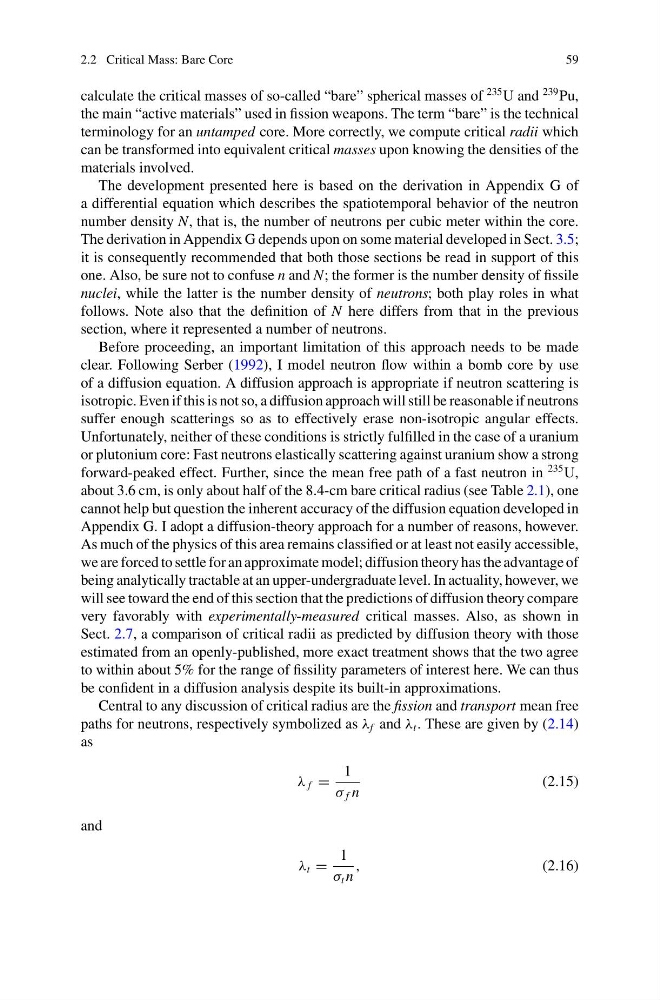
Central to any discussion of critical radius are the fission and transport mean free
paths for neutrons, respectively symbolized as λ f and λ t . These are given by (2.14)
as
λ f =
1
σ f n
(2.15)
and
λ t =
1
σ t n
,
(2.16)
59
calculate the critical masses of so-called “bare” spherical masses of
235 U and
239 Pu,
the main “active materials” used in fission weapons. The term “bare” is the technical
terminology for an untamped core. More correctly, we compute critical radii which
can be transformed into equivalent critical masses upon knowing the densities of the
materials involved.
The development presented here is based on the derivation in Appendix G of
a differential equation which describes the spatiotemporal behavior of the neutron
number density N, that is, the number of neutrons per cubic meter within the core.
The derivation in Appendix G depends upon on some material developed in Sect. 3.5;
it is consequently recommended that both those sections be read in support of this
one. Also, be sure not to confuse n and N; the former is the number density of fissile
nuclei, while the latter is the number density of neutrons; both play roles in what
follows. Note also that the definition of N here differs from that in the previous
section, where it represented a number of neutrons.
Before proceeding, an important limitation of this approach needs to be made
clear. Following Serber (1992), I model neutron flow within a bomb core by use
of a diffusion equation. A diffusion approach is appropriate if neutron scattering is
isotropic. Even if this is not so, a diffusion approach will still be reasonable if neutrons
suffer enough scatterings so as to effectively erase non-isotropic angular effects.
Unfortunately, neither of these conditions is strictly fulfilled in the case of a uranium
or plutonium core: Fast neutrons elastically scattering against uranium show a strong
forward-peaked effect. Further, since the mean free path of a fast neutron in
235 U,
about 3.6 cm, is only about half of the 8.4-cm bare critical radius (see Table 2.1), one
cannot help but question the inherent accuracy of the diffusion equation developed in
Appendix G. I adopt a diffusion-theory approach for a number of reasons, however.
As much of the physics of this area remains classified or at least not easily accessible,
we are forced to settle for an approximate model; diffusion theory has the advantage of
being analytically tractable at an upper-undergraduate level. In actuality, however, we
will see toward the end of this section that the predictions of diffusion theory compare
very favorably with experimentally-measured critical masses. Also, as shown in
Sect. 2.7, a comparison of critical radii as predicted by diffusion theory with those
estimated from an openly-published, more exact treatment shows that the two agree
to within about 5% for the range of fissility parameters of interest here. We can thus
be confident in a diffusion analysis despite its built-in approximations.
Central to any discussion of critical radius are the fission and transport mean free
paths for neutrons, respectively symbolized as λ f and λ t . These are given by (2.14)
as
λ f =
1
σ f n
(2.15)
and
λ t =
1
σ t n
,
(2.16)